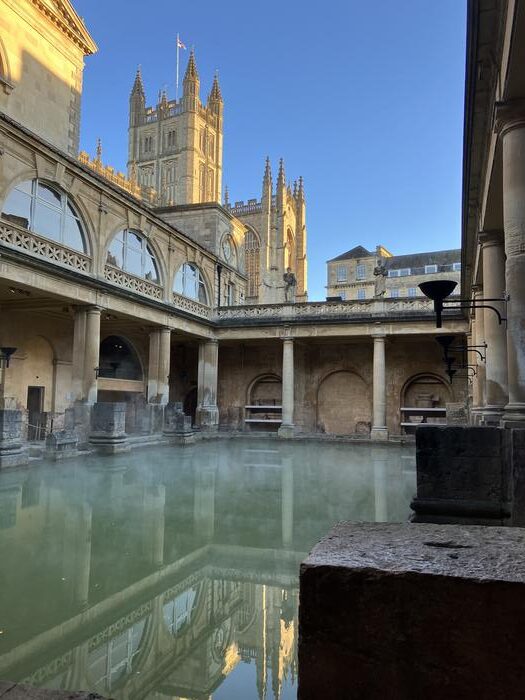
The world-famous Roman Baths are home to a diverse range of microorganisms which could be critical in the global fight against antimicrobial resistance, a new study suggests.
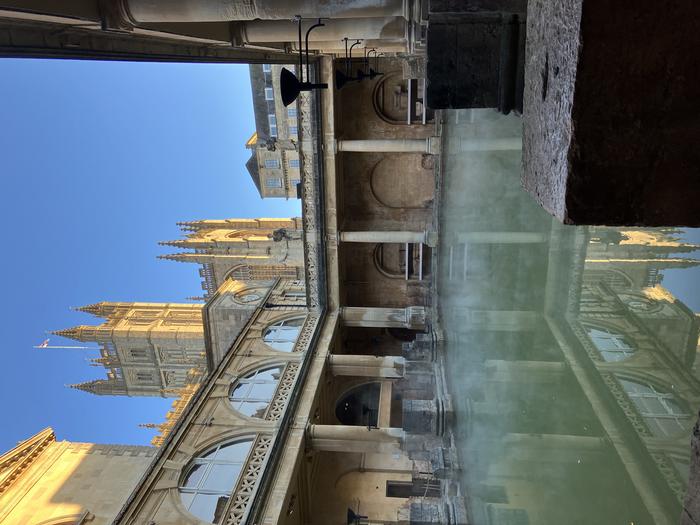
Credit: Bath & North East Somerset Council
The world-famous Roman Baths are home to a diverse range of microorganisms which could be critical in the global fight against antimicrobial resistance, a new study suggests.
The research, published in the journal The Microbe, is the first to provide a detailed examination of the bacterial and archaeal communities found within the waters of the popular tourist attraction in the city of Bath (UK).
Scientists collected samples of water, sediment and biofilm from locations within the Roman Baths complex including the King’s Spring (where the waters reach around 45°C) and the Great Bath, where the temperatures are closer to 30°C.
The samples were then analysed using cutting edge sequencing technology and traditional culturing techniques were employed to isolate bacteria with antibiotic activity.
Around 300 distinct types of bacteria were isolated across the Roman Baths site – among them the key candidate groups, Actinobacteria and Myxococcota, known for antibiotic production – with different examples being more prominent within the varying water temperatures.
Further tests showed 15 of these isolates – including examples of Proteobacteria and Firmicutes – showed varying levels of inhibition against human pathogens including E.coli, Staphylococcus Aureus and Shigella flexneri.
The research comes at a time when the need for new sources of antibiotics is at unprecedented levels, with resistance of bacteria to currently used medication estimated to be responsible for more than 1.25million deaths globally each year.
Writing in the study, scientists say a significant amount of additional investigation is required before the microorganisms found in the Roman Baths can be applied in the fight against disease and infection globally.
However, they add that this initial study has shown there is clear potential for novel natural products contained within its hot springs to be explored further for that purpose.
The research was carried out by students and academics from the University of Plymouth’s School of Biomedical Sciences and School of Biological and Marine Sciences, working closely with staff at the Roman Baths.
Dr Lee Hutt, Lecturer in Biomedical Sciences at the University of Plymouth, is the study’s senior author. He said: “This is a really important, and very exciting, piece of research. Antimicrobial resistance is recognised as one of the most significant threats to global health, and the hunt for novel antimicrobial natural products is gathering pace. This study has for the first time demonstrated some of the microorganisms present within the Roman Baths, revealing it as a potential source of novel antimicrobial discovery. There is no small irony in the fact the waters of the Roman Baths have long been regarded for their medicinal properties and now, thanks to advances in modern science, we might be on the verge of discovering the Romans and others since were right.”
The Roman Baths has been welcoming visitors for almost two millennia, and in 2023 more than one million people toured its hot springs and other collections.
Zofia Matyjaszkiewicz, Collections Manager at the Roman Baths and a co-author of the new study, added: “People have visited the springs in Bath for thousands of years, worshipping at, bathing in and drinking the waters over the centuries. Even in the Victorian period the Spa Treatment Centre in Bath used the natural spring waters for their perceived curative properties in all sorts of showers, baths and treatments. It’s really exciting to see cutting edge scientific research like this taking place here, on a site with so many stories to tell.”
The research is now being expanded through a PhD studentship, which will represent the first in-depth study of a UK thermal hot spring focused on antimicrobial discovery.
Scheduled to begin in October 2024, it will apply a variety of techniques to screen microorganisms found in the Roman Baths for antimicrobial activity, with a view to identifying which might have the potential for future clinical use.
Journal
The Microbe
DOI
10.1016/j.microb.2024.100075
Method of Research
Experimental study
Subject of Research
Not applicable
Article Title
chemical and metagenomic analysis of samples from the Roman Baths (Bath, UK) reveals high bacterial and archaeal diversity and a potential for antimicrobial discovery
Article Publication Date
17-May-2024