A team of researchers led by Osaka University discovers “microtube implosion,” a novel mechanism that demonstrates the generation of megatesla-order magnetic fields
Credit: M. Murakami
Magnetic fields are used in various areas of modern physics and engineering, with practical applications ranging from doorbells to maglev trains. Since Nikola Tesla’s discoveries in the 19th century, researchers have strived to realize strong magnetic fields in laboratories for fundamental studies and diverse applications, but the magnetic strength of familiar examples are relatively weak. Geomagnetism is 0.3-0.5 gauss (G) and magnetic tomography (MRI) used in hospitals is about 1 tesla (T = 104 G). By contrast, future magnetic fusion and maglev trains will require magnetic fields on the kilotesla (kT = 107 G) order. To date, the highest magnetic fields experimentally observed are on the kT order.
Recently, scientists at Osaka University discovered a novel mechanism called a “microtube implosion,” and demonstrated the generation of megatesla (MT = 1010G) order magnetic fields via particle simulations using a supercomputer. Astonishingly, this is three orders of magnitude higher than what has ever been achieved in a laboratory. Such high magnetic fields are expected only in celestial bodies like neutron stars and black holes.
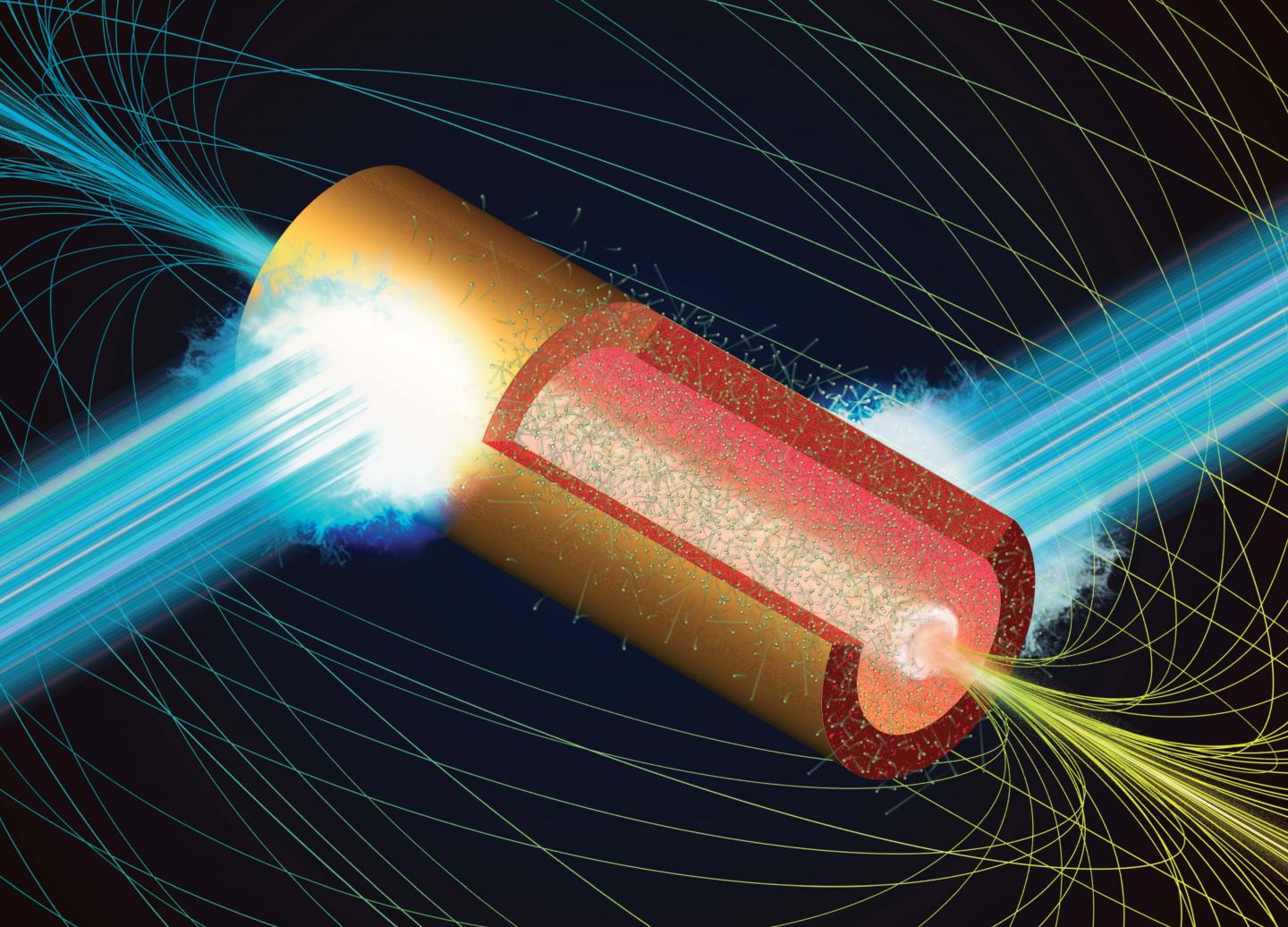
Irradiating a tiny plastic microtube one-tenth the thickness of a human hair by ultraintense laser pulses produces hot electrons with temperatures of tens of billion of degrees. These hot electrons, along with cold ions, expand into the microtube cavity at velocities approaching the speed of light. Pre-seeding with a kT-order magnetic field causes the imploding charged particles infinitesimally twisted due to Lorenz force. Such a unique cylindrical flow collectively produces unprecedentedly high spin currents of about 1015 ampere/cm2 on the target axis and consequently, generates ultrahigh magnetic fields on the MT order.
The study conducted by Masakatsu Murakami and colleagues has confirmed that current laser technology can realize MT-order magnetic fields based on the concept. The present concept for generating MT-order magnetic fields will lead to pioneering fundamental research in numerous areas, including materials science, quantum electrodynamics (QED), and astrophysics, as well as other cutting-edge practical applications.
###
The article, “Generation of megatesla magnetic fields by intense-laser-driven microtube implosions,” was published in Scientific Reports at DOI: https:/
About Osaka University
Osaka University was founded in 1931 as one of the seven imperial universities of Japan and is now one of Japan’s leading comprehensive universities with a broad disciplinary spectrum. This strength is coupled with a singular drive for innovation that extends throughout the scientific process, from fundamental research to the creation of applied technology with positive economic impacts. Its commitment to innovation has been recognized in Japan and around the world, being named Japan’s most innovative university in 2015 (Reuters 2015 Top 100) and one of the most innovative institutions in the world in 2017 (Innovative Universities and the Nature Index Innovation 2017). Now, Osaka University is leveraging its role as a Designated National University Corporation selected by the Ministry of Education, Culture, Sports, Science and Technology to contribute to innovation for human welfare, sustainable development of society, and social transformation.
Website: https:/
Media Contact
Saori Obayashi
[email protected]
Original Source
http://resou.
Related Journal Article
http://dx.