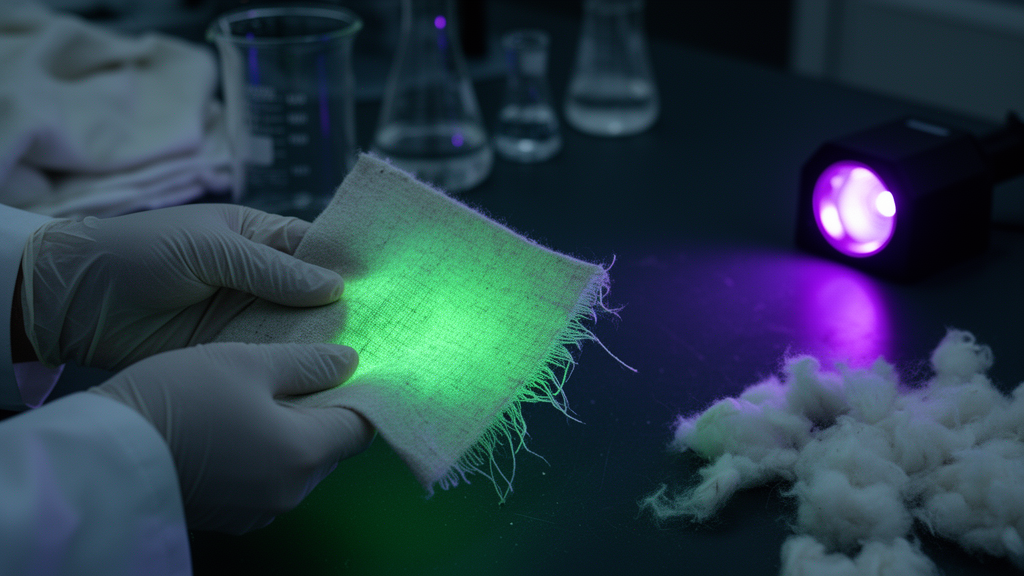
In a twist that sounds almost too neat, researchers have taken the leftover stalks of the cotton plant and turned them into a glowing tag for the cotton fiber itself. A team writing in BMC Plant Biology reports green fluorescent carbon dots synthesized hydrothermally from renewable cotton stalk waste, then fed to living cotton plants through their roots. The dots were absorbed, hauled upward through the plant’s plumbing, and finally deposited inside mature cotton fibers, where they glowed under the microscope. Crucially, the treatment left plant growth and fiber quality statistically unchanged, offering a non-destructive route to labeling one of the world’s most important textile crops.
Carbon dots are nanoscale carbon-based particles, typically a few nanometers across, that emit light when excited. Unlike semiconductor quantum dots, which often contain heavy metals, carbon dots are prized for strong photoluminescence, good biocompatibility, and low toxicity. Those properties have made them popular for bioimaging and in planta tracking. The team behind the new study saw an opening: conventional cotton labeling techniques can damage fiber structure, lack environmental stability, and cost too much for practical sustainable traceability. A biomass-derived fluorescent nanoparticle could sidestep all three problems at once.
The synthesis itself is elegantly simple. Cotton stalks, an abundant agricultural byproduct usually burned or discarded, served as the carbon source in a hydrothermal reaction. The resulting green fluorescent carbon dots, dubbed G-CDs, showed excitation-dependent photoluminescence, meaning the color of their emission shifts with the wavelength used to excite them. Under optimal excitation at 410 nanometers, the dots emitted at 530 nanometers, squarely in the green range, with a quantum yield of 5.99 percent. That figure describes the fraction of absorbed photons re-emitted as fluorescence, a key performance metric for any labeling agent.
Transmission electron microscopy revealed uniformly dispersed nanoparticles ranging from 1.75 to 4.25 nanometers in size, with an average diameter of 2.67 nanometers. For comparison, a single strand of DNA is about 2 nanometers wide. Fourier-transform infrared spectroscopy and X-ray photoelectron spectroscopy confirmed abundant hydrophilic functional groups on the particle surfaces, including hydroxyl, carbonyl, and carbon-nitrogen bonds. These surface chemistries matter enormously: they make the dots water-soluble and give them the chemical handles needed to interact with plant tissues as they move through roots, stems, leaves, and eventually fibers.
The delivery method was root irrigation, applied from the seedling stage all the way to the boll-opening stage. Confocal laser scanning microscopy and quantitative fluorescence analysis traced the dots’ journey through the plant. Cotton roots absorbed the dots most strongly, with a fluorescence reading of 56.281 plus or minus 1.073. The dots were then translocated upward to stems, reading 52.413 plus or minus 2.003, and leaves, reading 41.306 plus or minus 2.063. Finally, they accumulated in mature cotton fibers, reading 29.985 plus or minus 0.939. The declining gradient from roots to fibers is consistent with the dots hitching a ride through the plant’s vascular system rather than being applied directly to the fiber.
What makes this result genuinely striking is what did not happen. The researchers measured all growth-related indicators and fiber quality parameters and found no statistically significant differences between control and treatment groups, with p values above 0.05. In other words, the glowing tag did its job without impairing plant growth or fiber quality. For a crop where fiber length, strength, and fineness determine market value, that non-interference is not a footnote; it is the whole point. Labeling agents that alter fiber properties would be useless for traceability, since the tagged cotton would no longer be the same cotton.
The dual advantage here is hard to overstate. The synthesis strategy reuses agricultural cotton stalk waste, turning a disposal problem into a feedstock. Meanwhile, the labeling approach avoids the structural damage, environmental instability, and high costs that restrict conventional techniques. Together, these features point toward non-destructive cotton labeling and sustainable utilization of biomass waste. The work illustrates the applicable potential of biomass-derived carbon dots for in planta fiber labeling and cotton traceability research, a field where proving the origin of a fiber batch has real economic and regulatory weight.
Technically, the dots’ excitation-dependent emission is a signature of carbon dot photophysics. Because the particles have a distribution of surface states and sizes, different excitation wavelengths populate different emissive states, shifting the emission color. The 410-nanometer optimum sits in the violet-blue range, accessible with standard laboratory light sources, and the 530-nanometer green emission is easy to detect with confocal microscopy. The hydrophilic surface groups, hydroxyl, carbonyl, and carbon-nitrogen, likely facilitate the dots’ movement through the plant’s apoplast and symplast, the extracellular and intracellular pathways that govern nanoparticle transport in vascular plants.
The implications reach beyond the laboratory. Cotton traceability, the ability to prove where a fiber batch came from, is increasingly important for supply chain transparency, anti-counterfeiting, and sustainable sourcing claims. A labeling agent that is cheap, stable, and non-damaging could be applied at the field level, with the fluorescent signature read later under a microscope or spectrometer. Because the dots are derived from the same crop they label, the approach closes a loop: the waste from one harvest becomes the tag for the next. The researchers suggest this dual advantage facilitates non-destructive cotton labeling and the sustainable utilization of biomass waste, positioning biomass-derived carbon dots as a feasible route for low-damage, cost-effective, and stable labeling approaches in sustainable cotton traceability.
There are caveats, of course. The study was conducted under controlled conditions, and the long-term environmental fate of the dots, their stability in processed textiles, and their behavior at industrial scale remain open questions. The quantum yield of 5.99 percent is respectable for biomass-derived carbon dots but modest compared with some synthetic alternatives. Still, the core demonstration stands: green fluorescent carbon dots made from cotton stalk waste achieved in situ fluorescent labeling of cotton fibers without impairing plant growth or fiber quality. For a field hungry for sustainable, verifiable labeling, that is a result worth glowing about.
Subject of Research: Plant biotechnology and fluorescent nanomaterials
Article Title: Green fluorescent carbon dots derived from cotton stalks for in situ labeling of cotton fibers
Article References: Sun, H., Wang, R., Wu, J., Ni, Y., Wan, L., Ye, S., Han, H., Chen, D., Deng, X., & Zhu, J. (2026). Green fluorescent carbon dots derived from cotton stalks for in situ labeling of cotton fibers. BMC Plant Biology. https://doi.org/10.1186/s12870-026-10211-7
Image Credits: AI Generated
DOI: 10.1186/s12870-026-10211-7
Keywords: carbon dots, cotton, fluorescent labeling, biomass waste, traceability, plant bioimaging, nanotechnology, textile engineering, Green, fluorescent, carbon, dots
News Source: Alan Morgan. (October 17, 2026). Cotton Waste Becomes a Glowing Tag That Labels Cotton Fibers From the Inside. Scienmag.