Fire-resistant glass assemblies in modern buildings depend on a component most people never see: the secondary sealant that bonds the glass edges together and keeps the fire compartment sealed. A new open-access study published in Architectural Research reports a formulation strategy that resolves a long-standing trade-off in these materials, allowing a two-component polysulfide sealant to survive a 60-minute standard furnace test while actually gaining mechanical strength compared with an unfilled baseline.
The research team, led by Dosu Yoon, Keesun Park, and Sumin Kim, set out to tackle a well-known problem in sealant chemistry. To make polysulfide sealants fire-resistant, formulators load them with large amounts of inorganic flame retardants. These fillers work against combustion, but they also disrupt the cross-linking network of the polymer matrix, restricting stress transfer pathways and weakening both tensile strength and adhesion to glass. The result is a material that resists fire but can no longer reliably carry the structural load of an insulated glass unit at room temperature.
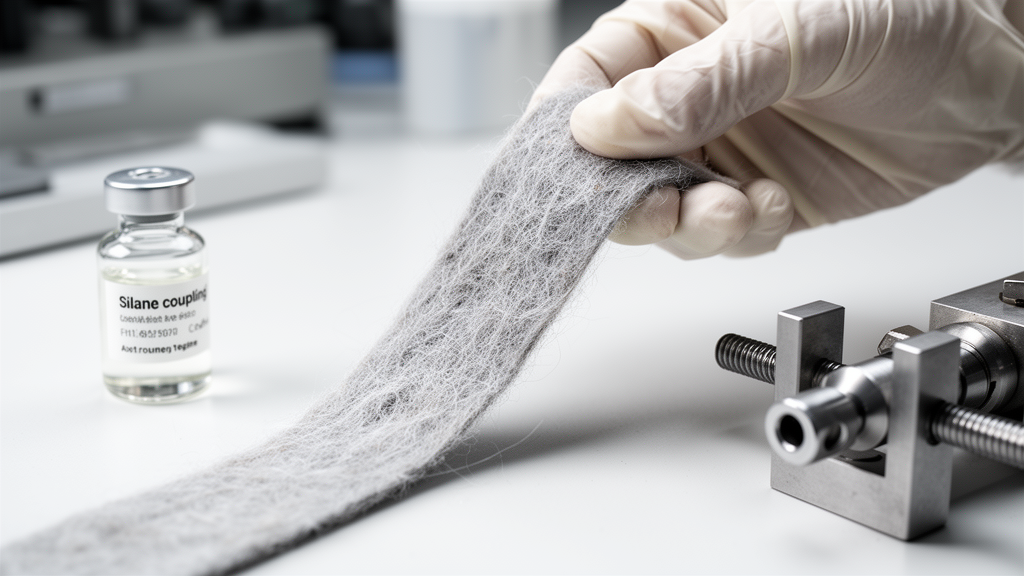
The study addressed this trade-off through a step-by-step variable-control design. The researchers prepared a control group with no refractory components and four experimental groups, each adding ingredients in stages. All formulations were calculated on 100 parts by weight of the base polysulfide polymer, with the matrix and curing agent mixed at a fixed 10:1 ratio by volume to reflect commercial double-glazing practice. Group 1 received a basic refractory package of magnesium hydroxide, aluminum hydroxide, and expanded graphite. Group 2 added an amino-silane-based adhesion promoter, Group 3 added zinc stannate with inorganic nanofibers, and Group 4 added surface-flame-retardant-treated cotton fiber powder with a high aspect ratio.
The mechanical results were striking. Experimental Group 4, the complete formulation, reached an average tensile strength of 37 kgf per square centimeter, equivalent to 3.63 megapascals, based on five replicate measurements with a standard deviation of 0.98. That represents a statistically significant 23.3 percent improvement over the control group’s average of 30 kgf per square centimeter, or 2.94 megapascals, with p less than 0.05. The control specimens, without any inorganic filler, had shown trial values ranging from 29.2 to 31.1 kgf per square centimeter.
Adhesion strength told a complementary story. Experimental Group 2, which contained the aminosilane coupling agent, achieved the highest average adhesive strength of 31 kgf per square centimeter, or 3.04 megapascals, a statistically significant 24.0 percent increase over the control group’s 25 kgf per square centimeter. Group 4, relying on treated cotton fibers instead of the coupling agent, still recorded 30 kgf per square centimeter, a 20.87 percent improvement. The researchers attribute these gains to chemical siloxane cross-links formed between the hydrophilic inorganic particle surfaces, the hydrophobic polymer matrix, and the glass substrate, which restore interfacial bonding that high filler loading would otherwise destroy.
The fire performance was evaluated with vertical furnace tests following KS F 2845:2013, the Korean standard for fire resistance of glass partitions. Specimens consisted of triple-pane tempered glass assemblies with three 5-millimeter panes, two air gaps, and a 7-millimeter layer of sealant injected along the outer perimeter. The pass criterion was strict: the assembly had to maintain fire compartmentation for the full 60 minutes without flame penetration, sealant softening and sagging, delamination from the glass, or structural collapse. The control group failed quickly, as the unfilled polysulfide matrix decomposed and softened almost immediately, detached from the glass, and allowed flames and combustible gases through the resulting gaps.
Every experimental group, from Group 1 through Group 4, passed the full 60-minute test. Because the standard is threshold-based, all four formulations equivalently satisfied the fire-blocking requirement, and the differences among them appeared instead in room-temperature mechanical performance. The researchers attribute the fire resistance to a layered defense. Magnesium and aluminum hydroxides decompose under heat in a strongly endothermic reaction, releasing crystalline water as vapor that cools the matrix, dilutes flammable gases, and leaves a primary insulating oxide layer. Expanded graphite then activates as a second line of defense, expanding to tens or hundreds of times its original volume to form a thick, worm-like porous char barrier that blocks radiant heat and oxygen.
Zinc stannate serves as a chemical stabilizer for that fragile porous char. According to the study, it promotes cross-linking reactions among metal oxides during polymer combustion, increasing the anaerobic char yield and producing a denser, more compact structure that resists detachment under convective airflow. The authors also cite prior combustion experiments in which a zinc stannate hybrid compound reduced peak heat release rate by roughly 40 percent and carbon monoxide emissions by approximately 80 percent compared with pure resin, though those figures come from earlier related research rather than the present experiments.
The cotton fiber powder provides the physical complement to this chemistry. With an aspect ratio exceeding 50, the randomly distributed short fibers bridge disconnected polymer chain segments between inorganic particles, creating three-dimensional stress transfer pathways that disperse external loads along the fiber axes instead of concentrating stress at single points. At high temperature, after the polysulfide resin has pyrolyzed and lost viscosity, the flame-retardant-treated fibers retain a skeletal structure that physically supports the inorganic char film, preventing sagging or collapse under gravity and fire-driven convection. Surface treatment of the natural fibers imparts hydrophobicity, securing the interfacial adhesion needed for effective load transfer.
The authors are candid about the limits of their evidence. No thermogravimetric analysis or scanning electron microscopy was performed, so the mechanistic explanations of interfacial cross-linking and char stabilization are inferred from macroscopic performance data and prior literature rather than direct microstructural observation. The 60-minute standard also ends at compliance, leaving behavior under longer thermal exposure unexplored. Even so, the study delivers a concrete formulation principle: fire safety and structural reliability in secondary sealants need not be opposing goals. By combining endothermic metal hydroxides, expandable graphite, zinc stannate, aminosilane coupling chemistry, and high-aspect-ratio cotton fibers, a single polysulfide system can hold a fire compartment intact for an hour while carrying more load at room temperature than the unfilled resin it replaces.
Subject of Research: Formulation design of fire-resistant two-component polysulfide sealants for insulated glass using cotton fibers and adhesion promoters
Article Title: Formulation Design and Evaluation for Performance Balancing of Fire-Resistant Polysulfide Sealants: Analysis of Mechanisms for Enhancing the Physical Properties of Fire-Resistant Compositions Using Cotton Fibers and Adhesion Promoter
Article References: Yoon, D., Park, K., & Kim, S. (2026). Formulation Design and Evaluation for Performance Balancing of Fire-Resistant Polysulfide Sealants: Analysis of Mechanisms for Enhancing the Physical Properties of Fire-Resistant Compositions Using Cotton Fibers and Adhesion Promoter. Architectural Research, 28(1), Article 23. https://doi.org/10.1007/s44515-026-00026-w
Image Credits: AI Generated
DOI: 10.1007/s44515-026-00026-w
Keywords: polysulfide sealant, fire-resistant glass, insulated glass units, flame retardants, expanded graphite, zinc stannate, aminosilane coupling agent, cotton fiber reinforcement, KS F 2845, tensile strength, adhesion strength, building fire safety
News Source: Denise Maddox. (October 28, 2026). Cotton Fibers and Silane Coupling Restore Strength in Fire-Resistant Sealants. Scienmag.