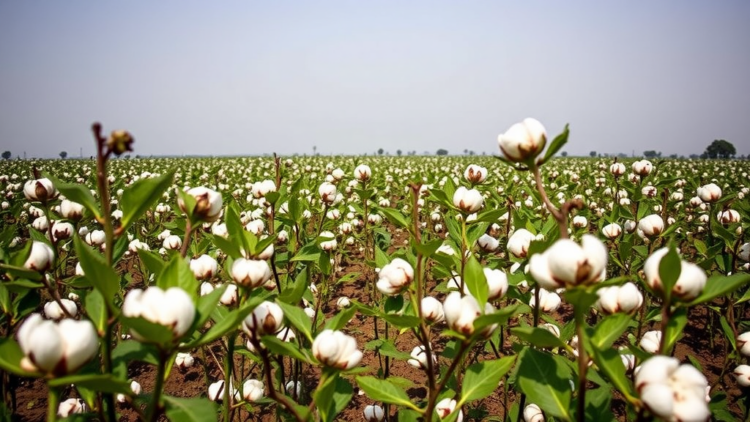
Cotton is far more than a crop in Benin. It anchors the national economy, accounts for roughly 90 percent of agricultural exports, contributes about 35 percent of export earnings, and provides income for nearly three million people. By 2019, Benin had become the leading cotton producer in West Africa’s Franc Zone, anchoring what researchers describe as the largest cotton basin in the region. Yet a fundamental question has lingered beneath the white bolls: is the sector actually becoming more productive, or are farmers simply working harder and spending more to achieve their harvests? A new study offers the most detailed answer yet, and its findings carry significant implications for agricultural policy across sub-Saharan Africa.
The research, published in the journal Discover Agriculture, examined the sources of total factor productivity (TFP) and profit growth in Beninese cotton production between 2000 and 2018. A team led by Idelphonse O. Saliou of the University of Abomey-Calavi assembled an impressive dataset: 482 cotton producers surveyed across three major agroecological zones—the central region around Savalou, the northern district of Banikoara, and the western Atacora region around Cobly. To qualify for the study, producers had to be at least 40 years old with a minimum of 19 consecutive years of farming experience, ensuring that each participant could reconstruct nearly two decades of production history.
Reconstructing nineteen years of farm records in a setting where most smallholders keep no formal accounts is a formidable challenge. The researchers used retrospective recall techniques, dividing the study period into four sub-periods aligned with successive presidential regimes—a practical aid to memory in a country where agricultural policy shifts with political transitions. Producers identified years of high and low performance within each sub-period, then supplied production details for the remaining years. Where available, farmers supplemented their recollections with accounting books, input purchase invoices, and labor contracts. The final estimation sample included 5,577 observations, reduced from a theoretical maximum of 9,158 by recall limitations, missing variables, and strict data-cleaning procedures that the authors argue should not introduce systematic bias under standard missing-data assumptions.
Methodologically, the study employed a parametric translog cost frontier approach, a flexible second-order approximation of the true cost function that imposes few prior restrictions on the underlying technology. The framework, following the decomposition methods of Kumbhakar and colleagues, separates productivity growth into three distinct components: technical efficiency change, which measures how close farmers operate to the best-practice frontier; technological change, which captures shifts in that frontier itself; and scale effects, which reflect economies or diseconomies of expanding production. Input prices for fertilizer, labor, and a Laspeyres index of other inputs—including seeds, insecticides, herbicides, and animal or mechanical traction—were normalized by land prices to satisfy linear homogeneity constraints. Crucially, the model accounted for unobserved heterogeneity among farms, distinguishing persistent inefficiency rooted in structural conditions from time-varying inefficiency that fluctuates year to year.
The headline result is modest but meaningful: TFP in Beninese cotton production grew by an average of 1.26 percent per year between 2000 and 2018. Decomposition reveals that this growth was powered almost entirely by technological progress, which advanced at 2.81 percent annually, complemented by a modest gain in technical efficiency of 0.24 percent per year. The technological momentum reflects concrete changes in the field: continuous varietal improvement programs that guarantee quality seed to producers, the gradual replacement of hand tools with animal traction and mechanical power, and intensified use of mineral fertilizers and pesticides for weed control and plant health. The technical efficiency gains, meanwhile, are credited in part to Benin’s dense extension network—nearly all cotton farmers belong to Village Cotton Producers Cooperatives, and extension agents are evaluated on the basis of cotton production performance.
But there is a troubling counterweight. The scale component exerted a negative effect of 1.83 percent per year on TFP, indicating that Beninese cotton farms are operating under decreasing returns to scale. When farmers increased the use of all inputs, output rose proportionally less, driving up unit costs for each additional kilogram of cotton harvested. In plain terms, farms are growing beyond their most efficient size, and unexploited economies of scale represent a pool of unrealized productivity. The authors note similar findings in Chinese agriculture after reforms, and contrast them with European and Finnish dairy farms where scale effects contributed positively to productivity—evidence that lower average costs could be achieved by producing at more optimal scales.
The study also traced how productivity translated, or failed to translate, into the bottom line. Farm profits grew by an average of 1.65 percent per year over the period, but the sources of that growth were largely external rather than internal. Rising cotton prices, which climbed at 3.03 percent annually, were the dominant driver, aided by Benin’s price stabilization mechanism that guarantees a minimum income for producers and shields them from world market volatility. Output quantity growth of 0.89 percent per year and the TFP gains also helped. Working against these gains, input prices rose at 2.91 percent per year, steadily eroding profitability—a pattern the authors note mirrors Kumbhakar and Lien’s findings in Norwegian dairy farming. Profit growth was strongest between 2011 and 2015, driven by favorable price movements, while the earliest sub-period saw profits squeezed by input cost inflation.
One finding stands out for its starkness: the estimated overall cost efficiency of Beninese cotton farms is only about 23.5 percent, combining persistent efficiency of 28 percent with time-varying efficiency of 83.8 percent. Actual production costs remain substantially above the minimum attainable frontier. The authors caution that this does not simply reflect poor management. Rather, the persistent inefficiency component likely captures structural and systemic constraints beyond individual farmers’ control: poor rural infrastructure, high transportation and input transaction costs, imperfect access to mechanization services, climate variability, credit market imperfections, and institutional rigidities. Similar low-efficiency findings across West Africa support this interpretation, with prior research showing that institutional environments—particularly access to credit, inputs, and marketing channels—significantly shape producer performance.
The researchers confirmed both of their formal hypotheses: technical efficiency gains contributed positively to TFP growth, and rising cotton prices positively influenced farm profits. Yet they are candid about the study’s limitations. Retrospective data collection risks recall bias and measurement error; the sample of experienced, older producers may overestimate efficiency; the cost frontier framework does not address potential endogeneity, including the possibility that government-set cotton prices are not truly exogenous; and the assumption of full allocative efficiency—that farmers use optimal input combinations—may not hold in practice. Future work using profit frontier models could test how sensitive these conclusions are to those assumptions.
For policymakers, the recommendations are clear. The authors call for strengthening producer capacities through training, promoting technological innovations such as mechanization and pest-resistant varieties, and implementing incentive-compatible price policies that support optimal input use. The stagnation of TFP growth in the final sub-period of the study, driven by losses in technical efficiency and negative scale effects, serves as a warning that past gains are not guaranteed to persist. With nearly three million livelihoods tethered to the cotton plant, Benin’s experience offers a broader lesson for agricultural development across West Africa: productivity growth is possible even under structural constraints, but converting it into durable farmer prosperity requires tackling the institutions, infrastructure, and input markets that determine whether efficiency gains reach the farm gate.
Subject of Research: Total factor productivity and profit growth in cotton production in Benin, West Africa
Article Title: Total factor productivity and profit growth in cotton production in Benin, West Africa
Article References: Total factor productivity and profit growth in cotton production in Benin, West Africa. (n.d.). https://doi.org/10.1007/s44279-026-00749-3
Image Credits: AI Generated
DOI: 10.1007/s44279-026-00749-3
Keywords: Benin, cotton production, total factor productivity, technical efficiency, profit growth, cost frontier, agricultural economics, West Africa, technological change, economies of scale, farm profitability, agricultural policy
Cite Scienmag News
APA
MLA
Chicago
Alan Morgan. (September 12, 2026). Cotton Farms in Benin Show Steady Productivity and Profit Growth, Study Finds. Scienmag. https://scienmag.com/cotton-farms-in-benin-show-steady-productivity-and-profit-growth-study-finds/
Alan Morgan. “Cotton Farms in Benin Show Steady Productivity and Profit Growth, Study Finds.” Scienmag, 12 September 2026, https://scienmag.com/cotton-farms-in-benin-show-steady-productivity-and-profit-growth-study-finds/. Accessed 12 September 2026.
Alan Morgan. “Cotton Farms in Benin Show Steady Productivity and Profit Growth, Study Finds.” Scienmag. September 12, 2026. https://scienmag.com/cotton-farms-in-benin-show-steady-productivity-and-profit-growth-study-finds/
Copy citation
Download RIS
Tags: agricultural economicsagricultural policyagricultural policy implications in Beninagricultural productivity analysisBenincost frontiercotton farm profitabilityCotton farming in Benincotton productioncotton sector development in Franc Zoneeconomies of scalefarm profitabilityimpact of cotton exports on Benin’s economyprofit growthregional differences in cotton productionrole of cotton in sub-Saharan African agriculturesocioeconomic impact of cotton cultivationsustainable cotton farming practicestechnical efficiencytechnological changetotal factor productivitytotal factor productivity in cotton farmingWest AfricaWest African cotton industry