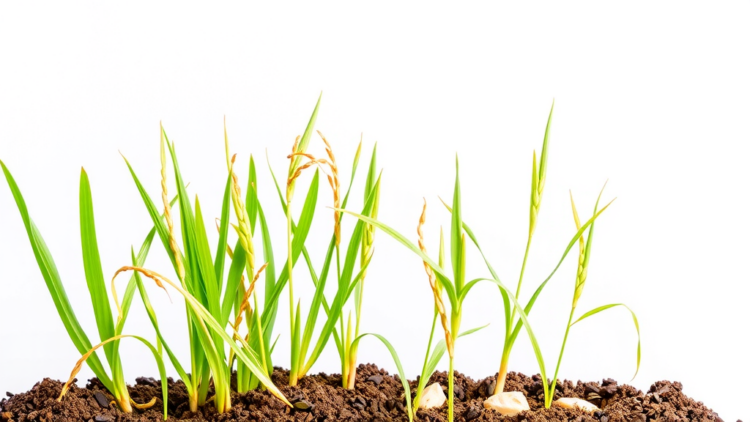
Rice feeds more people than any other cereal, yet the way it is grown is changing fast. Across Asia, farmers are increasingly abandoning the centuries-old practice of transplanting seedlings into flooded paddies in favour of direct-seeded rice, or DSR, in which seeds are sown straight into the field. The switch saves enormous quantities of water and labour, but it exposes a critical weakness in most modern varieties: they germinate and grow slowly at the seedling stage, leaving young plants vulnerable to drought, weeds and erratic field conditions. A new study from Tamil Nadu Agricultural University in India argues that the answer may lie not in high-tech gene editing but in the humble landraces that farmers have cultivated for generations.
Researchers led by Sree Vathsa Sagar and Pushpam Ramamoorthy evaluated 150 traditional rice landraces alongside four check varieties under natural direct-seeded conditions at two contrasting locations in Tamil Nadu, Thanjavur and Paramakudi. Seedlings were assessed at 15 and 30 days after sowing for sixteen traits linked to early seedling vigour, including seedling height, root length, leaf number, leaf width, tiller number, dry weight, relative growth rate and crop growth rate. The design allowed the team to separate genuine genetic differences from environmental noise, a persistent challenge in field-based phenotyping of vigour traits.
The results, published in the Indian Journal of Genetics and Plant Breeding, revealed substantial genetic variability across the landrace collection at both locations. Crucially, several of the most important traits—seedling dry weight, root length, number of leaves, relative growth rate and crop growth rate—showed high broad-sense heritability coupled with high genetic advance. In practical breeding terms, that combination is gold: it means the traits are largely controlled by additive genetic effects rather than being swamped by the environment, so selection for them should produce real, predictable gains in the next generation of varieties.
Correlation analysis added a layer of strategic insight. Seedling dry weight emerged as a central hub, showing strong positive associations with leaf width, leaf number, tiller number, leaf length and shoot length. Because dry weight integrates the plant’s overall capacity to capture light, water and nutrients in the first weeks of life, it serves as a powerful composite indicator of vigour. Breeders seeking a single, easily measured proxy for early establishment could therefore focus on biomass accumulation rather than juggling a dozen separate measurements in the nursery.
To refine the selection toolkit further, the team applied stepwise regression, a statistical technique that identifies which variables contribute the most explanatory power. Three traits consistently rose to the top: seedling dry weight, root length and number of leaves. Root length is particularly significant for direct-seeded systems, where a rapidly elongating root system allows seedlings to reach moisture in aerobic soils and withstand early-season dry spells. The finding suggests that a compact three-trait selection index could capture most of the genetic signal for early vigour, dramatically simplifying screening programmes in resource-limited breeding stations.
Genotype-by-trait biplot analysis then translated the statistical patterns into concrete candidates. Five landraces—RL8841, RL6010, RL9452, RL9975 and RL10156—stood out as consistently superior across environments, combining strong seedling biomass, robust root architecture and prolific leaf production. These accessions represent ready-made donors that breeding programmes can cross into elite backgrounds without waiting for novel variation to be created. Their stability across the two locations also hints at broad adaptability, an essential quality as climate variability makes growing conditions less predictable from season to season.
The broader significance of the work lies in the agronomic transition it supports. Direct-seeded rice eliminates the nursery stage and puddling of fields, cutting methane emissions, reducing water use by up to a third and relieving the acute labour shortages that plague rice-farming regions. But the technology only succeeds if seeds can establish themselves quickly without the protective head start that transplanting provides. Early seedling vigour is widely recognised as an indirect indicator of both drought tolerance and weed competitiveness, because fast-growing seedlings shade out weeds and access soil moisture before competitors do. Varieties bred for vigour could therefore reduce reliance on herbicides while buffering yields against increasingly erratic rainfall.
Landraces are often dismissed as low-yielding relics, yet studies like this one demonstrate why conserving and characterising them remains a strategic priority. Centuries of natural and farmer selection in drought-prone, weed-heavy environments have imbued these traditional varieties with adaptive alleles that modern breeding largely bypassed during the Green Revolution era. By quantifying heritability and genetic advance across a large, well-structured panel, the Tamil Nadu team has converted a diffuse reservoir of folk germplasm into a ranked, trait-annotated resource that molecular breeders can immediately exploit, whether through conventional crossing, marker-assisted selection or genomic prediction.
The authors note that no external funding supported the work, underscoring the role of public agricultural universities in maintaining long-term germplasm evaluation programmes. Datasets from the study are available from the corresponding author on reasonable request, and the identified superior accessions are expected to enter crossing programmes aimed at developing DSR-adapted varieties for southern India and beyond. As water scarcity intensifies and rice systems worldwide face pressure to become less labour- and emission-intensive, the humble seedling—its dry weight, its roots, its first few leaves—may prove to be the most consequential battleground in the next chapter of rice improvement.
Subject of Research: Genetic variability in early seedling vigour traits among rice landraces for improved direct-seeded rice performance
Article Title: Unveiling Early Seedling Vigour Traits in Rice (Oryza sativa L.) Landraces for Enhanced Direct-Seeded Rice (DSR) Performance
Article References: Unveiling Early Seedling Vigour Traits in Rice (Oryza sativa L.) Landraces for Enhanced Direct-Seeded Rice (DSR) Performance. (n.d.). https://doi.org/10.1007/s44489-026-00039-8
Image Credits: AI Generated
DOI: 10.1007/s44489-026-00039-8
Keywords: rice, landraces, early seedling vigour, direct-seeded rice, plant breeding, drought tolerance, weed competitiveness, heritability, seedling dry weight, root length, genotype-by-trait analysis, Tamil Nadu Agricultural University
Cite Scienmag News
APA MLA Chicago
Alan Morgan. (September 12, 2026). Ancient Rice Landraces Reveal Genetic Secrets of Vigorous Early Seedling Growth. Scienmag. https://scienmag.com/ancient-rice-landraces-reveal-genetic-secrets-of-vigorous-early-seedling-growth/
Alan Morgan. “Ancient Rice Landraces Reveal Genetic Secrets of Vigorous Early Seedling Growth.” Scienmag, 12 September 2026, https://scienmag.com/ancient-rice-landraces-reveal-genetic-secrets-of-vigorous-early-seedling-growth/. Accessed 12 September 2026.
Alan Morgan. “Ancient Rice Landraces Reveal Genetic Secrets of Vigorous Early Seedling Growth.” Scienmag. September 12, 2026. https://scienmag.com/ancient-rice-landraces-reveal-genetic-secrets-of-vigorous-early-seedling-growth/
Copy citation Download RIS
Tags: Ancient rice landracesdirect-seeded ricedirect-seeded rice cultivationdrought and weed resilience in ricedrought toleranceearly seedling growth assessment in riceearly seedling vigourgenetic secrets of vigorous rice seedlingsgenetic variation in early seedling growthgenotype-by-trait analysisgenotype-environment interactions in riceheritabilityimpact of landraces on modern rice breedinglandracesplant breedingricerice seedling vigour traitsroot lengthseedling dry weightTamil Nadu Agricultural UniversityTamil Nadu rice landrace diversitytraditional rice varieties for sustainable farmingwater-saving rice cultivation practicesweed competitiveness