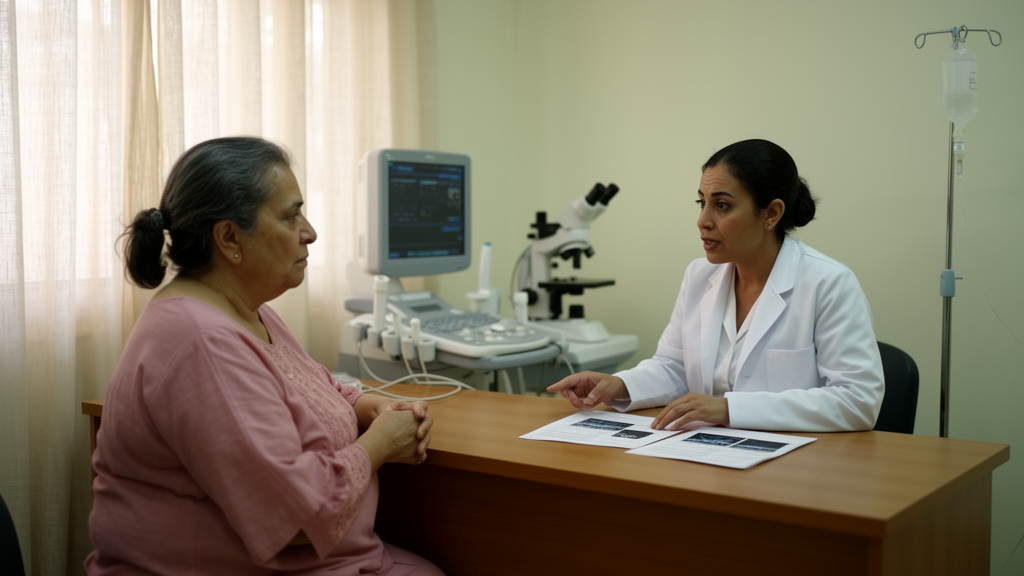
Biomarker testing plays an important role in characterising breast cancer and guiding treatment decisions, particularly through routinely used markers such as the oestrogen receptor (ER), progesterone receptor (PR), HER2, and Ki-67. A new exploratory survey from Benghazi, Libya, shows that the medical oncologists treating breast cancer there overwhelmingly value these tests, yet many say that cost and a shortage of testing facilities are the main barriers to their use.
The study, published as an open-access research paper in BMC Cancer, took the form of an exploratory cross-sectional questionnaire survey. Between 18 March and 12 April 2025, the researchers contacted 30 medical oncologists practising in Benghazi; 27 of them participated. The adapted structured questionnaire covered demographic characteristics, biomarker use, perceived accessibility, and the respondents’ views on biomarker-informed treatment planning. The team analysed responses with descriptive statistics and Fisher’s exact tests.
The headline result was a striking consensus on clinical value. Most respondents, 85.2 percent, rated biomarker testing as extremely important for guiding treatment decisions, and a majority, 74.1 percent, said that biomarker testing always influences the treatment choices they make. In terms of routine practice, ER was the most frequently reported biomarker in use, cited by 92.6 percent of participants, followed by HER2 at 88.9 percent and PR at 81.5 percent.
But the survey also documented a consistent pattern of obstacles. High cost was the most commonly perceived barrier, reported by 66.7 percent of respondents, while limited availability of testing centres followed at 55.6 percent. Those figures point to a setting in which the perceived clinical value of biomarker testing is widely accepted even as participants report practical barriers to accessing it.
The participants did not simply identify problems; they also indicated what they believed would help most. Expanding the number of testing centres was the most frequently selected suggested improvement, chosen by 77.8 percent of respondents, and enhancing medical training on biomarker-based treatment followed at 74.1 percent. Taken together, the two top answers frame the gap in both structural and educational terms.
The authors are careful about the limits of what their data can show. As an exploratory survey of a small group of 27 participating oncologists in a single Libyan city, the findings reflect clinician perceptions and reported practice. The study’s conclusion states explicitly that these results should not be generalised beyond the surveyed group, nor interpreted as evidence of patient-level clinical outcomes. Perceived barriers reported in a questionnaire are not the same as directly measured laboratory capacity, testing volumes, or patient outcomes.
What the survey does offer is a structured snapshot of how these oncologists perceive the system. The strong endorsement of biomarker testing’s importance, alongside the reported dominance of cost and facility availability as barriers, identifies the directions the respondents themselves prioritised: more testing capacity and stronger training in biomarker-based treatment. The authors call for larger studies that incorporate objective service-level and patient-level data, which would test whether the perceptions captured here correspond to measurable gaps in care.
For now, the study stands as a small, exploratory data point on the delivery of biomarker-guided breast cancer management in Benghazi. Its central message is that, among the oncologists surveyed, the barrier they most often reported was not conviction about the tests’ utility but their cost and availability, a problem of laboratories and budgets rather than of clinical belief.
Subject of Research: Medical oncologists' perceptions of biomarker testing utility and accessibility in breast cancer management in Benghazi, Libya
Article Title: An exploratory cross-sectional survey of participating medical oncologists’ perceptions of biomarker testing utility and accessibility in breast cancer management in Benghazi, Libya
Article References: ALhraam, I. S., ALhijazi, F. O., Alshweref, M. S., Shahen, A. S., Elkawafi, M. K. A., Alshrif, W. M., & Elhashani, S. (2026). An exploratory cross-sectional survey of participating medical oncologists’ perceptions of biomarker testing utility and accessibility in breast cancer management in Benghazi, Libya. BMC Cancer. https://doi.org/10.1186/s12885-026-17159-9
Image Credits: AI Generated
DOI: 10.1186/s12885-026-17159-9
Keywords: breast cancer, biomarker testing, ER, PR, HER2, Ki-67, Libya, Benghazi, medical oncologists, cross-sectional survey, health care access, exploratory
News Source: Nathaniel Bowman. (October 23, 2026). Cost and Testing Access Limit Biomarker-Guided Breast Cancer Care in Benghazi, Oncologists Report. Scienmag.