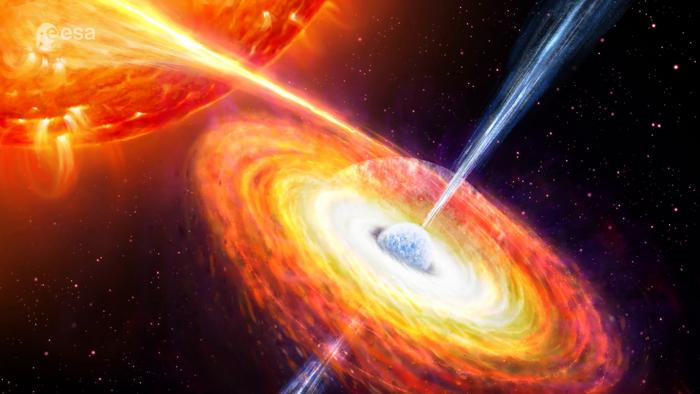
Credit: Credit: ESA.
Aknowledgments: D. Futselaar and N. Degenaar, University of Amsterdam. Work performed by ATG Medialab under contract with ESA
License: ESA Standard Licence
- Astronomers including those at the University of Warwick, have observed jets of matter being expelled into space at more than one-third the speed of light.
- These jets play an important role in the universe, from forming stars to transporting elements deep into space.
- Jets are produced by many different astronomical objects but studying them is hard, as they are so energetic.
- This study forms a blueprint for future research into many areas of the cosmos.
For the first time, astronomers have measured the speed of fast-moving jets in space, crucial to star formation and the distribution of elements needed for life.
The jets of matter, expelled by stars deemed ‘cosmic cannibals’, were measured to travel at over one-third of the speed of light – thanks to a groundbreaking new experiment published in Nature today.
The study sheds new light on these violent processes, making clever use of runaway nuclear explosions on the surface of stars.
Co-Author Jakob van den Eijnden, Warwick Prize Fellow at the Department of Physics, University of Warwick, said: “The explosions occurred on neutron stars, which are incredibly dense and notorious for their enormous gravitational pull that makes them swallow gas from their surroundings – a gravitational pull that is only surpassed by black holes.
“The material, mostly hydrogen from a nearby star that orbits around, swirls towards the collapsed star, falling like snow across its surface. As more and more material rains down, the gravitational field compresses it until a runaway nuclear explosion is initiated. This explosion impacts the jets, that are also shot out from the infalling material and eject particles into space at very high speed.”
The team devised a way of measuring the speed and properties of the jets by comparing X-ray and radio signals picked up by the Australia Telescope Compact Array (owned and operated by CSIRO, Australia’s national science agency) and the European Space Agency’s (ESA’s) Integral satellite.
Co-Author Thomas Russell, National Institute for Astrophysics, INAF, Palermo, Italy, said: “This gave us a perfect experiment. We had a very brief short-lived impulse of extra material that gets shot into the jet and that we can track as it moves down the jet to learn about its speed.”
Jakob van den Eijnden added: “These explosion occur every couple of hours, but you can’t predict exactly when they will happen. So you have to stare at the telescope observations for a long time, and hope you catch a couple of bursts. Over three days of observations we saw 10 explosions and jets lighting up.”
The jets travelled around 114,000 kilometres per second, an incredible 35-40% the speed of light.
This was the first time astronomers had been able to anticipate and directly watch how a certain amount of gas got channelled into a jet and accelerated into space.
Co-Author Nathalie Degenaar, University of Amsterdam, the Netherlands, continued: “Based on previous data, we thought the explosion would destroy the location where the jet was being launched. But we saw exactly the opposite: a strong input into the jet rather than a disruption.”
The researchers believe the mass and rotation of neutron stars and black holes also impacts the jets.
Having now shown this research is possible, this study will form the blueprint for future experiments into neutron stars and their jets. Jets can also be produced by cataclysmic events such as supernova explosions and gamma-ray bursts. The new results will have wide applicability in many studies of the cosmos.
Read the paper here: https://www.nature.com/articles/s41586-024-07133-5
Notes to editors
Radio emission was collected using the Australia Telescope Compact Array, owned and operated by CSIRO, Australia’s national science agency, and X-rays from The European Space Agency’s Integral satellite.
Scientific paper
Thermonuclear explosions on neutron stars reveal the speed of their jets. By: Thomas D. Russell, Nathalie Degenaar, Jakob van den Eijnden, Thomas Maccarone, Alexandra J. Tetarenko, Celia Sánchez-Fernández, James C.A. Miller-Jones, Erik Kuulkers & Melania Del Santo. In: Nature,
“Thermonuclear explosions on neutron stars reveal the speed and feeding of their jets” is published in Nature. DOI: 10.1038/s41586-024-07133-5
Journal
Nature
DOI
10.1038/s41586-024-07133-5