• HOME
  • NEWS
  • EXPLORE
    • CAREER
      • Companies
      • Jobs
    • EVENTS
    • iGEM
      • News
      • Team
    • PHOTOS
    • VIDEO
    • WIKI
  • BLOG
  • COMMUNITY
    • FACEBOOK
    • INSTAGRAM
    • TWITTER
Tuesday, May 12, 2026
BIOENGINEER.ORG
No Result
View All Result
  • Login
  • HOME
  • NEWS
  • EXPLORE
    • CAREER
      • Companies
      • Jobs
        • Lecturer
        • PhD Studentship
        • Postdoc
        • Research Assistant
    • EVENTS
    • iGEM
      • News
      • Team
    • PHOTOS
    • VIDEO
    • WIKI
  • BLOG
  • COMMUNITY
    • FACEBOOK
    • INSTAGRAM
    • TWITTER
  • HOME
  • NEWS
  • EXPLORE
    • CAREER
      • Companies
      • Jobs
        • Lecturer
        • PhD Studentship
        • Postdoc
        • Research Assistant
    • EVENTS
    • iGEM
      • News
      • Team
    • PHOTOS
    • VIDEO
    • WIKI
  • BLOG
  • COMMUNITY
    • FACEBOOK
    • INSTAGRAM
    • TWITTER
No Result
View All Result
Bioengineer.org
No Result
View All Result
Home NEWS Science News Chemistry

Correlations in COVID-19 growth point to universal strategies for slowing spread

Bioengineer by Bioengineer
April 28, 2020
in Chemistry
Reading Time: 3 mins read
0
IMAGE
Share on FacebookShare on TwitterShare on LinkedinShare on RedditShare on Telegram

Models drawing on chaos theory find growth in nine countries conforms to a power law curve and highlight the value of strict social distancing and testing policies.
IMAGE

Credit: Cesar Manchein

WASHINGTON, April 28, 2020 — Many months since the first COVID-19 outbreak in Wuhan, China, countries continue to explore solutions that are effective at managing the spread of the virus and culturally feasible to implement. Chaos theory analysis has provided insight on how well infection prevention strategies can be adopted by multiple countries.

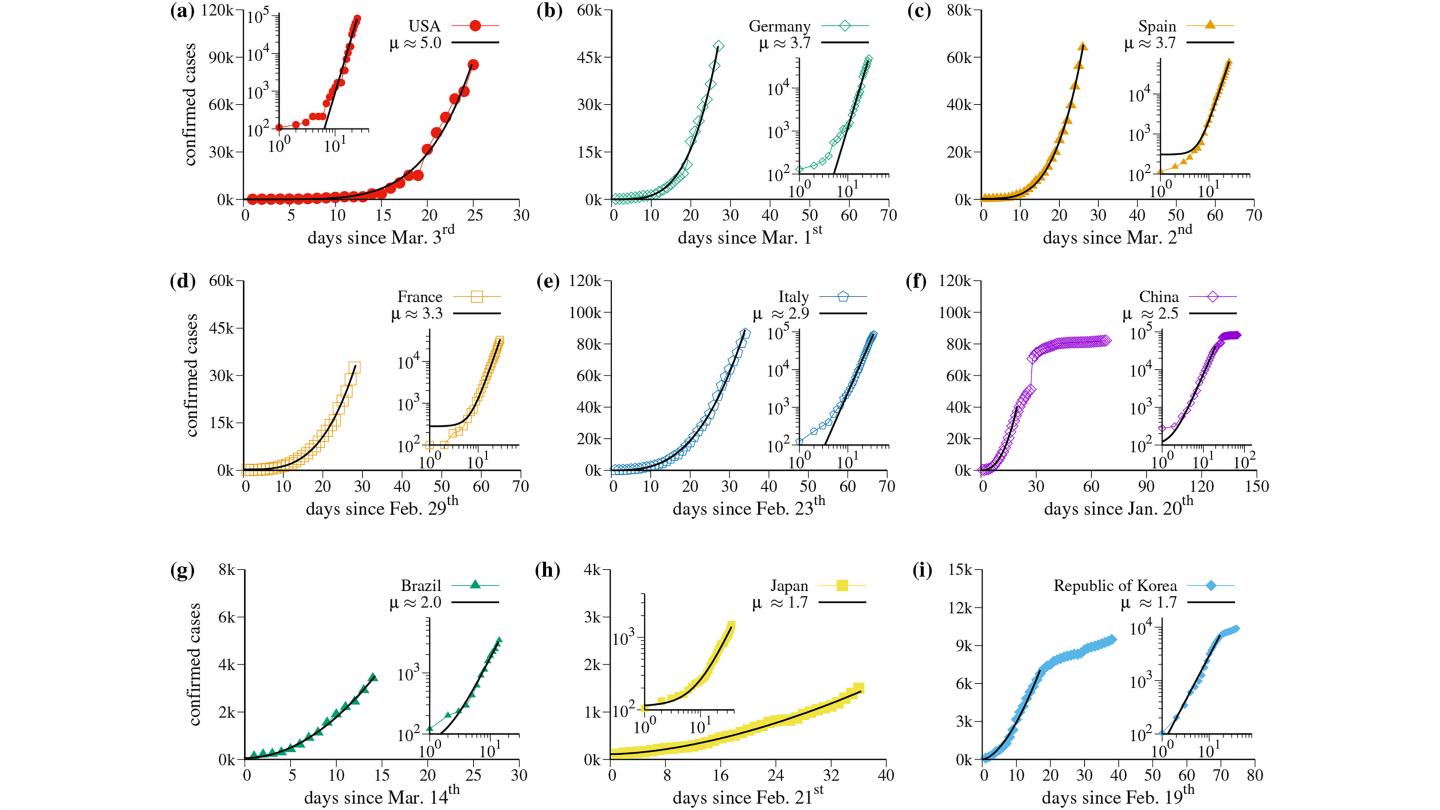
Researchers in Brazil analyzed the growth of confirmed infected COVID-19 cases across four continents to better characterize the spread of the virus and examine which strategies are effective in reducing its spread.

Their results, published in Chaos, from AIP Publishing, found the virus commonly grows along a power law curve, in which the social, economic and geographical features of a particular area affect the exponent to which the infection spreads rather than affecting traits of the infection itself.

“We decided to use our expertise to perform extensive numerical analysis using the real-time series of the cumulative confirmed cases of COVID-19 in order to search for answers about the spreading of this pathogen,” said author Cesar Manchein.

The study draws on data current through March 27 from Brazil, China, France, Germany, Italy, Japan, South Korea, Spain and the United States.

The group’s approach draws from a technique called numerical modeling, which leverages computing power to solve a set of differential equations in drawing comparisons between groups.

The high correlation in power law curves between each of the countries has allowed the group to single out generic effective strategies. Softer quarantine measures, they write, are inefficient at flattening curves compared to stricter isolation guidelines.

“Our results essentially show that an efficient strategy to avoid the increase of the number of infected individuals by coronavirus combines two actions: Keep to a high level of social distance and implement a significant number of tests to identify and isolate asymptomatic individuals,” said author Rafael M. da Silva.

They mention that the combination of the two actions, stay-at-home measures and more aggressive disease testing, are essentially the strategies used in South Korea.

The researchers plan on continuing to apply real-world data to further improve their model. Da Silva said the group hopes to use their models to test distinct strategies that could avoid the use of long quarantines.

“Physics and chaos theory researchers can have a fundamental role in the battle against the coronavirus,” said author Cesar Manchein. “From the theoretical point of view, researchers can use their knowledge and experience to study the time and territorial evolution of the disease.”

###

The article, “Strong correlations between power-law growth of COVID-19 in four continents and the inefficiency of soft quarantine strategies,” is authored by Cesar Manchein, Eduardo Luís Brugnago, Rafael M. da Silva, Carlos F.O. Mendes and Marcus W. Beims. The article will appear in Chaos on April 28, 2020 (DOI: 10.1063/5.0009454). After that date, it can be accessed at https://aip.scitation.org/doi/10.1063/5.0009454.

ABOUT THE JOURNAL

Chaos is devoted to increasing the understanding of nonlinear phenomena in all areas of science and engineering and describing their manifestations in a manner comprehensible to researchers from a broad spectrum of disciplines. See https://aip.scitation.org/journal/cha.

Media Contact
Larry Frum
[email protected]

Related Journal Article

http://dx.doi.org/10.1063/5.0009454

Tags: Algorithms/ModelsChemistry/Physics/Materials SciencesMathematics/StatisticsMedicine/HealthSystems/Chaos/Pattern Formation/Complexity
Share13Tweet8Share2ShareShareShare2

Related Posts

Humans and Zebra Finches Share Similar Speech Learning Techniques #ASA190 — Chemistry

Humans and Zebra Finches Share Similar Speech Learning Techniques #ASA190

May 11, 2026
Unveiling Dark Matter Through Molecular Insights — Chemistry

Unveiling Dark Matter Through Molecular Insights

May 11, 2026

From Touch to Sight: A Bioinspired Multisensory Framework Endows Robots with Human-Like Perception

May 11, 2026

Announcing the 2026 Carbon Future Young Investigator Award Winners

May 11, 2026
Please login to join discussion

POPULAR NEWS

  • Research Indicates Potential Connection Between Prenatal Medication Exposure and Elevated Autism Risk

    841 shares
    Share 336 Tweet 210
  • New Study Reveals Plants Can Detect the Sound of Rain

    728 shares
    Share 290 Tweet 182
  • Salmonella Haem Blocks Macrophages, Boosts Infection

    62 shares
    Share 25 Tweet 16
  • Breastmilk Balances E. coli and Beneficial Bacteria in Infant Gut Microbiomes

    57 shares
    Share 23 Tweet 14

About

We bring you the latest biotechnology news from best research centers and universities around the world. Check our website.

Follow us

Recent News

Humans and Zebra Finches Share Similar Speech Learning Techniques #ASA190

New Study Uncovers How Fungal Parasites Attack Strawberries and Raspberries

City of Hope Researchers to Present Groundbreaking Immunotherapy and Precision Medicine Advances Across Multiple Cancer Types at ASCO 2026

Subscribe to Blog via Email

Enter your email address to subscribe to this blog and receive notifications of new posts by email.

Join 82 other subscribers
  • Contact Us

Bioengineer.org © Copyright 2023 All Rights Reserved.

Welcome Back!

Login to your account below

Forgotten Password?

Retrieve your password

Please enter your username or email address to reset your password.

Log In
No Result
View All Result
  • Homepages
    • Home Page 1
    • Home Page 2
  • News
  • National
  • Business
  • Health
  • Lifestyle
  • Science

Bioengineer.org © Copyright 2023 All Rights Reserved.