A correction published in CVIR Oncology has updated the competing-interests declaration attached to a review of pressure modification during hepatic tumor embolization. The notice concerns the article “Pressure modification during hepatic tumor embolization: principles, mechanism of action, and current evidence,” written by Zachary T. Berman and Venkatesh P. Krishnasamy. The original article appeared on 19 June 2026, and the correction was published on 13 August 2026. According to the notice, the scientific article itself has been updated to reflect the revised disclosure. The correction does not announce new clinical results, revise a treatment recommendation, or report a change to the review’s discussion of pressure. Instead, it addresses information about professional relationships that readers should consider when evaluating work involving devices, techniques, or companies in a rapidly developing area of interventional oncology. The corrected article is openly available through Springer’s CVIR Oncology.
The revised declaration states that Berman and Krishnasamy are consultants for Trisalus Life Sciences, while Krishnasamy is also a consultant for Embolix Inc. The notice says the declaration originally listed competing interests as “Not applicable.” The correction replaces that statement with the more specific account of consultancy relationships. Such disclosures are a standard part of the scientific record because they give readers context about possible financial or professional connections between authors and organizations relevant to the subject under review. A conflict-of-interest statement does not, by itself, establish that a paper is biased or that its conclusions are incorrect. It identifies relationships that could be relevant to how evidence is interpreted, and it allows readers, editors, clinicians, and researchers to assess the work with that information in view. Here, the journal explicitly records both the original wording and the declaration that should have appeared.
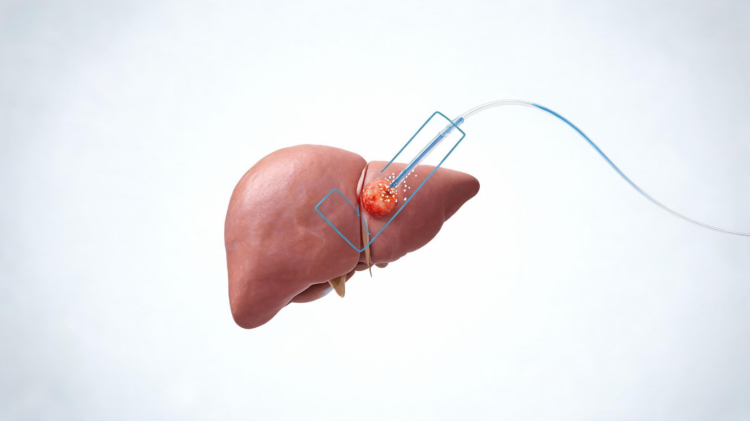
The underlying topic is a specialized form of liver-cancer treatment known as hepatic tumor embolization. In embolization, an interventional radiologist guides a catheter through the arterial system to blood vessels supplying a tumor and delivers material intended to reduce or stop that blood flow. Depending on the procedure, embolic particles, liquid agents, or drug-containing materials may be used. The treatment is designed to exploit a feature of liver tumors: many receive a substantial share of their blood supply from the hepatic arterial circulation, whereas much of the surrounding liver is supplied through the portal venous system. Blocking selected arterial branches can therefore concentrate treatment in the tumor while attempting to preserve as much healthy liver as possible. The precise result depends on vascular anatomy, catheter position, embolic material, injection technique, and the tumor’s connections with neighboring vessels.
Pressure becomes important because embolization is not simply a matter of placing a catheter and injecting a fixed quantity of material. Blood vessels form a branching, dynamic network, and pressure differences influence how fluid and particles move through it. During an injection, the resistance of the catheter, the size and shape of the downstream vessels, the viscosity of the carrier fluid, and the amount of material already deposited can all alter local pressures. As embolization progresses, the treated branch may become increasingly resistant to flow. That change can redirect material into other branches, cause reflux toward the catheter, or limit how deeply an agent travels. In principle, modifying pressure during the procedure could change the distribution of embolic material, but the practical effect depends on the interaction between the delivery system and the patient’s individual vascular architecture. The corrected publication is a review of these principles and mechanisms, not a newly reported clinical trial.
The mechanism under discussion can be understood through the relationship between flow, resistance, and pressure. In a simplified vessel, flow rises when the pressure difference across the vessel increases, while resistance depends strongly on vessel radius and on the properties of the fluid. Real tumor-feeding networks are more complicated than this simplified picture: vessels branch, curve, narrow, and communicate through collateral channels. Embolic particles can lodge at different levels, progressively changing resistance as the procedure continues. A pressure-driven change in flow may then determine whether material remains near the tumor’s arterial feeders or reaches smaller branches. The same forces can also matter for safety. Excessive pressure or an unfavorable pressure gradient may promote reflux into non-target vessels, while insufficient penetration may leave portions of a tumor under-treated. These are physiological and engineering considerations that make pressure a potential control variable, rather than a mere by-product of injection.
The article’s title also places pressure modification within the broader question of current evidence. In interventional oncology, technical concepts may be supported by laboratory experiments, flow models, imaging studies, procedural observations, or clinical outcomes, and those forms of evidence do not answer identical questions. A model can show how pressure changes affect particle trajectories under controlled conditions, while a clinical study must account for differences in tumor size, arterial anatomy, liver function, prior treatment, and operator technique. A review can connect those strands, clarify proposed mechanisms, and identify where evidence remains limited. The source material supplied for the correction does not provide the review’s detailed evidence assessment, numerical outcomes, or treatment comparisons. It therefore supports reporting the correction and explaining the clinical context, but not attributing specific efficacy or safety findings to the authors’ review.
For patients and clinicians, the immediate significance of the notice is transparency. Consultancy relationships can arise in fields where physicians help companies understand clinical workflows, evaluate technologies, or advise on product development. Those activities may contribute useful expertise, but they also make complete disclosure especially important when an article addresses techniques or technologies connected to commercial organizations. Readers can use the information to distinguish the article’s evidence and reasoning from the authors’ professional affiliations. The correction also illustrates why journals maintain mechanisms for updating the published record. When a declaration is incomplete or inaccurate, a formal correction creates a visible link between the original publication and the revised information, preserving the history of what changed rather than silently replacing the record. Springer identifies the corrected item as an open-access article and provides its version-of-record date as 13 August 2026.
The notice does not state that the authors’ consultancy relationships affected the review’s methods or conclusions, and it does not describe any alteration to the article’s clinical content. Its specific action is to correct the competing-interests declaration and confirm that the original article has been updated. That distinction matters in interpreting the publication: the correction adds disclosure, not a new pressure-modification technique or a new body of outcome data. The paper remains a review of the principles, proposed mechanisms, and available evidence surrounding pressure changes during hepatic tumor embolization. Its subject sits at the intersection of vascular physiology, catheter-based drug delivery, embolic-material behavior, and liver-cancer care. By pairing the technical subject with a revised declaration, the journal gives readers a fuller account of both the medical discussion and the professional context in which it was prepared.
The correction also clarifies how the publication should be located and cited within the journal’s record. The notice is identified as volume 2, article 19, whereas the review being corrected is volume 2, article 11. These are separate publication records linked by the correction notice. For readers searching databases, the correction’s DOI, 10.1007/s44343-026-00054-2, identifies the notice itself; the review retains its own DOI, 10.1007/s44343-026-00044-4. Keeping those identifiers distinct is important because a database search for the review may otherwise omit the later disclosure update, while a citation to the correction alone does not substitute for consulting the review’s scientific content.
In practical terms, the corrected declaration should be read alongside the review rather than treated as an independent assessment of pressure-modification technology. The notice does not indicate that the authors’ institutional affiliations changed, that the article was withdrawn, or that the journal had identified an error in its analysis of hepatic tumor embolization. Its function is narrower: it documents a change to the authors’ competing-interests information and states that the original article has been updated. This distinction helps readers interpret the status of the publication accurately. A correction can concern disclosures, data, wording, figures, or other elements of the record; the nature of the correction determines what conclusions, if any, should be reconsidered. In this case, the supplied notice identifies the affected element as the competing-interests declaration.
The source also identifies the authors’ affiliations with interventional radiology and cancer-care institutions in the United States. Institutional affiliation provides useful context about the clinical and academic setting in which a review was prepared, but it is not a substitute for evaluating the review’s methods, cited evidence, or stated limitations. Readers assessing a technical review may therefore consider several layers of information separately: who prepared the article, where the work was conducted or supported, what relationships were disclosed, and what evidence the authors used to develop their conclusions. The correction improves the completeness of that contextual information without, on the evidence provided here, supplying a new evaluation of the underlying literature.
Because the item is designated open access under a Creative Commons Attribution 4.0 license, the publication can be read and, subject to the license terms, shared or adapted with appropriate attribution and an indication of changes. The notice cautions that some third-party material may be governed by a separate credit line, so reuse of material such as figures requires attention to the rights information attached to that material. For scientific communication, open availability can make it easier for clinicians, investigators, and patients to inspect both the correction and the related review. It also supports transparent linking between the original article and the updated record, allowing future readers to see not only the corrected declaration but also when and why the journal amended the publication.
Subject of Research: Pressure modification during hepatic tumor embolization
Article Title: Correction: Pressure modification during hepatic tumor embolization: principles, mechanism of action, and current evidence
Article References: Berman, Z. T., & Krishnasamy, V. P. (2026). Correction: Pressure modification during hepatic tumor embolization: principles, mechanism of action, and current evidence. CVIR Oncology, 2(1), Article 19. https://doi.org/10.1007/s44343-026-00054-2
Image Credits: AI Generated
DOI: 10.1007/s44343-026-00054-2
Keywords: hepatic tumors, tumor embolization, interventional oncology, vascular pressure, liver cancer, conflict disclosure, Correction, Pressure, modification, during, hepatic, tumor
Cite Scienmag News
APA MLA Chicago
Scienmag. (August 29, 2026). Correction Updates Conflict Disclosure in Liver Tumor Embolization Review. https://scienmag.com/correction-updates-conflict-disclosure-in-liver-tumor-embolization-review/
Scienmag. “Correction Updates Conflict Disclosure in Liver Tumor Embolization Review.” Scienmag, 29 August 2026, https://scienmag.com/correction-updates-conflict-disclosure-in-liver-tumor-embolization-review/. Accessed 29 August 2026.
Scienmag. “Correction Updates Conflict Disclosure in Liver Tumor Embolization Review.” Scienmag. August 29, 2026. https://scienmag.com/correction-updates-conflict-disclosure-in-liver-tumor-embolization-review/
Copy citation Download RIS
Tags: conflict disclosureconflict of interest disclosure in interventional oncologyCorrectioncorrection in medical research publicationCVIR Oncology publication updatesdisclosure of consultancy roles in medical devicesduringethical considerations in interventional oncologyhepatichepatic tumor embolization techniqueshepatic tumorsimpact of conflicts of interest on medical reviewsinterventional oncologyliver cancerLiver tumor embolizationmodificationPressurepressure modification in hepatic interventionprofessional relationships in interventional radiologyrole of device companies in liver cancer treatmenttransparency in clinical researchtumortumor embolizationvascular pressure