Detecting dangerous bacteria in food and water has long been a slow, laboratory-bound affair, but a team of researchers in Indonesia has unveiled a biosensor that could change that. In a study published in the Journal of Materials Science, Yuant Tiandho of Universitas Bangka Belitung and Institut Teknologi Bandung, together with colleagues at Institut Teknologi Bandung, the National Research and Innovation Agency (BRIN), and Universitas Negeri Padang, describe an integrated plasmonic and machine learning system that can rapidly and selectively detect Escherichia coli, one of the most consequential indicators of contamination in consumable products and the environment.
The heart of the system is a nanoparticle with a carefully engineered architecture: a silver core wrapped in a thin gold shell. These core-shell Ag@Au nanoparticles are designed to exploit localized surface plasmon resonance, or LSPR, a phenomenon in which conduction electrons on a metal nanoparticle oscillate collectively when struck by light. When the local refractive index around the particle changes, for instance because bacterial cells bind to its surface, the resonance shifts to longer wavelengths. That shift is the physical signal the sensor reads out, turning an invisible molecular binding event into a measurable optical change.
The choice of a bimetallic structure is not arbitrary. Silver nanoparticles are famously sensitive to their surroundings, producing large resonance shifts per unit change in refractive index, but silver is chemically fragile, prone to oxidation and degradation that would cripple a biosensor in real-world use. Gold, by contrast, is robust and easy to functionalize with biological molecules but somewhat less sensitive on its own. By depositing a controlled gold shell over a silver core, the researchers sought the best of both worlds: the high sensitivity of silver protected and functionalized by a stable gold exterior.
Getting that balance right required careful synthesis. The team grew the gold shells through a controlled deposition process, varying the amount of the gold precursor, chloroauric acid (HAuCl4), added during synthesis. The optimal configuration emerged when 75 microliters of HAuCl4 was used, producing nanoparticles with a refractive index sensitivity of 195.3 nanometers per refractive index unit. That figure quantifies how many nanometers the plasmon peak moves for each unit change in the surrounding refractive index, and it is a key benchmark for how responsive the sensor can be to the arrival of bacterial cells on its surface.
Sensitivity alone is not enough; a useful biosensor must also be selective, able to recognize its target amid a crowd of other microorganisms. To achieve this, the researchers functionalized the nanoparticles with anti-E. coli antibodies, molecules that bind specifically to the target bacterium. Fourier-transform infrared (FTIR) spectroscopy confirmed that the antibodies had been successfully attached to the nanoparticle surfaces, providing the chemical evidence that the biorecognition layer was in place. With this molecular fishing line deployed, the sensor could distinguish E. coli from the nontarget bacteria tested in the study, a critical capability for avoiding false alarms in food safety and environmental monitoring.
The analytical performance reported is striking. As bacterial concentration increased across a range from 1 to 10^7 colony-forming units (CFU), the LSPR peak position shifted linearly toward longer wavelengths while the absorbance intensity decreased. The team extracted two independent limits of detection from these responses: 36.9 CFU based on peak shift analysis and 21.2 CFU based on absorbance intensity variation. Having two readout channels from the same platform is valuable, since it provides internal cross-validation of results and allows the user to choose the most convenient measurement mode for a given setting.
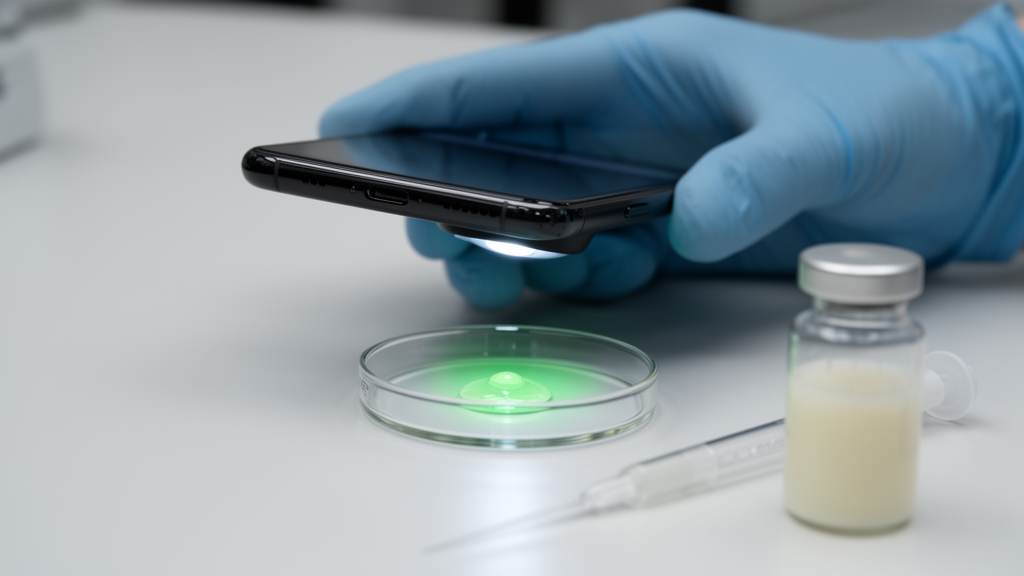
What elevates the work beyond a conventional laboratory biosensor is its integration with everyday technology. Rather than requiring an expensive benchtop spectrometer, the system uses a smartphone camera to capture images of the sensing platform. Those images are then fed into machine learning classification algorithms, with the k-nearest neighbors (k-NN) algorithm proving particularly effective. The result is accurate visual detection and classification of samples across different regulatory categories, meaning the system can not only flag the presence of E. coli but sort results into the compliance classes used by food and water safety standards.
The k-nearest neighbors approach is conceptually simple but well suited to this task. The algorithm compares the feature profile of a new sample, derived from the smartphone image, against a library of previously labeled examples and assigns it to the category shared by its closest neighbors. Because the color and intensity signatures of the plasmonic response vary systematically with bacterial concentration, these features form distinguishable clusters that k-NN can separate reliably. The pairing of a cheap optical transducer with lightweight machine learning is a growing trend in biosensing, and this study demonstrates how far it can go when the underlying nanoparticle platform is engineered for a strong, consistent signal.
The practical implications are considerable. E. coli contamination of food and water remains a persistent public health threat worldwide, and conventional detection methods, which often rely on culturing bacteria over days, are too slow to intervene before contaminated products reach consumers. Rapid colorimetric and plasmonic biosensors have attracted intense interest for exactly this reason, and prior work has explored silver nanoparticles, gold nanoparticles conjugated to antibodies, and lateral flow formats for E. coli detection. The present study builds on that foundation, including the authors’ own earlier research on ellipsoid Ag@Au nanoparticles for refractive index sensing and on silver-gold nanorods for waterborne pathogen detection, and pushes it toward a complete, deployable system.
Perhaps the most consequential aspect is the system’s suitability for resource-constrained environments. Because the readout requires only a smartphone and the classification runs on standard machine learning tools, the barrier to adoption in field settings, rural clinics, small food producers, and local water utilities could be dramatically lower than for laboratory instrumentation. The authors argue that their Ag@Au-based LSPR biosensor, combining high sensitivity, antibody-driven selectivity, dual-mode detection limits in the tens of CFU, and machine learning-assisted visual classification, stands as a promising template for rapid bacterial contamination screening. If such platforms can be validated across diverse real-world sample matrices and manufactured at scale, the humble smartphone may become one of the most powerful public health tools in the field.
Subject of Research: A plasmonic biosensor using Ag@Au nanoparticles and machine learning for rapid, selective detection of Escherichia coli
Article Title: Integrated plasmonic–machine learning system for the rapid and selective detection of Escherichia Coli using Ag@Au nanoparticles
Article References: Tiandho, Y., Muslihati, A., Septiani, N. L. W., Afriani, F., Jonuarti, R., Suprijadi, S., & Yuliarto, B. (2026). Integrated plasmonic–machine learning system for the rapid and selective detection of Escherichia Coli using Ag@Au nanoparticles. Journal of Materials Science. https://doi.org/10.1007/s10853-026-13963-7
Image Credits: AI Generated
DOI: 10.1007/s10853-026-13963-7
Keywords: E. coli, biosensor, localized surface plasmon resonance, Ag@Au nanoparticles, machine learning, k-nearest neighbors, smartphone detection, food safety, water quality, nanotechnology, refractive index sensitivity, antibody functionalization
News Source: Denise Maddox. (October 19, 2026). Core-Shell Nanoparticles and Smartphones Team Up to Catch E. coli in Minutes. Scienmag.