Tay-Sachs disease is one of the orphan diseases currently in focus of attention for many research groups in the world. This disorder occurs due to gene mutations in one of the lysosomal enzymes (β-hexosaminidase A) and leads to the accumulation of specific lipids (GM2 gangliosides) in the cells of the nervous system. The disease is characterized by progressive neurodegeneration, leading to disability and subsequent death. Today, there are no drugs which can cure it.
Credit: Kazan Federal University
Tay-Sachs disease is one of the orphan diseases currently in focus of attention for many research groups in the world. This disorder occurs due to gene mutations in one of the lysosomal enzymes (β-hexosaminidase A) and leads to the accumulation of specific lipids (GM2 gangliosides) in the cells of the nervous system. The disease is characterized by progressive neurodegeneration, leading to disability and subsequent death. Today, there are no drugs which can cure it.
Scientists have investigated the effects of curcumin and cord blood cell transplantation in Tay-Sachs disease. Cord blood cell transplantation is often used in lysosomal storage diseases to increase the level of functionally active enzymes, since donors do not have mutations in the β-hexosaminidase A gene. Transplanting cells which synthesize a working enzyme can prevent further progression of the disease, thereby prolonging the life of patients. Curcumin is known as a dietary supplement that is beneficial for its anti-inflammatory and antioxidant properties in many neurodegenerative diseases. According to scientists, combination therapy combining these approaches can relieve symptoms of the disease and improve the condition of patients.
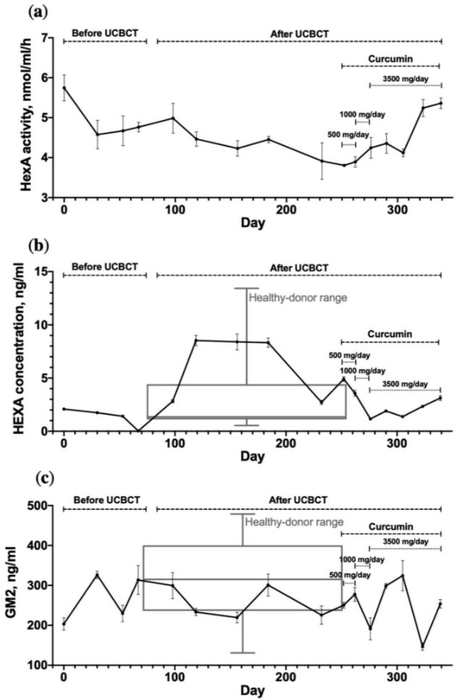
The researchers have shown that after transplantation of umbilical cord blood cells in the patient’s plasma, the concentration of the missing enzyme increases. This effect is achieved due to the fact that the umbilical cord blood contains stem cells, which are the source of normal enzymes. In addition, both curcumin intake and transplantation resulted in a decrease in inflammation, which was confirmed by measuring the level of inflammatory cytokines in the patient’s blood plasma.
“Tay-Sachs disease is associated with severe neurodegeneration and neuroinflammation. An increase in the level of inflammatory cytokines leads to the migration of activated microglia and astrogliosis, which is characteristic of gangliosidosis. Umbilical cord blood is rich in hematopoietic stem cells that have immunoregulatory properties. Also, donor cord blood cells produce a normal enzyme. Therefore, transplantation can lead to suppression of the inflammatory response and reduce the amount of accumulated GM2 gangliosides,” says co-author, Professor Albert Rizvanov.
Valeriya Solovyeva, head of the genomic and cell engineering group at Gene and Cell Technologies Lab, Lead Research Associate, explained that curcumin at the molecular level affects various processes in the human body. In particular, it is able to suppress inflammatory responses by lowering the level of inflammatory cytokines and has a beneficial effect on the course of neurodegenerative diseases, which has been confirmed by many clinical studies. However, the molecular mechanisms of the effect of curcumin on the body of patients with Tay-Sachs disease have not been studied.
Importantly, the described approach is not a clinical recommendation because the paper only covers a single case report. Clinical trials are needed to support the takeaways from the research.
Journal
Life
DOI
10.3390/life11101007
Method of Research
Experimental study
Subject of Research
People
Article Title
Serum Cytokine Profile, Beta-Hexosaminidase A Enzymatic Activity and GM2 Ganglioside Levels in the Plasma of a Tay-Sachs Disease Patient after Cord Blood Cell Transplantation and Curcumin Administration: A Case Report
Article Publication Date
24-Sep-2021
COI Statement
V.V. Kursenko owns the company Individual Entrepreneur Kursenko V.V. The authors declare no conflict of interest.