Every mango season, growers around the world place their hopes on a single, invisible event: the moment when a dormant bud on a mature branch decides to abandon leaf production and become a flowering panicle. A new open-access review in Discover Plants pulls together decades of physiology and a wave of recent molecular studies to explain how that decision is made, and the picture that emerges is strikingly intricate. According to author Fei Liang of the South Subtropical Crops Research Institute in China, mango flowering is not governed by any single switch. Instead, it is a competence-gated process in which environmental signals, water status, hormonal crosstalk and a growing catalogue of flowering genes converge on the fate of each individual bud.
The review begins by untangling terminology that has confused the field for years. Floral competence, induction and initiation are often used interchangeably, but they describe distinct stages in a developmental sequence. Competence means that a mature bud is capable of responding; induction is the environmental or physiological signal that actually shifts bud fate; initiation marks the first detectable changes in the meristem; and bud break, panicle emergence and anthesis come later. This distinction matters enormously for growers, because a treatment that merely accelerates bud break, such as a nitrate spray on a mature bud, can be mistaken for a true inductive signal when it is really acting downstream of the critical decision point.
Temperature emerges as the most consistently supported environmental cue, yet the review stresses that no universal threshold exists. Controlled experiments point to inductive regimes near 19 to 15 degrees Celsius during the day and 15 to 10 degrees at night. A particularly vivid comparison comes from potted Tommy Atkins trees held at either 13 or 25 degrees Celsius for three months: nearly 100 percent of the cool-treated trees flowered, while none of the warm-treated trees did. But the story does not end there. A post-induction study of Kensington mango found that inflorescences developed at 20/10, 25/15 and 30/20 degree day/night regimes, yet failed entirely at 15/5 degrees, showing that temperatures promoting induction are not necessarily optimal for later panicle development. Field data from Australian selections further confirm that the relevant minimum and maximum temperatures differ among cultivars.
Water status adds a second, non-linear gate to the flowering decision. In low-latitude experiments, a water deficit lasting roughly five weeks promoted earlier or more intense flowering in Kensington Pride and Irwin mango, suggesting that moderate pre-induction stress can partially substitute for seasonal cooling in some tropical settings. Earlier container work showed that temperature and water stress interact rather than acting as independent switches. The review is careful to note, however, that the direction of the response changes dramatically with severity and timing. Severe drought, or drought imposed during panicle expansion or near anthesis, can reduce photosynthesis, panicle survival, pollen function and fruit set. Drought is best understood as a context-dependent modifier of bud competence and carbon balance, not a universally beneficial flowering treatment.
The hormonal dimension of flowering centres on an interplay between gibberellins, which generally promote shoot extension and can antagonize reproductive competence, and abscisic acid, which has recently been linked to floral transition through direct molecular evidence. In the 13 versus 25 degree comparison, cool treatment was associated with lower GA3 in wood and bark and higher ABA in wood, alongside nearly complete flowering. This supports a local or vascular ABA-GA shift during induction, but the review cautions that it does not show all tissues or all cultivars experience the same hormone changes. Gibberellin and ABA responses are best interpreted as tissue- and treatment-specific rather than as universal rules.
The strongest recent gene-level evidence comes from work on mepiquat chloride, a quaternary ammonium growth retardant. When mepiquat chloride induced floral transition, gibberellin levels fell, expression of gibberellin 2-oxidase genes rose, ABA accumulated, and the ABA-responsive genes MiNCED1 and MiABI5-like7 increased in expression. Critically, exogenous ABA accelerated the transition, an ABA-inhibitor treatment delayed it, and biochemical and transgenic assays showed that MiABI5-like7 directly activates MiFT3, a florigenic gene. Silencing MiABI5-like7 delayed the transition, whereas ectopic expression promoted early flowering. This constitutes direct evidence for an ABA-responsive MiABI5-like7-MiFT3 regulatory module in mango, though the review emphasizes that this does not automatically mean fruit load, sugar signals, circadian rhythms or plant age regulate ABA in the same way.
The molecular framework extends well beyond this module. Mango homologues of FLOWERING LOCUS T act as florigenic pathway integrators, while TERMINAL FLOWER 1 homologues function as anti-florigens. Three MiFT genes have been isolated and functionally compared, with MiFT1 promoting early flowering in Arabidopsis, and four MiTFL1 genes delaying flowering in the same heterologous system. Downstream integrators include MiSOC1, MiAP1, MiLFY and the repressive MADS-box genes MiSVP1 through MiSVP4. The CONSTANS-LIKE family adds further complexity: two cultivar-derived variants, MiCOL14B-GQ and MiCOL14B-JH, bind MiFT promoters but have opposite effects on transcription and flowering. Newer candidates include 14-3-3 proteins, a RING zinc-finger protein called MiRZFP34, SLENDER RICE-like DELLA genes MiSLR1 and MiSLR2, and GA receptor genes MiGID1A and MiGID1B, all of which promoted early flowering when overexpressed in Arabidopsis.
The review is explicit about the limits of such heterologous evidence. A gene can change flowering time in Arabidopsis without being the same limiting regulator in a mature mango bud, and the review organizes all molecular players into a three-tier hierarchy: direct mango hormone or gene perturbation, functional tests in a heterologous system, and transcriptome or co-expression association. Fruit load, for example, has a direct link to FT/TFL1 expression through studies in Shelly mango, where low fruit load was associated with earlier MiFT1 upregulation in winter leaves and high fruit load with higher expression of anti-florigenic MiTFL1 genes. But the claim that sugars, circadian transcripts or plant age regulate ABA during mango floral induction remains correlative rather than causally established. The miR156-SPL age pathway offers a plausible comparative framework for juvenility effects, but direct mango experiments are still lacking.
Chemical growth retardants receive careful treatment as mechanistic probes rather than as prescriptions. Paclobutrazol, a triazole inhibitor of early gibberellin biosynthesis, consistently lowered GA concentrations in wood and bark of tropical Tommy Atkins trees, while potassium nitrate increased zeatin-type cytokinins near induction. But no single paclobutrazol dose can be recommended across all orchards, because product concentration, canopy size, cultivar, soil, climate and application date all change exposure. Published experimental rates range from 0.25 to 3 millilitres or grams per metre of canopy spread depending on the study, and high rates may compact panicles or leave residues for months. Ethephon, which releases ethylene, shows similarly stage-dependent and cultivar-dependent effects, with responses appearing within two to five weeks and new growth emerging six to twenty-one weeks later that could be floral or non-floral.
The integrated model that emerges is a two-gate framework with real implications for a warming, less predictable climate. Gate one is bud competence, determined by shoot maturity, seasonal temperature history, water status, source-sink balance and juvenile state. Gate two is signal execution, in which gibberellin restraint, ABA responses, cytokinin and ethylene effects, and the FT/TFL1 balance determine whether a competent bud enters the floral pathway. The review lays out priority experiments: multi-year, cultivar-stratified field trials recording hourly temperature and exact bud fate; tissue-specific measurements of ABA, GA3, GA20, cytokinins and sugars at matched developmental stages; mango-compatible silencing, editing or transient assays for key modules like MiABI5-like7-MiFT3 and MiCOL14B; and paired measurement of flowering with panicle quality, fruit set and residue data. In an era of irregular rainfall and shifting winter temperatures, understanding these gates may prove essential for keeping the king of fruits flowering reliably across the tropics and subtropics.
Subject of Research: Environmental, hormonal and molecular regulation of flowering in mango (Mangifera indica)
Article Title: Environmental sensing, hormonal crosstalk and molecular control of mango flowering in Mangifera indica L.
Article References: Environmental sensing, hormonal crosstalk and molecular control of mango flowering in Mangifera indica L.. (n.d.). https://doi.org/10.1007/s44372-026-00947-9
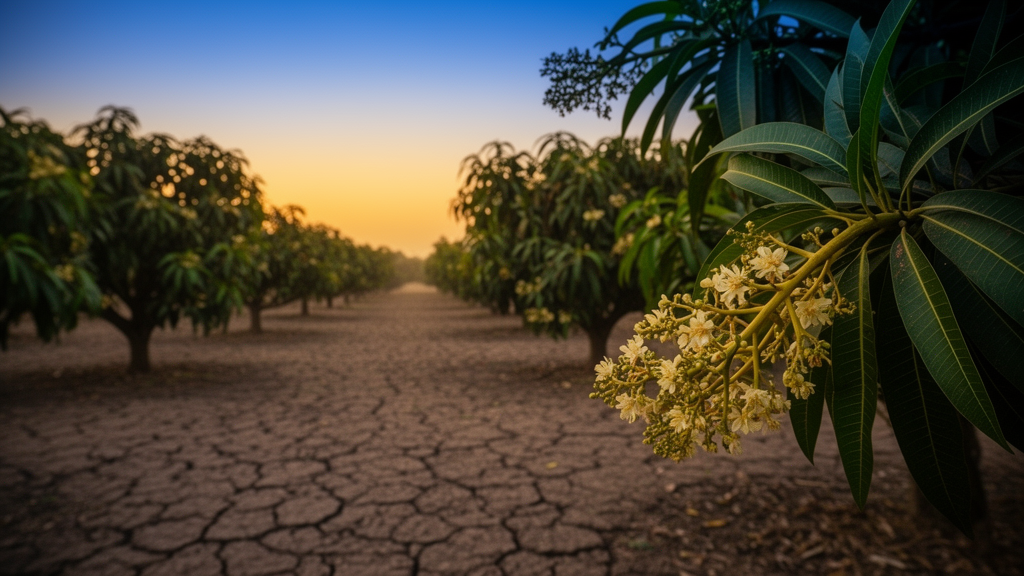
Image Credits: AI Generated
DOI: 10.1007/s44372-026-00947-9
Keywords: mango, flowering, floral induction, gibberellin, abscisic acid, FT/TFL1, temperature, water stress, paclobutrazol, circadian regulation, MiCOL14B, climate resilience
News Source: Juliet Wilcox. (October 15, 2026). Cool Nights, Drought and Hormones: How Mango Trees Decide to Flower. Scienmag.