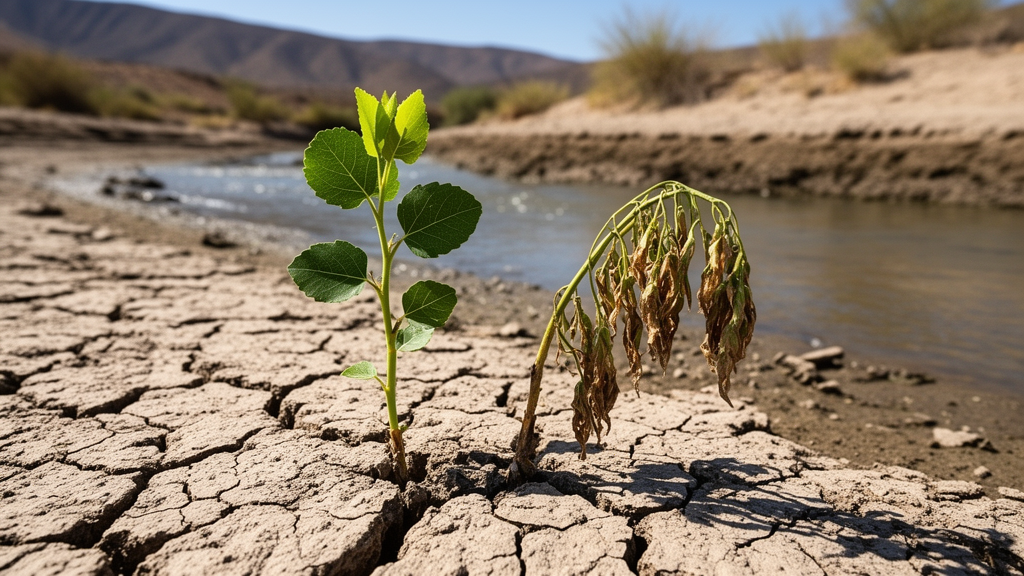
Seeds of the Mexican poplars Populus luziarum and P. primaveralepensis germinated less successfully as temperatures rose and water availability declined in a controlled laboratory experiment. The study examined two restricted-range species, each with fewer than 250 mature individuals occupying less than 100 km².
Researchers collected mature catkins in October 2021 from at least 10 trees of each species along La Virgen and La Lobera streams in Jalisco, Mexico. They extracted 3,000 seeds per species and stored them in sealed glass bottles at 4 °C to reduce viability loss. The experiment tested 1,500 seeds per species.
Seeds were incubated at 24, 28 and 32 °C under five water potentials: 0, –0.07, –0.15, –0.3 and –0.6 megapascals. Each treatment included five replicates of 20 seeds in Petri dishes lined with cotton and moistened with 5 millilitres of the assigned solution. Polyethylene glycol solutions simulated increasingly dry soil conditions, while sealed dishes and a 12-hour photoperiod standardized incubation.
Germination was defined as radicle emergence and recorded hourly for 48 hours, although no additional germination occurred after 24 hours. Statistical analyses found effects of temperature, water potential and their interaction on germination percentage for both species. Under fully hydrated conditions at 24 °C, germination reached 90% for P. luziarum and 94% for P. primaveralepensis.
For P. primaveralepensis, germination was between 81% and 94% at 24 and 28 °C under water potentials from 0 to –0.15 MPa. At 32 °C, however, germination was significantly lower than at 24 and 28 °C specifically under the –0.15, –0.3 and –0.6 MPa treatments; the reduction did not apply across the full range of water potentials. The lowest value, 23%, occurred at –0.6 MPa and 32 °C.
Severe water stress produced average germination of 29% for P. luziarum at –0.6 MPa regardless of temperature. The species began germinating at the seventh hour under water potentials of 0 to –0.3 MPa and at the ninth hour at –0.6 MPa, independently of temperature. Water potential significantly affected its minimum germination time, whereas temperature did not.
For P. primaveralepensis, both temperature and water potential affected minimum germination time. Germination began within 1.44 hours at 0 and –0.07 MPa and took 3.08 hours at –0.6 MPa. Mean germination rate also responded to temperature, water potential and their interaction in both species.
The fastest mean rates occurred at 28 °C and 0 MPa: 0.0959 ± 0.001 hours⁻¹ for P. luziarum and 0.177 ± 0.009 hours⁻¹ for P. primavera lepensis. The experiment did not follow seedling establishment, survival, reproduction or population trajectories in the field. It therefore measured responses to controlled germination conditions and cannot establish that hotter, drier conditions will cause population declines.
The authors identify seedling development and survival under different water and heat stresses as priorities for future research. Their results indicate that projected warming and reduced moisture could negatively affect seed germination for these two Mexican poplars, although the laboratory experiment did not test field recruitment or reproduce the full effects of climate change.
Subject of Research: Effects of temperature and water potential on germination in two restricted-range Mexican Populus species
Article Title: High temperatures and drought affect the germination of Populus luziarum and P. primaveralepensis , endangered species from the Neotropical region of Mexico
Article References: Jacobo-Pereira, C., Huerta-Martínez, F. M., Flores, J., Razo-Leon, A. E., & Muñoz-Urias, A. (2025). High temperatures and drought affect the germination of Populus luziarum and P. primaveralepensis, endangered species from the Neotropical region of Mexico. Neotropical Biology and Conservation, 20(3), 191-203. https://doi.org/10.3897/neotropical.20.e155025
Image Credits: AI Generated
DOI: 10.3897/neotropical.20.e155025
Keywords: Populus luziarum, Populus primaveralepensis, seed germination, drought stress, high temperatures, riparian ecosystems, Mexican poplars, Jalisco, laboratory experiment, High, temperatures, drought
News Source: Drew Townsend. (October 21, 2026). Controlled study finds heat and drought reduce germination in two restricted-range Mexican poplars. Scienmag.