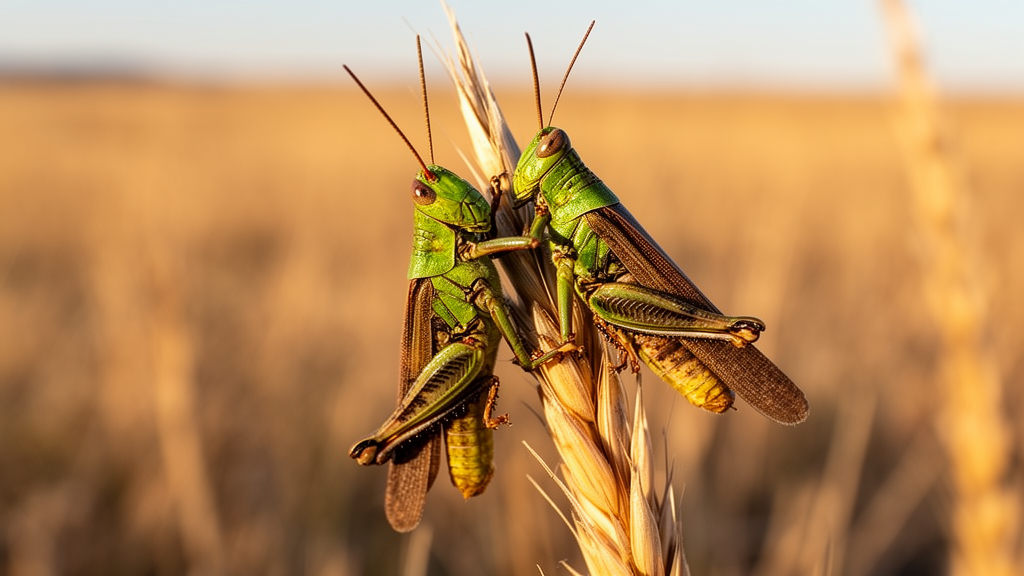
A chance observation during a field collection in Kazakhstan documented a male Dociostaurus kraussi mounting a male Oedaleus decorus and connecting its cerci to the other male’s external genitalia. The two species belong to different subfamilies, making the captive observation a record of cross-subfamily male-male mating behavior in acridid grasshoppers.
The researchers captured Orthoptera on the morning of June 26, 2023, at a semi-desert locality in the northern foothills of the Dzungarian Alatau Mountains near Lake Alaqol, about 10 km south of Koktuma in Kazakhstan’s Jetisu Region. The site was at 45.7957°N, 81.6379°E and approximately 655 m above sea level. They transported about five to six live insects per container in seven containers for processing at camp.
One container held a male D. kraussi from Gomphocerinae, identified by field number SOH_1561, together with a male O. decorus from Oedipodinae, identified as SOH_1560. During an afternoon inspection, the D. kraussi male was found mounted on the O. decorus male, with its cerci connected to the mounted male’s genitalia. The position persisted into the evening.
Neither insect released its hold when the container was removed or when the pair was immersed in 80% ethanol for preservation. The researchers detected no resistance behavior from the mounted O. decorus male. They subsequently pinned and dried the specimens and produced a three-dimensional scan with a Disc3D insect scanner at the Leibniz Institute for the Analysis of Biodiversity Change in Hamburg.
The scan confirmed that the D. kraussi male’s cerci were connected to the O. decorus male’s external genitalia. It did not establish whether genital insertion occurred or whether sperm was transferred. The preserved specimens are held at the University of Zurich in Switzerland.
This was a chance observation under captivity rather than a controlled behavioral experiment. The researchers considered erroneous mate recognition to be the most likely explanation. Chemical mating barriers in most grasshopper species should make such an attempt extremely rare under natural conditions, while captivity and possible stress may have inhibited signals normally used to recognize mates.
Body-size similarity may also have contributed. Male O. decorus measure 18–31 mm, while female D. kraussi measure 19.3–31.5 mm. The observation cannot establish why the mounting occurred. D. kraussi is known to produce very simple calling songs and is described as having a wandering mating strategy, with both sexes moving around their territories; females are not known to answer the males’ calls. For O. decorus, no courtship behavior or acoustic communication had been demonstrated.
The authors also discussed reproductive interference as a possible, but unproven, alternative function. They noted that interspecific same-sex mating might interfere with a competing species’ reproduction, while the initiating male would bear the cost of being unable to pursue another reproductive opportunity at the same time. They suggested such behavior might be advantageous if the male had depleted its sperm or if few conspecific females were available, but the single observation does not test this hypothesis.
Because the event was observed only in captivity, the case cannot establish its natural frequency, adaptive significance, or whether copulation and sperm transfer occurred. The mounting and sustained genital contact may indicate that similar events can occur in nature, but no such event was directly observed in a natural setting.
Subject of Research: A single captive observation of cross-subfamily male-male mating behavior in two acridid grasshopper species.
Article Title: Observation of a cross-subfamily male-male mating attempt of grasshoppers in Kazakhstan ( Orthoptera , Acrididae )
Article References: Hawlitschek, O., Sevastianov, N., Pamin, J.-H., & Husemann, M. (2025). Observation of a cross-subfamily male-male mating attempt of grasshoppers in Kazakhstan (Orthoptera, Acrididae). Alpine Entomology, 9, 1-3. https://doi.org/10.3897/alpento.9.151006
Image Credits: AI Generated
Keywords: grasshoppers, male-male behavior, mating attempt, Dociostaurus kraussi, Oedaleus decorus, Orthoptera, Acrididae, mate recognition, captive observation, Kazakhstan, Observation, cross-subfamily
News Source: Gavin Prescott. (October 21, 2026). Captive grasshoppers show cross-subfamily male-male mating attempt. Scienmag.