• HOME
  • NEWS
  • EXPLORE
    • CAREER
      • Companies
      • Jobs
    • EVENTS
    • iGEM
      • News
      • Team
    • PHOTOS
    • VIDEO
    • WIKI
  • BLOG
  • COMMUNITY
    • FACEBOOK
    • INSTAGRAM
    • TWITTER
Sunday, July 12, 2026
BIOENGINEER.ORG
No Result
View All Result
  • Login
  • HOME
  • NEWS
  • EXPLORE
    • CAREER
      • Companies
      • Jobs
        • Lecturer
        • PhD Studentship
        • Postdoc
        • Research Assistant
    • EVENTS
    • iGEM
      • News
      • Team
    • PHOTOS
    • VIDEO
    • WIKI
  • BLOG
  • COMMUNITY
    • FACEBOOK
    • INSTAGRAM
    • TWITTER
  • HOME
  • NEWS
  • EXPLORE
    • CAREER
      • Companies
      • Jobs
        • Lecturer
        • PhD Studentship
        • Postdoc
        • Research Assistant
    • EVENTS
    • iGEM
      • News
      • Team
    • PHOTOS
    • VIDEO
    • WIKI
  • BLOG
  • COMMUNITY
    • FACEBOOK
    • INSTAGRAM
    • TWITTER
No Result
View All Result
Bioengineer.org
No Result
View All Result
Home NEWS Science News Biology

Controlled dynamics of colloidal rods

Bioengineer by Bioengineer
September 16, 2020
in Biology
Reading Time: 2 mins read
0
IMAGE
Share on FacebookShare on TwitterShare on LinkedinShare on RedditShare on Telegram

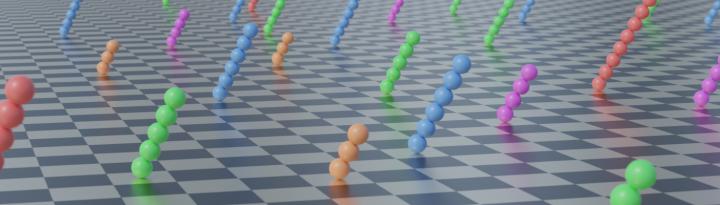
Physicists from Bayreuth develop basic principles for mini-laboratories on chips
IMAGE

Credit: Image: Adrian Ernst.

Colloidal particles have become increasingly important for research as vehicles of biochemical agents. In future, it will be possible to study their behaviour much more efficiently than before by placing them on a magnetised chip. A research team from the University of Bayreuth reports on these new findings in the journal Nature Communications. The scientists have discovered that colloidal rods can be moved on a chip quickly, precisely, and in different directions, almost like chess pieces. A pre-programmed magnetic field even enables these controlled movements to occur simultaneously.

For the recently published study, the research team, led by Prof. Dr. Thomas Fischer, Professor of Experimental Physics at the University of Bayreuth, worked closely with partners at the University of Poznán and the University of Kassel. To begin with, individual spherical colloidal particles constituted the building blocks for rods of different lengths. These particles were assembled in such a way as to allow the rods to move in different directions on a magnetised chip like upright chess figures – as if by magic, but in fact determined by the characteristics of the magnetic field.

In a further step, the scientists succeeded in eliciting individual movements in various directions simultaneously. The critical factor here was the “programming” of the magnetic field with the aid of a mathematical code, which in encrypted form, outlines all the movements to be performed by the figures. When these movements are carried out simultaneously, they take up to one tenth of the time needed if they are carried out one after the other like the moves on a chessboard.

“The simultaneity of differently directed movements makes research into colloidal particles and their dynamics much more efficient,” says Adrian Ernst, doctoral student in the Bayreuth research team and co-author of the publication. “Miniaturised laboratories on small chips measuring just a few centimetres in size are being used more and more in basic physics research to gain insights into the properties and dynamics of materials. Our new research results reinforce this trend. Because colloidal particles are in many cases very well suited as vehicles for active substances, our research results could be of particular benefit to biomedicine and biotechnology,” says Mahla Mirzaee-Kakhki, first author and Bayreuth doctoral student.

###

Media Contact
Prof. Dr. Thomas Fischer
[email protected]

Original Source

https://www.uni-bayreuth.de/en/university/press/press-releases/2020/124-colloidal-particles/index.html

Related Journal Article

http://dx.doi.org/10.1038/s41467-020-18467-9

Tags: Atomic/Molecular/Particle PhysicsBiochemistryChemistry/Physics/Materials SciencesMaterialsMolecular Physics
Share12Tweet8Share2ShareShareShare2

Related Posts

Han directs new $15M NIH center for organ-on-chip technology

Han directs new $15M NIH center for organ-on-chip technology

July 11, 2026
Bacteriophages Enable Next-Gen Smart Pathogen Detection Sensors

Bacteriophages Enable Next-Gen Smart Pathogen Detection Sensors

July 10, 2026

Temperature Fluctuations Have Greater Impact Than Previously Believed

July 10, 2026

New Study Uncovers Biology Behind Glioma Cancer Progression

July 10, 2026
Please login to join discussion

POPULAR NEWS

  • Detection of EDCs in Breast Milk and Infant Urine Up to Six Months Highlights Early Exposure Risks

    77 shares
    Share 31 Tweet 19
  • New Drug Candidate Developed at McMaster Shows Potential for Treating Brain Cancer

    58 shares
    Share 23 Tweet 15
  • KTU Researchers Explore Ultrasound’s Role in Enhancing Blood Flow Beyond Diagnostics

    53 shares
    Share 21 Tweet 13
  • 高齢者の骨粗鬆症治療の持続性比較

    51 shares
    Share 20 Tweet 13

About

We bring you the latest biotechnology news from best research centers and universities around the world. Check our website.

Follow us

Recent News

Nationwide Study Reveals Multimorbidity Factors in Older Chinese Adults

Clinicopathologic Study Reveals Amyloid Clearance in Alzheimer’s Disease

Long-Term Kidney Outcomes After Living Donation in Older Adults Explored

Subscribe to Blog via Email

Enter your email address to subscribe to this blog and receive notifications of new posts by email.

Join 85 other subscribers
  • Contact Us

Bioengineer.org © Copyright 2023 All Rights Reserved.

Welcome Back!

Login to your account below

Forgotten Password?

Retrieve your password

Please enter your username or email address to reset your password.

Log In
No Result
View All Result
  • Homepages
    • Home Page 1
    • Home Page 2
  • News
  • National
  • Business
  • Health
  • Lifestyle
  • Science

Bioengineer.org © Copyright 2023 All Rights Reserved.