The idea of creating a digital copy of the human brain has long belonged more to science fiction than to working biology. Now, a review published in Nature Reviews Electrical Engineering argues that digital twin brains could become a serious scientific and medical technology—but only if researchers stop defining success by the number of simulated neurons and begin measuring it by the quality of the data used to construct and update the model.
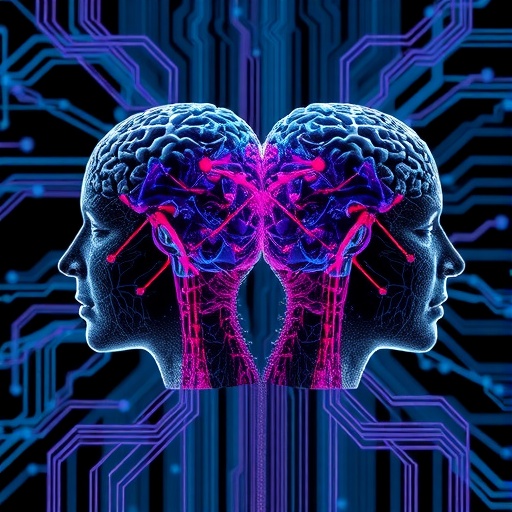
A digital twin brain, or DTB, is designed as an individualized computational counterpart of a living brain. Unlike a generic brain simulation, which attempts to reproduce broad principles of neural activity, a DTB is constrained by measurements from a particular person. These measurements may include brain anatomy, connectivity, electrical activity, blood flow, molecular signals, behavior and clinical records. The goal is not simply to build a large model, but to create a system whose structure and dynamics correspond to an identifiable biological brain.
The review by Zhang, Hou, Lu and colleagues presents a central limitation that could determine the future of the field: a digital twin can only be as detailed as the observations available to build and revise it. This creates what the authors describe as a measurement-defined emulation scale. At one level, a DTB might reproduce large-scale anatomy or activity patterns observed with magnetic resonance imaging. At a finer level, it could incorporate regional network dynamics, cellular populations or biochemical processes. Each increase in biological detail requires measurements with corresponding resolution, accuracy and temporal speed.
This distinction separates digital twin brains from several neighboring technologies. Whole-brain simulations generally seek to model brain-wide processes using mathematical descriptions of neural populations or networks. Neuromorphic systems use specialized hardware to reproduce aspects of neural computation with high efficiency. Predictive surrogate models, often powered by machine learning, can forecast brain signals or behavior without reproducing the underlying biology in detail. These approaches can be valuable, but the review argues that they typically capture selected properties rather than maintain a continuously updated representation of one living individual.
The most advanced DTBs today are therefore better understood as partial, simulation-based counterparts rather than complete digital replicas. A model may reconstruct a person’s brain structure from imaging data and reproduce certain patterns of activity through a network simulation. It may also estimate how the brain could respond to stimulation, disease progression or changes in connectivity. Yet such systems remain limited by incomplete observations, uncertain biological assumptions and the difficulty of connecting information collected across different technologies and timescales.
The technical challenge is enormous because brain data are fragmented by design. Structural scans provide relatively detailed anatomical information but usually offer limited insight into moment-to-moment neural signaling. Electroencephalography captures electrical activity with high temporal precision but comparatively poor spatial resolution. Functional imaging can reveal changing patterns of blood flow, while molecular and genetic measurements may expose biological mechanisms that unfold over much longer periods. Combining these data requires sophisticated data assimilation methods capable of aligning measurements that differ in scale, noise, timing and meaning.
A true digital twin would also need to update itself as the biological brain changes. Human brains are not static objects: learning alters circuits, disease can disrupt networks, medication can modify activity and aging gradually reshapes structure and function. Persistent updating would require reliable streams of new data, models that can distinguish meaningful change from measurement noise and algorithms able to revise their internal parameters without becoming unstable. At present, the review identifies continuous updating as a long-term objective rather than a routine capability.
Another frontier is closed-loop interaction. A clinically useful DTB might eventually receive data from a patient, predict brain states, test possible interventions in simulation and return recommendations or stimulation commands to the real brain. Such a system could support personalized treatment for neurological and psychiatric disorders by estimating how an individual might respond to medication, surgery or electrical stimulation. However, closed-loop operation introduces stringent requirements for validation, safety and interpretability. A prediction that is merely interesting in a laboratory becomes a serious risk if it directly influences medical care.
The authors also emphasize that embodiment remains beyond current DTB capabilities. A brain does not operate in isolation; it is continuously shaped by the body, sensory systems, movement, hormones and the surrounding environment. A digital model that reproduces neural signals while ignoring these interactions may fail to represent the conditions under which cognition and behavior emerge. Building a more complete twin would therefore require linking brain models to virtual or physical bodies, environmental inputs and behavioral feedback, creating an integrated system rather than a brain-only simulation.
The race toward biological-scale digital twins will consequently depend on more than faster computers or larger artificial intelligence models. Researchers will need shared standards for data representation, methods for validating models against independent observations and transparent procedures for quantifying uncertainty. Governance will be equally important because DTBs could contain deeply sensitive information about health, cognition and individual vulnerability. The review concludes that digital twin brains are emerging first as instruments for discovery and health care, while also offering a possible foundation for brain-inspired artificial intelligence. Their ultimate fidelity, however, will be determined not by how many neurons a computer claims to simulate, but by how accurately and responsibly science can measure, integrate and update the living brain.
Subject of Research: Individualized digital twin brains, brain simulation, neuroscience data integration and personalized computational models.
Article Title: Building digital twin brains at the limits of measurement
Article References: Zhang, R., Hou, Y., Lu, W. et al. “Building digital twin brains at the limits of measurement.” Nature Reviews Electrical Engineering (2026). https://doi.org/10.1038/s44287-026-00320-8
Image Credits: AI Generated
DOI: 10.1038/s44287-026-00320-8
Keywords: Digital twin brain, brain simulation, neuroscience, artificial intelligence, neurotechnology, personalized medicine, neuromorphic computing, brain imaging, neural data, computational neuroscience
Tags: brain connectivity and anatomy mappingchallenges in brain measurement accuracyclinical neural data integrationDigital twin brain developmentelectrical brain activity measurementfuture of brain digital twinsindividualized computational brain modelslimitations of neural data qualitymeasurement-based brain simulationmolecular brain signalsneurotechnology advancementspersonalized brain modeling