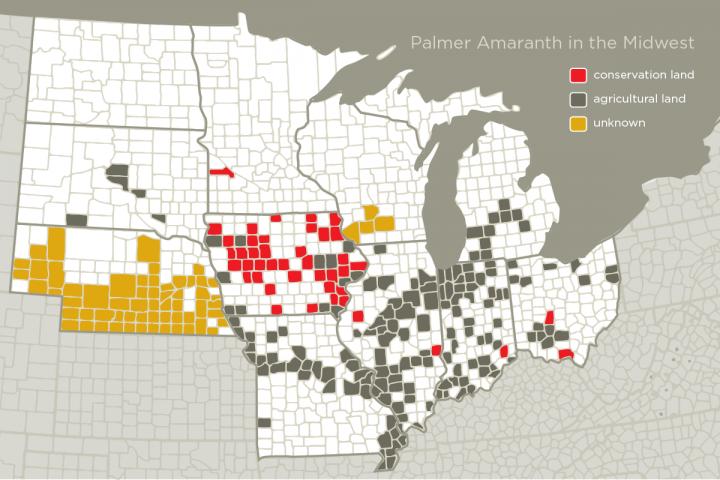
Credit: Graphic by Julie McMahon, University of Illinois
CHAMPAIGN, Ill. — Weed scientists in at least two Midwestern states have been reporting for years that a conservation program meant to provide habitat for pollinating insects is sowing bad seeds – including seeds of the potentially devastating agricultural weed Palmer amaranth – along with the good. Now, researchers at the University of Illinois have traced the weed seeds to at least one source: pollinator habitat seed sold by a company in the Midwest.
A tag on the seed mix claims it is 100 percent weed-free. The provider of the seed, whom the researchers declined to name, is one of dozens of companies that sells seed mixes used in the U.S. Department of Agriculture Pollinator Habitat Initiative and Conservation Reserve Program.
"We're not going to name the company because we don't think this is the only one distributing weed seeds in their pollinator seed," said U. of I. crop sciences professor Aaron Hager, who led the research at Illinois.
The USDA and the Farm Services Agency, which helps administer the program, do not license the seed companies or inspect the seed mixes farmers use in the pollinator program, said Yvonne Odom, the executive director of the Champaign County, Illinois FSA. They do review the seed tags, which are supposed to accurately represent the varieties and abundance of seeds in the mix and the presence or absence of weeds, she said.
The Illinois team germinated the seeds and grew the plants in a greenhouse to identify them. They found seeds of several species of the genus Amaranthus, including smooth pigweed, waterhemp and Palmer amaranth, a wildly prolific seed producer that grows up to 7 feet tall. Some Palmer amaranth populations are resistant to several groups of herbicides, Hager said.
Once established, herbicide-resistant Palmer amaranth is almost impossible to stop. Some cotton farmers in the South have discovered that it can ruin once-productive farmland in only a few years.
"There are a lot of scary stories about Palmer amaranth coming from the mid-South," Hager said. "It's hard to describe this species as anything less than potentially devastating. It's put people out of business before."
Herbicide resistance has become such a problem for farmers that reports of illegal herbicide use during the growing season to control resistant weeds are on the rise across the Midwest and South. At least one recent murder, in northeast Arkansas, was directly related to a farmer's illegal use of the herbicide dicamba to control resistant weeds.
So far, researchers have found Palmer amaranth growing in dozens of counties. At least 35 of 48 counties in Iowa with Palmer amaranth infestations, two in Illinois, two in Ohio and one in Indiana saw the problem first on conservation program lands. The University of Minnesota also recently identified its first occurrence of Palmer amaranth in Minnesota, on land enrolled in the pollinator habitat program. (See map.)
"These are just the ones that have been detected," Hager said.
Growers and extension educators need proactive guidance on how to prevent the newly introduced Palmer amaranth from moving onto agricultural land, Hager said.
"I don't know whether those enrolled in the pollinator habitat program are allowed the flexibility needed to control these populations," he said.
"We don't have any issues at all with the concept behind the pollinator habitat program; it's a good program," Hager said. "But as a result of this program, we've now introduced Palmer amaranth to potentially thousands of acres of land, and we need to know what we are going to be allowed to do to try to stem the spread of it. And we need to do that quickly."
Odom said participants in USDA conservation programs who suspect that they have weeds such as Palmer amaranth growing in their pollinator plots should call their local FSA administrator to report the problem and ask for guidance. She said restricted mowing and applications of herbicides will likely be recommended for such infestations.
###
Editor's note:
To reach Aaron Hager, call 217-333-9646; email [email protected].
Media Contact
Diana Yates
[email protected]
217-333-5802
@NewsAtIllinois
http://www.illinois.edu
############
Story Source: Materials provided by Scienmag