• HOME
  • NEWS
  • EXPLORE
    • CAREER
      • Companies
      • Jobs
    • EVENTS
    • iGEM
      • News
      • Team
    • PHOTOS
    • VIDEO
    • WIKI
  • BLOG
  • COMMUNITY
    • FACEBOOK
    • INSTAGRAM
    • TWITTER
Saturday, February 7, 2026
BIOENGINEER.ORG
No Result
View All Result
  • Login
  • HOME
  • NEWS
  • EXPLORE
    • CAREER
      • Companies
      • Jobs
        • Lecturer
        • PhD Studentship
        • Postdoc
        • Research Assistant
    • EVENTS
    • iGEM
      • News
      • Team
    • PHOTOS
    • VIDEO
    • WIKI
  • BLOG
  • COMMUNITY
    • FACEBOOK
    • INSTAGRAM
    • TWITTER
  • HOME
  • NEWS
  • EXPLORE
    • CAREER
      • Companies
      • Jobs
        • Lecturer
        • PhD Studentship
        • Postdoc
        • Research Assistant
    • EVENTS
    • iGEM
      • News
      • Team
    • PHOTOS
    • VIDEO
    • WIKI
  • BLOG
  • COMMUNITY
    • FACEBOOK
    • INSTAGRAM
    • TWITTER
No Result
View All Result
Bioengineer.org
No Result
View All Result
Home NEWS Science News Biology

Confronting colony collapse

Bioengineer by Bioengineer
October 3, 2019
in Biology
Reading Time: 3 mins read
0
IMAGE
Share on FacebookShare on TwitterShare on LinkedinShare on RedditShare on Telegram

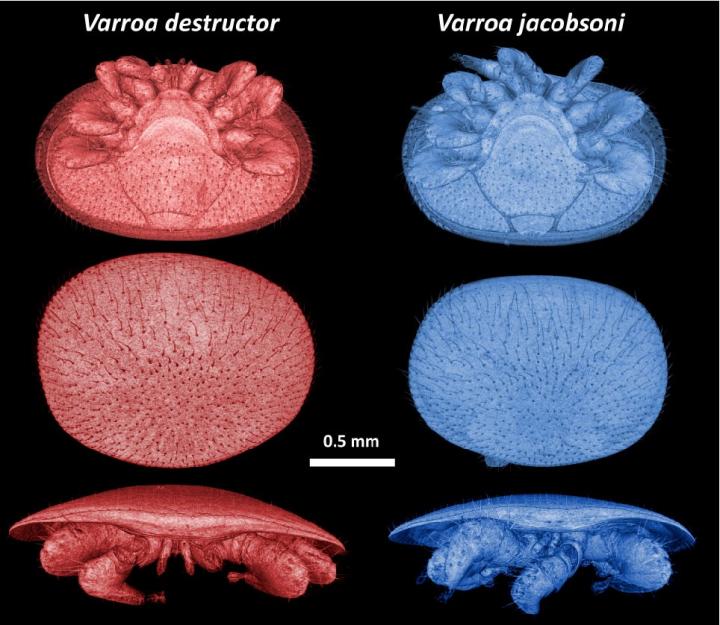
Scientists sequence the genomes of the parasitic mites harming the world’s bees
IMAGE

Credit: OIST

Honey bee colony collapse has devastating consequences for the environment, the global economy, and food security worldwide. The culprits behind some of the destruction – parasitic Varroa mites – are just a couple of millimeters in size, and they infiltrate colonies and infect bees with viruses. Yet surprisingly little is known about the mite’s biology.

Researchers from the Ecology and Evolution Unit at the Okinawa Institute of Science and Technology Graduate University (OIST) sequenced the genomes of the two Varroa mite species that parasitize the honey bee. They found that each species of mite used its own distinct strategy to survive in its bee host, potentially overwhelming the bees’ defenses. In addition to pointing to how scientists might vanquish these deadly intruders, the findings also shed light on how parasites and hosts evolve in response to one another.

The scientists’ findings, published in Communications Biology, represent an international effort by scientists in the United States and Australia, underscoring the global nature of the issue.

“When you look outside, every species you see has managed to survive infestation by parasites or diseases. Many organisms haven’t met the challenge and have gone extinct,” said Professor Alexander Mikheyev, the last author of the study. “We want to understand the coevolutionary interactions between mites and bees to save the honey bee from such a fate.”

The Evolution of a Parasite

Two distinct species of the Varroa mite parasitize domesticated honey bees. Originating in Asia, the mites originally targeted the eastern honey bee. As settlers transported bee colonies across the world throughout the 20th century, the mites spread to Europe, then to the Americas in the 1970s and 1980s, threatening western honey bee populations.

To better understand how the mites and bees co-evolved over time, Mikheyev, postdoctoral researcher Dr. Maeva Techer, and their collaborators sequenced the genomes of each of the two Varroa species, finding that they share 99.7% of their DNA and appear virtually indistinguishable.

Despite these similarities, genetic evidence indicated that the mite species followed separate evolutionary paths. These divergent strategies of adaptation may make it more difficult for the host species to develop a tolerance to multiple parasites at once.

“The implication is that if you’re trying to fight parasites, the methods that might work for one might not work for another due to differing mechanisms for adapting to the host,” said Mikheyev.

Mikheyev and Techer hope the sequenced genomes can help lay the foundation for species-specific interventions to address colony collapse, while also furthering scientific understanding of parasite evolution and adaptation.

“It’s important to consider that parasites are constantly evolving, and, in many ways, they have a greater potential to evolve than honeybees because they reproduce quickly,” Mikheyev said. “As we’re trying to fight these parasites, we have to remember that our target is always moving.”

###

Media Contact
Tomomi Okubo
[email protected]

Original Source

https://www.oist.jp/news-center/news/2019/10/1/confronting-colony-collapse

Tags: BiologyGenesGeneticsMolecular Biology
Share13Tweet8Share2ShareShareShare2

Related Posts

Florida Cane Toad: Complex Spread and Selective Evolution

Florida Cane Toad: Complex Spread and Selective Evolution

February 7, 2026
New Study Uncovers Mechanism Behind Burn Pit Particulate Matter–Induced Lung Inflammation

New Study Uncovers Mechanism Behind Burn Pit Particulate Matter–Induced Lung Inflammation

February 6, 2026

DeepBlastoid: Advancing Automated and Efficient Evaluation of Human Blastoids with Deep Learning

February 6, 2026

Navigating the Gut: The Role of Formic Acid in the Microbiome

February 6, 2026
Please login to join discussion

POPULAR NEWS

  • Robotic Ureteral Reconstruction: A Novel Approach

    Robotic Ureteral Reconstruction: A Novel Approach

    82 shares
    Share 33 Tweet 21
  • Digital Privacy: Health Data Control in Incarceration

    63 shares
    Share 25 Tweet 16
  • Study Reveals Lipid Accumulation in ME/CFS Cells

    57 shares
    Share 23 Tweet 14
  • Breakthrough in RNA Research Accelerates Medical Innovations Timeline

    53 shares
    Share 21 Tweet 13

About

We bring you the latest biotechnology news from best research centers and universities around the world. Check our website.

Follow us

Recent News

Phage-Antibiotic Combo Beats Resistant Peritoneal Infection

Boosting Remote Healthcare: Stepped-Wedge Trial Insights

Barriers and Boosters of Seniors’ Physical Activity in Karachi

Subscribe to Blog via Email

Enter your email address to subscribe to this blog and receive notifications of new posts by email.

Join 73 other subscribers
  • Contact Us

Bioengineer.org © Copyright 2023 All Rights Reserved.

Welcome Back!

Login to your account below

Forgotten Password?

Retrieve your password

Please enter your username or email address to reset your password.

Log In
No Result
View All Result
  • Homepages
    • Home Page 1
    • Home Page 2
  • News
  • National
  • Business
  • Health
  • Lifestyle
  • Science

Bioengineer.org © Copyright 2023 All Rights Reserved.