Scientists at Scripps Institution of Oceanography at UC San Diego used an unprecedented technique to detect that levels of helium are rising in the atmosphere, resolving an issue that has lingered among atmospheric chemists for decades.
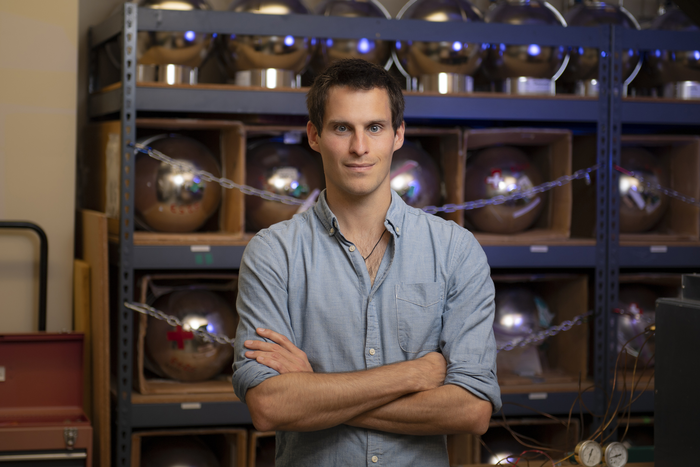
Credit: Erik Jepsen/UC San Diego
Scientists at Scripps Institution of Oceanography at UC San Diego used an unprecedented technique to detect that levels of helium are rising in the atmosphere, resolving an issue that has lingered among atmospheric chemists for decades.
The atmospheric abundance of the 4-helium (4He) isotope is rising because 4He is released during the burning and extraction of fossil fuels. The researchers report that it is increasing at a very small but, for the first time, clearly measurable rate. The 4He isotope itself does not add to the greenhouse effect that is making the planet warmer, but measures of it could serve as indirect markers of fossil-fuel use.
The National Science Foundation-supported study appears today in the journal Nature Geoscience.
“The main motivation was to resolve a longstanding controversy in the science community about atmospheric helium concentrations,” said study lead author Benni Birner, a former graduate student and now postdoctoral researcher at Scripps Institution of Oceanography at UC San Diego.
The isotope 4He is produced by radioactive decay in the Earth’s crust and accumulates in the same reservoirs as fossil fuels, in particular those of natural gas. During the extraction and combustion of fossil fuels, 4He is coincidentally released, which creates another means to evaluate the scale of industrial activity.
The study’s breakthrough is in the technique the Scripps Oceanography team used to measure how much helium is in the atmosphere. Birner and Scripps geoscientists Jeff Severinghaus, Bill Paplawsky, and Ralph Keeling created a precise method to compare the 4He isotope to levels of the common atmospheric gas nitrogen. Because nitrogen levels in the atmosphere are constant, an increase in He/N2 is indicative of the rate of 4He buildup in the atmosphere.
Study co-author and Scripps Oceanography geochemist Ralph Keeling, overseer of the famed carbon dioxide measurement known as the Keeling Curve, describes the study as a “masterpiece of fundamental geochemistry.” Though helium is relatively easy for scientists to detect in air samples, present at levels of five parts per million of air, no one had done the work to measure it carefully enough to observe an atmospheric increase, he said.
The study also provides a foundation for scientists to better understand the valuable 3-helium (3He) isotope, which has uses for nuclear fusion, cryogenics, and other applications. Proposals to acquire the scarce gas from the moon are an indication of the lengths to which manufacturers will go to harvest it.
According to previous work by other researchers, the 4He isotope exists in the atmosphere in what appears to be an unvarying ratio with 3He. The atmospheric rise of 4He isotope measured at Scripps therefore implies that the 3He isotope must be rising at a comparable rate as 4He. The research by Birner’s team raises several questions about the accuracy of scientists’ previous assumptions about how 3He is produced and in what quantity.
“We don’t know for sure, but I wonder if there is more 3He coming out of the Earth than we previously thought, which could perhaps be harvested and fuel our nuclear fusion reactors in the future,” Birner said.
“The study lays in starker relief a controversy surrounding the rare helium isotope 3He,” said Keeling. “The implications are far from clear, but it begs additional work.”
Journal
Nature Geoscience
DOI
10.1038/s41561-022-00932-3
Method of Research
Observational study
Subject of Research
Not applicable
Article Title
Increasing atmospheric helium due to fossil fuel exploitation
Article Publication Date
9-May-2022
COI Statement
None