• HOME
  • NEWS
  • EXPLORE
    • CAREER
      • Companies
      • Jobs
    • EVENTS
    • iGEM
      • News
      • Team
    • PHOTOS
    • VIDEO
    • WIKI
  • BLOG
  • COMMUNITY
    • FACEBOOK
    • INSTAGRAM
    • TWITTER
Wednesday, October 7, 2026
BIOENGINEER.ORG
No Result
View All Result
  • Login
  • HOME
  • NEWS
  • EXPLORE
    • CAREER
      • Companies
      • Jobs
        • Lecturer
        • PhD Studentship
        • Postdoc
        • Research Assistant
    • EVENTS
    • iGEM
      • News
      • Team
    • PHOTOS
    • VIDEO
    • WIKI
  • BLOG
  • COMMUNITY
    • FACEBOOK
    • INSTAGRAM
    • TWITTER
  • HOME
  • NEWS
  • EXPLORE
    • CAREER
      • Companies
      • Jobs
        • Lecturer
        • PhD Studentship
        • Postdoc
        • Research Assistant
    • EVENTS
    • iGEM
      • News
      • Team
    • PHOTOS
    • VIDEO
    • WIKI
  • BLOG
  • COMMUNITY
    • FACEBOOK
    • INSTAGRAM
    • TWITTER
No Result
View All Result
Bioengineer.org
No Result
View All Result
Home NEWS Science News Chemistry

Condensed matter: Bethe strings experimentally observed

Bioengineer by Bioengineer
April 6, 2020
in Chemistry
Reading Time: 2 mins read
0
IMAGE
Share on FacebookShare on TwitterShare on LinkedinShare on RedditShare on Telegram

Long-standing prediction of quantum physics now proven
IMAGE

Credit: HZB

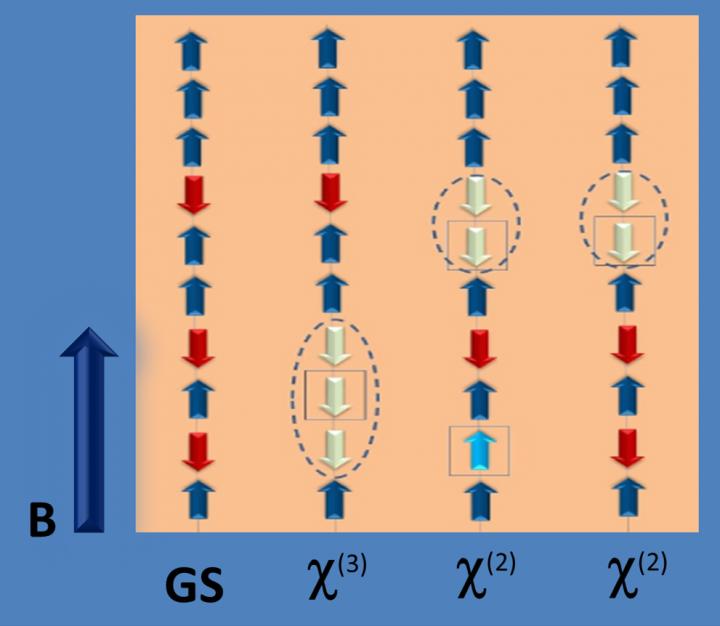
The regular arrangement of atoms in a crystal allows complex interactions that can lead to new states of matter. Some crystals have magnetic interactions in only one dimension, i.e. are they magnetically one-dimensional. If, in addition, successive magnetic moments are pointing in opposite directions , then we are dealing with a one-dimensional antiferromagnet. Hans Bethe first described this system theoretically in 1931, predicting also the presence of excitations of strings of two or more consecutive moments pointing in one direction, so called Bethe strings.

However those string states could not be observed under normal experimental conditions because they are unstable and obscured by the other features of the system. The trick used in this paper is to isolate the strings by applying a magnetic field.

Now an international cooperation around the HZB physicist Bella Lake and her colleague Anup Bera was able to experimentally identify and characterise Bethe strings in a real solid for the first time. The team made crystals of SrCo2V2O8, which is a model system one-dimensional antiferromagnnet. Only the cobalt atoms have magnetic moments, they all are aligned along one direction and adjacent moments cancel each other out.

At the Berlin neutron source BER II it was possible to investigate the sample with neutrons under extremely high magnetic fields up to 25.9 Tesla. From the data, the physicists obtained a phase diagram of the sample as a function of the magnetic field, and also further information about the internal magnetic patterns, which could be compared with the idea of Bethe that were quantified by a theoretical group led by Jianda Wu.

“The experimental data are in excellent agreement with the theory,” says Prof. Bella Lake. “We were able to clearly identify two and even three chains of Bethe strings and determine their energy dependence. These results show us once again how fantastically well quantum physics works.”

###

Media Contact
Antonia Roetger
[email protected]

Original Source

https://www.helmholtz-berlin.de/bin/news_seite?nid=21228;sprache=en;intern=1

Related Journal Article

http://dx.doi.org/10.1038/s41567-020-0835-7

Tags: Atomic PhysicsAtomic/Molecular/Particle PhysicsChemistry/Physics/Materials SciencesMaterials
Share12Tweet8Share2ShareShareShare2

Related Posts

Peel and Pulp Decisions Reshape Kiwi Wine Flavor and Methanol Risk

Peel and Pulp Decisions Reshape Kiwi Wine Flavor and Methanol Risk

October 7, 2026
Silver Particles on Graphite: A Cleaner Route to Model Catalysts for Ethylene Epoxidation

Silver Particles on Graphite: A Cleaner Route to Model Catalysts for Ethylene Epoxidation

October 7, 2026

Iron-Modified Nanotube Electrode Strips Persistent Pollutant from Water in Two Hours

October 7, 2026

Sugar-and-Silica Hybrid Material Strips Cholesterol From Fish Oil While Saving Omega-3s

October 7, 2026
Please login to join discussion

POPULAR NEWS

  • Alloys That Shrink Their Own Grains: New PIX Mechanism Refines Metals With Heat Alone

    Alloys That Shrink Their Own Grains: New PIX Mechanism Refines Metals With Heat Alone

    29 shares
    Share 12 Tweet 7
  • Endurance Exercise Reshapes the Liver in Males and Females Through Distinct Molecular Routes

    29 shares
    Share 12 Tweet 7
  • Single Transcription Factor PU.1 Rapidly Converts Fibroblasts into Macrophage-Lineage Cells

    29 shares
    Share 12 Tweet 7
  • New Scale Measures How Ready Nurse Educators Really Are for the AI Era

    29 shares
    Share 12 Tweet 7

About

We bring you the latest biotechnology news from best research centers and universities around the world. Check our website.

Follow us

Recent News

Alloys That Shrink Their Own Grains: New PIX Mechanism Refines Metals With Heat Alone

Endurance Exercise Reshapes the Liver in Males and Females Through Distinct Molecular Routes

Single Transcription Factor PU.1 Rapidly Converts Fibroblasts into Macrophage-Lineage Cells

Subscribe to Blog via Email

Success! An email was just sent to confirm your subscription. Please find the email now and click 'Confirm' to start subscribing.

Join 85 other subscribers
  • Contact Us

Bioengineer.org © Copyright 2023 All Rights Reserved.

Welcome Back!

Login to your account below

Forgotten Password?

Retrieve your password

Please enter your username or email address to reset your password.

Log In
No Result
View All Result
  • Homepages
    • Home Page 1
    • Home Page 2
  • News
  • National
  • Business
  • Health
  • Lifestyle
  • Science

Bioengineer.org © Copyright 2023 All Rights Reserved.