Automated video tracking of laying hens fitted with individual visual markers has revealed that recurring piling behaviour carries significant genetic variance, establishing for the first time that a hen’s propensity to crowd into dense clusters is a heritable trait. Recurring piling occurs when birds gather in tightly packed groups in commercial-style housing, leading to problems such as heat stress, physical injuries, diminished egg production, and occasionally fatal smothering. While commercial egg operations have increasingly shifted toward non-cage aviary environments following animal welfare regulations, flock managers have struggled to address sudden or gradual crowding behaviours through conventional management changes. The new investigation, led by researchers evaluating crossbred commercial flocks, demonstrated that individual birds display consistent behavioral tendencies to join these gatherings, providing a biological foundation for selective breeding strategies aimed at reducing piling in large group facilities.
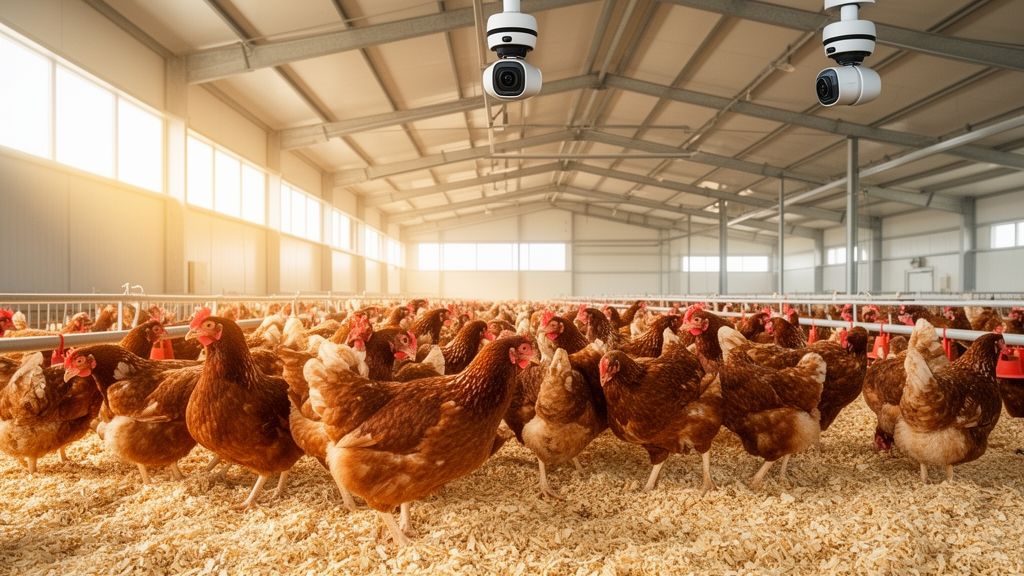
The study tracked 1,441 genotyped Dekalb White laying hens housed at 40 weeks of age across 12 pens within a single barn facility. The population comprised three-way crossbred hens produced by inseminating maternal crossbred lines with pooled semen from pureline sires, reflecting standard industrial layer stock. Each pen measured 195 centimeters by 203 centimeters and was structured into three distinct vertical levels, including a ground litter area, a nesting area, and an elevated perching zone accessed via a ramp. Birds were housed at a stocking density of approximately 13 birds per square meter under a 16-hour light and 8-hour dark schedule at approximately 20 degrees Celsius. To distinguish individual animals within crowded groups, the researchers fitted each hen at 36 weeks of age with an ergonomic backpack bearing a unique two-dimensional ArUco marker from an OpenCV visual dictionary, linking each optical identifier directly to the bird’s logged wing-tag number and genotype profile.
Continuous daytime video recordings were captured over nine consecutive days by surveillance cameras positioned directly above the litter zone of each pen, collecting roughly 11 hours of footage per pen each day at a resolution of 2304 by 1296 pixels. To locate and parse crowding dynamics, the researchers deployed custom computer vision algorithms that detected piling events, defined as gatherings of at least five hens physically converging in sustained contact, climbing over one another, compressing against pen perimeters, or forming immobile masses. Whenever the software identified an event, it automatically segmented the footage from one minute prior to formation until complete dissolution and overlaid detected ArUco marker identifiers. Observers then recorded up to the first 20 participating birds in exact chronological order of entry to the nearest millisecond, establishing precise individual sequences across 115 separate piling events.
Across the observation period, piling activity proved highly heterogeneous and strongly clustered across specific pens, days, and hours. One pen recorded the highest aggregated volume of events, heavily concentrated in the late afternoon of a single observation day, whereas another pen exhibited steady daily activity specifically between 14:00 and 17:00, with an overall peak observed facility-wide around 16:00. These temporal peaks coincided with known diurnal rhythms in domestic laying hens, such as increased afternoon mobility, foraging, and pre-roosting social interaction. Approximately 51 percent of monitored hens never joined any annotated piling event over the nine days, while 34 percent joined one or two events, 11 percent participated in three to five, 3 percent joined six to ten, and only two individual birds joined more than ten events, reaching a recorded maximum of 13 participations.
To evaluate the genetic architecture of the behaviour, researchers defined three distinct phenotypic traits from the computer vision annotations. The first was One Score per Individual, a binary measure scoring whether an individual participated in at least one piling event across the entire trial. The second was One Score per Event, a repeated binary observation scoring whether an individual present in a pen joined a specific piling event that occurred in that pen. The third measure was Rank Score per Event, a continuous variable bounded between zero and one that captured an individual’s joining order relative to the maximum annotated pile size, assigning the highest score of one to the pile initiator and fractional values to subsequent arrivals. Genotypic relationships were established through a genomic relationship matrix constructed from 44,813 autosomal single nucleotide polymorphisms following stringent quality-control filtering of a commercial 60,000-marker layer beadchip.
Quantitative analysis using univariate animal threshold models and linear mixed models confirmed that all three defined traits possessed statistically significant additive genetic variance. On the observed measurement scale, heritability estimates were 0.11 for the overall binary participation trait, 0.05 for event-specific binary participation, and 0.05 for the continuous joining-order rank score. Ninety-nine percent confidence intervals confirmed that heritability estimates across all traits remained significantly above zero, demonstrating that genetic divergence among hens contributes measurably to their crowding tendencies. For the event-specific and rank traits, permanent environmental effects accounted for substantial phenotypic variance, exceeding additive genetic variance in the rank score model and indicating that persistent non-genetic individual factors also shape joining sequence.
Cross-validation analyses evaluating genomic prediction accuracy were conducted using a leave-one-pen-out scheme, wherein phenotypes from individual pens were sequentially masked and predicted from genomic breeding values derived from the remaining pens. Cross-validation accuracies for masked animals ranged from 0.27 to 0.44 across the evaluated models. Dispersion analyses showed that the regression coefficients of masked phenotypes on estimated breeding values had confidence intervals enclosing one, verifying that the genomic predictions were neither systematically inflated nor underdispersed. When evaluating pairwise trait predictions, models utilizing event-level binary participation data to predict an individual’s overall propensity to pile yielded an accuracy of 0.49, exceeding the within-trait predictive accuracy of the overall metric alone.
Between-trait genetic correlations estimated from bidirectional cross-validation accuracies approached unity, with point estimates exceeding 0.99 across all comparisons due to sampling variance. These strong correlations demonstrate that the general tendency to join piles, the probability of joining any single local event, and the speed of joining share an almost entirely overlapping genetic foundation. Simulation studies examining 100 replicates confirmed that the mixed model frameworks recovered known true genetic parameters with minimal bias, showing modest deviations of 10 to 14 percent between simulated parameters and threshold model outputs.
Based on the breeder’s equation, selecting against the lowest 10 percent of genomic breeding values for piling propensity yielded substantial predicted reductions in trait expression. For overall individual participation, selection was predicted to lower population prevalence from 48.7 percent to 38.6 percent, reflecting a relative reduction of 21 percent. For per-event participation, selecting against the bottom decile shifted predicted prevalence from 11.8 percent down to 6.8 percent, achieving a relative decrease of 42 percent, while the mean rank score decreased by 33 percent. These calculated response magnitudes suggest that commercial breeding programs could effectively select against piling by recording event-level binary participation in tracking-enabled test pens.
The authors noted several important constraints and methodological boundaries in their experimental setup. Stocking density was maintained at 13 birds per square meter to encourage social interaction, exceeding the European Union commercial maximum of 9 birds per square meter, though piling mechanisms in varied densities remain uncharacterized. Additionally, manual tracking limits restricted annotations to the first 20 hens per event, meaning participants entering later were recorded as non-participants and likely adding observational noise that conservative models had to absorb. The researchers emphasized that while genomic selection against piling offers a viable path to improve animal welfare and mitigate injury or smothering, future breeding applications must investigate social genetic interactions among pen mates and evaluate potential genetic correlations with production and other welfare traits to avoid inadvertent commercial trade-offs.
Subject of Research: Genomic parameters and automated tracking of piling behaviour in commercial laying hens
Article Title: Genetic parameters and genomic prediction accuracy for piling behaviour using individual-level computer-vision data from ArUco-marked laying hens
Article References: Osorio-Gallardo, T., van Putten, A., Janssen, D., Annene, C. K., Rodenburg, T. B., & Bijma, P. (2026). Genetic parameters and genomic prediction accuracy for piling behaviour using individual-level computer-vision data from ArUco-marked laying hens. Genetics Selection Evolution, 58(1), Article 89. https://doi.org/10.1186/s12711-026-01109-x
Image Credits: AI Generated
DOI: 10.1186/s12711-026-01109-x
Keywords: laying hens, piling behaviour, smothering, heritability, genomic prediction, computer vision, ArUco markers, animal welfare, Dekalb White, threshold model, linear mixed model, breeding values, quantitative genetics, stocking density, aviary housing, crossbred layers
News Source: Scienmag.