• HOME
  • NEWS
  • EXPLORE
    • CAREER
      • Companies
      • Jobs
    • EVENTS
    • iGEM
      • News
      • Team
    • PHOTOS
    • VIDEO
    • WIKI
  • BLOG
  • COMMUNITY
    • FACEBOOK
    • INSTAGRAM
    • TWITTER
Friday, May 15, 2026
BIOENGINEER.ORG
No Result
View All Result
  • Login
  • HOME
  • NEWS
  • EXPLORE
    • CAREER
      • Companies
      • Jobs
        • Lecturer
        • PhD Studentship
        • Postdoc
        • Research Assistant
    • EVENTS
    • iGEM
      • News
      • Team
    • PHOTOS
    • VIDEO
    • WIKI
  • BLOG
  • COMMUNITY
    • FACEBOOK
    • INSTAGRAM
    • TWITTER
  • HOME
  • NEWS
  • EXPLORE
    • CAREER
      • Companies
      • Jobs
        • Lecturer
        • PhD Studentship
        • Postdoc
        • Research Assistant
    • EVENTS
    • iGEM
      • News
      • Team
    • PHOTOS
    • VIDEO
    • WIKI
  • BLOG
  • COMMUNITY
    • FACEBOOK
    • INSTAGRAM
    • TWITTER
No Result
View All Result
Bioengineer.org
No Result
View All Result
Home NEWS Science News Chemistry

Composing new proteins with artificial intelligence

Bioengineer by Bioengineer
March 17, 2020
in Chemistry
Reading Time: 3 mins read
0
IMAGE
Share on FacebookShare on TwitterShare on LinkedinShare on RedditShare on Telegram

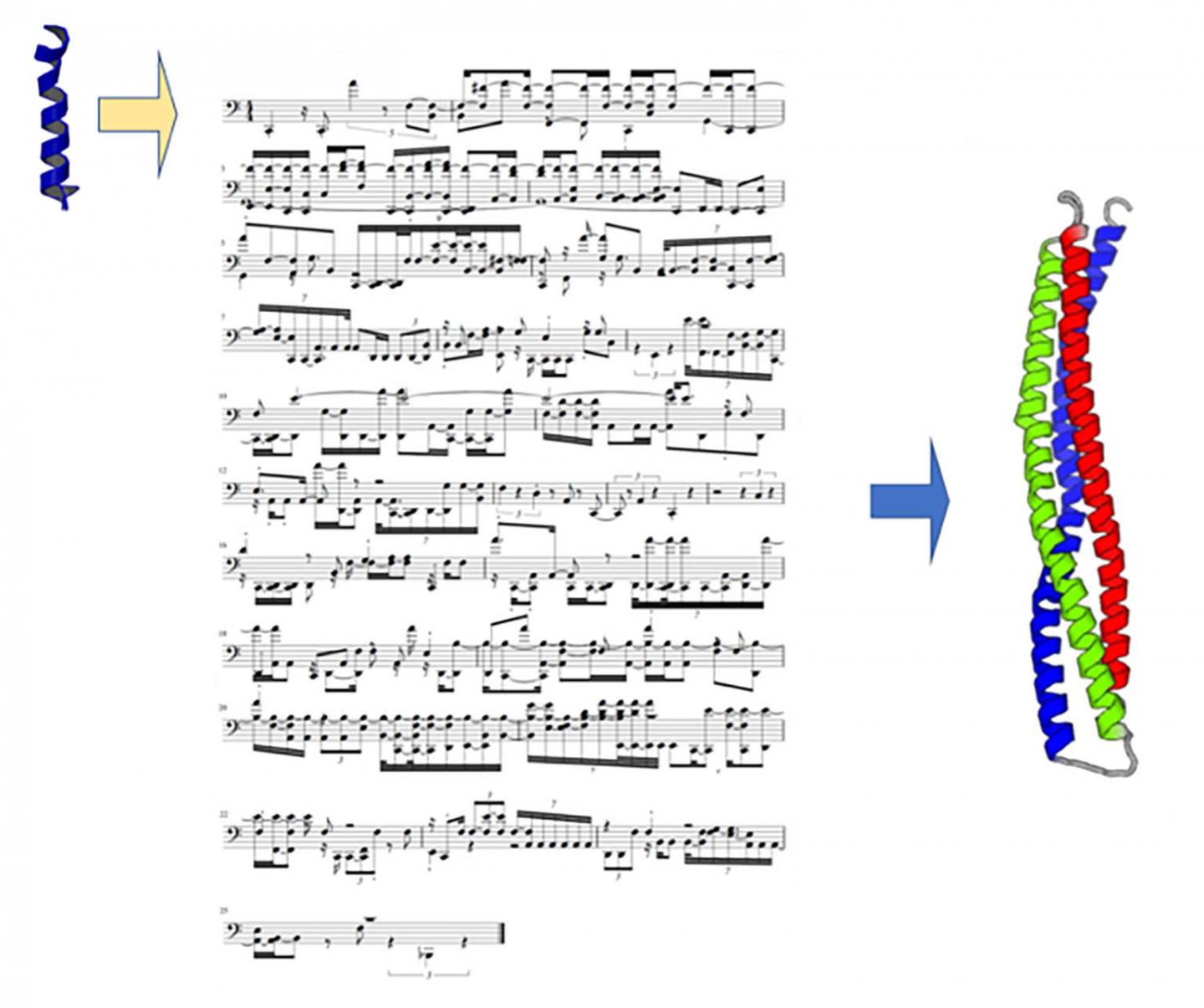
Using machine learning to create new proteins by translating proteins into musical scores
IMAGE

Credit: Markus J. Buehler


WASHINGTON, March 17, 2020 — Proteins are the building blocks of life, and consequently, scientists have long studied how they can improve proteins and design completely new proteins that perform new functions and processes.

Traditionally, new proteins are created by either mimicking existing proteins or manually editing the amino acids that make up the proteins. This process, however, is time-consuming, and it is difficult to predict the impact of changing any one of the amino acid components of a given protein.

In this week’s APL Bioengineering, from AIP Publishing, researchers in the United States and Taiwan explore how to create new proteins by using machine learning to translate protein structures into musical scores, presenting an unusual way to translate physics concepts across disparate domains.

Each of the 20 amino acids that make up proteins has a unique vibrational frequency. The chemical structure of entire proteins can consequently be mapped with audible representations, using known concepts from music theory like note volume, melody, chords and rhythm. The specific sounds generated, determined by the way a protein folds, can be used to train deep learning neural networks.

“These networks learn to understand the complex language folded proteins speak at multiple time scales,” said Markus J. Buehler, from the Massachusetts Institute of Technology. “And once the computer has been given a seed of a sequence, it can extrapolate and design entirely new proteins by improvising from this initial idea, while considering various levels of musical variations — controlled through a temperature parameter — during the generation.”

The team compared the new proteins against a large database with information about all known proteins and used molecular dynamics equilibration and characterization by using a normal mode analysis. Through these steps, the researchers demonstrated the method could design proteins that nature had not yet invented. The new proteins appear to be stable, folded designs, and scientists created an algorithm to materialize music from sound waves to matter.

“This paves the way for making entirely new biomaterials,” said Buehler. “Or perhaps you find an enzyme in nature and want to improve how it catalyzes or come up with new variations of proteins altogether.”

By adjusting the temperature, the number of variations the algorithm creates can be increased. The new mutations can be measured to see which are most effective as enzymes, for example.

The “protein music” (https://soundcloud.com/user-275864738) the researchers uncovered could also help create new compositional techniques in classical music by illuminating the rhythms and tones of proteins, a method Buehler refers to as materiomusic.

“In the evolution of proteins over thousands of years, nature also gives us new ideas for how sounds be combined and merged,” said Buehler.

###

The article, “Sonification based de novo protein design using artificial intelligence, structure prediction and analysis using molecular modeling,” is authored by Markus J. Buehler and Chi Hua Yu. The article will appear in APL Bioengineering on March 17, 2020 (DOI: 10.1063/1.5133026) After that date, it can be accessed at https://aip.scitation.org/doi/10.1063/1.5133026.

ABOUT THE JOURNAL

APL Bioengineering is an open access journal publishing significant discoveries specific to the understanding and advancement of physics and engineering of biological systems. See http://aip.scitation.org/journal/apb.

Media Contact
Larry Frum
[email protected]
301-209-3090

Related Journal Article

http://dx.doi.org/10.1063/1.5133026

Tags: BiologyBiomechanics/BiophysicsCell BiologyChemistry/Physics/Materials SciencesMolecular BiologyMolecular PhysicsRobotry/Artificial IntelligenceTechnology/Engineering/Computer Science
Share12Tweet8Share2ShareShareShare2

Related Posts

Scientists Overcome Longstanding Challenge in Measuring Semiconductor Defects — Chemistry

Scientists Overcome Longstanding Challenge in Measuring Semiconductor Defects

May 14, 2026
Wall Design Highlights Deaf and Hard-of-Hearing Experience at #ASA190 — Chemistry

Wall Design Highlights Deaf and Hard-of-Hearing Experience at #ASA190

May 14, 2026

New Method Finds More Efficient Route Between Earth and Moon Than Ever Before

May 14, 2026

Unveiling the Unseen: Exploring the Boundaries of Two-Photon Vision

May 14, 2026
Please login to join discussion

POPULAR NEWS

  • Research Indicates Potential Connection Between Prenatal Medication Exposure and Elevated Autism Risk

    842 shares
    Share 337 Tweet 211
  • New Study Reveals Plants Can Detect the Sound of Rain

    729 shares
    Share 291 Tweet 182
  • Salmonella Haem Blocks Macrophages, Boosts Infection

    62 shares
    Share 25 Tweet 16
  • Breastmilk Balances E. coli and Beneficial Bacteria in Infant Gut Microbiomes

    58 shares
    Share 23 Tweet 15

About

We bring you the latest biotechnology news from best research centers and universities around the world. Check our website.

Follow us

Recent News

Comprehensive Study Finds No Clear Association Between Common Antidepressant Use During Pregnancy and Autism or ADHD in Children

Viagra Shows Promise as Potential Treatment to Halt Peyronie’s Disease

Screening Leads to Moderate Reduction in Prostate Cancer Mortality

Subscribe to Blog via Email

Enter your email address to subscribe to this blog and receive notifications of new posts by email.

Join 82 other subscribers
  • Contact Us

Bioengineer.org © Copyright 2023 All Rights Reserved.

Welcome Back!

Login to your account below

Forgotten Password?

Retrieve your password

Please enter your username or email address to reset your password.

Log In
No Result
View All Result
  • Homepages
    • Home Page 1
    • Home Page 2
  • News
  • National
  • Business
  • Health
  • Lifestyle
  • Science

Bioengineer.org © Copyright 2023 All Rights Reserved.