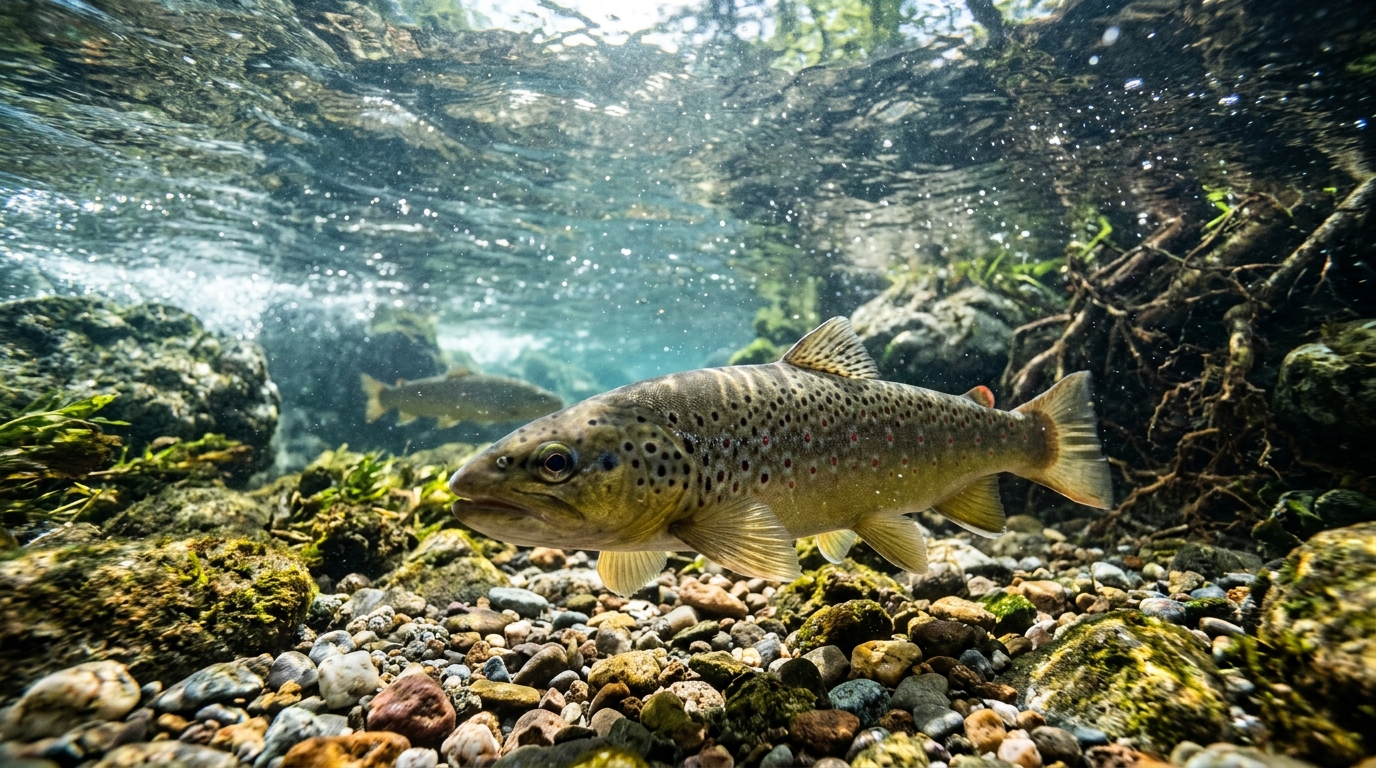
A new study of brook trout in Michigan’s Upper Peninsula shows that the presence of introduced rainbow trout reshapes the population’s dietary niche, suppresses the individuals that normally expand it, and leaves those that do push into new dietary territory paying a measurable physiological price.
The research team, led by scientists studying two connected stream systems, compared a brook trout population living alongside rainbow trout in the Salmon-Trout River with a brook trout population living alone in Obenhoff Creek, a tributary inhabited solely by brook trout. Brook and rainbow trout have co-occurred in the Salmon-Trout River since the 1930s with no fish stocking since the 1960s, allowing researchers to evaluate whether the presence of a non-native competitor alters how individuals within a population partition resources.
To track resource use, the researchers relied on fatty acid analysis of blood samples. Fatty acids are powerful biochemical tracers because many are assimilated with limited modification and reflect basal resource pathways and trophic interactions. Specific compounds carry ecological meaning: eicosapentaenoic acid, or EPA, is commonly associated with aquatic-derived energy pathways in stream food webs, while omega-6 fatty acids and C18 precursors such as alpha-linolenic acid and linoleic acid are frequently linked to terrestrial riparian inputs. Blood fatty acids in particular integrate diet over a short window of roughly two to three weeks, giving researchers a temporally integrated snapshot of what each fish had been eating.
Between May and September of 2023 through 2025, the team collected fish monthly using backpack electrofishing. Individuals longer than 110 millimeters were anesthetized, measured for total length and body mass, implanted with PIT tags, and sampled for whole blood drawn from the caudal vein before being released. Only brook trout with at least three blood draws were included in the analysis, yielding 47 individuals—26 from the allopatric stream and 21 from the sympatric one—representing 176 total sampling events, with each fish sampled between three and eight times.
The central concept in the study is the keystone niche individual, or KNI: an individual whose resource use exerts a disproportionate influence on population niche width, not merely because it eats a wide variety of things, but because of where it sits within the population’s niche space. The researchers quantified each fish’s contribution by estimating population niche width with all individuals present and then recalculating it after removing that individual. A positive change means the fish’s presence expands the population niche; a negative change means it constrains it. Individuals producing the largest reductions upon removal were interpreted as the strongest candidates for keystone niche individuals.
The results revealed a striking contrast between the two systems. The sympatric population, living with rainbow trout, had a larger overall population niche width—0.95 compared with 0.70 in the allopatric population—but this difference was driven almost entirely by greater within-individual variance, meaning individual fish were generalizing more broadly rather than diverging from one another. Between-individual variance, the component that reflects true dietary differentiation among population members, was only slightly higher in sympatry and its credible intervals overlapped substantially with the allopatric estimate. In other words, the population got bigger in dietary space, but its members became more similar to each other, not less.
Individual contributions to population niche width told the same story from a different angle. In the allopatric stream, 9 of 26 individuals—34.6 percent—had positive contributions, meaning they expanded the population niche, and the maximum individual contribution reached 4.87 percent. In the sympatric stream, only 2 of 21 individuals—9.5 percent—were above zero, and the highest value was a mere 0.20 percent. The mean contribution in sympatry was significantly more negative than in allopatry. The researchers did not detect discrete keystone niche individuals in the sympatric population; instead, most individuals constrained the population niche, suggesting a continuum of influence rather than a handful of outsized players.
What predicted an individual’s influence also differed between systems. In allopatry, the strongest predictor of contribution was niche position—how far an individual’s niche centroid sat from the population centroid. In sympatry, both niche breadth and niche position mattered, with broader niches associated with lower contributions. Across both populations, individuals contributing most to population niche width showed reduced overlap with competitors, and the relationship between proportional similarity and contribution was strong in allopatry and weaker but still present in sympatry. This suggests that niche differentiation, whether from conspecifics or the non-native competitor, is what allows certain individuals to expand the population’s dietary footprint.
The energetic cost emerged clearly in the fatty acid and condition data. In both streams, individuals enriched in saturated and monounsaturated fatty acids contributed more to population niche width, while those enriched in polyunsaturated fatty acids—including EPA, DHA, and their precursors—contributed less. Body condition told a context-dependent story: in allopatry, higher condition factor was associated with reduced individual contribution to population niche width, whereas in sympatry there was no detectable relationship. The authors interpret this as evidence that individuals expanding the population niche do so at a cost, consistent with optimal foraging theory, which predicts that deviation from an optimal resource range results in lower energetic efficiency. Reduced levels of essential fatty acids are known to carry fitness consequences, including decreased growth rates, reproductive capacity, and cognitive performance.
The study’s implications extend beyond trout. Keystone niche individuals have been proposed as a mechanism by which individual variation scales up to population resilience, and their loss could reduce the range of phenotypes available for niche expansion under environmental change. The finding that competitive pressure can suppress their emergence—or push them into a diffuse gradient rather than discrete roles—suggests that the adaptive capacity of populations facing invasive competitors may be more constrained than previously appreciated. The authors note that experimental manipulation of competitor density would help clarify these context-dependent dynamics, and that additional niche axes such as prey size and spatial resource use could reveal further dimensions of individual specialization not captured by fatty acid profiles alone. For now, the message is clear: who eats what within a population is not just a matter of individual preference, but a structured outcome of who else is at the table—and the price of being different is written in the blood.
Subject of Research: How interspecific competition reshapes individual dietary niches and the energetic cost of niche expansion in brook trout populations
Article Title: Interspecific Interactions Constrain Individual Niche Divergence and Reveal Energetic Cost of Niche Expansion
Article References: Roose, H. C., Junker, J. R., & Olin, J. A. (2026). Interspecific Interactions Constrain Individual Niche Divergence and Reveal Energetic Cost of Niche Expansion. Ecology and Evolution, 16(11), Article e74619. https://doi.org/10.1002/ece3.74619
Image Credits: AI Generated
DOI: 10.1002/ece3.74619
Keywords: brook trout, rainbow trout, keystone niche individuals, population niche width, fatty acid analysis, individual specialization, interspecific competition, dietary niche, body condition, Michigan streams, ecological niche, invasive species
News Source: Drew Townsend. (November 6, 2026). Competitor Presence Reshapes Trout Diets and Makes Niche Expansion Energetically Costly. Scienmag.