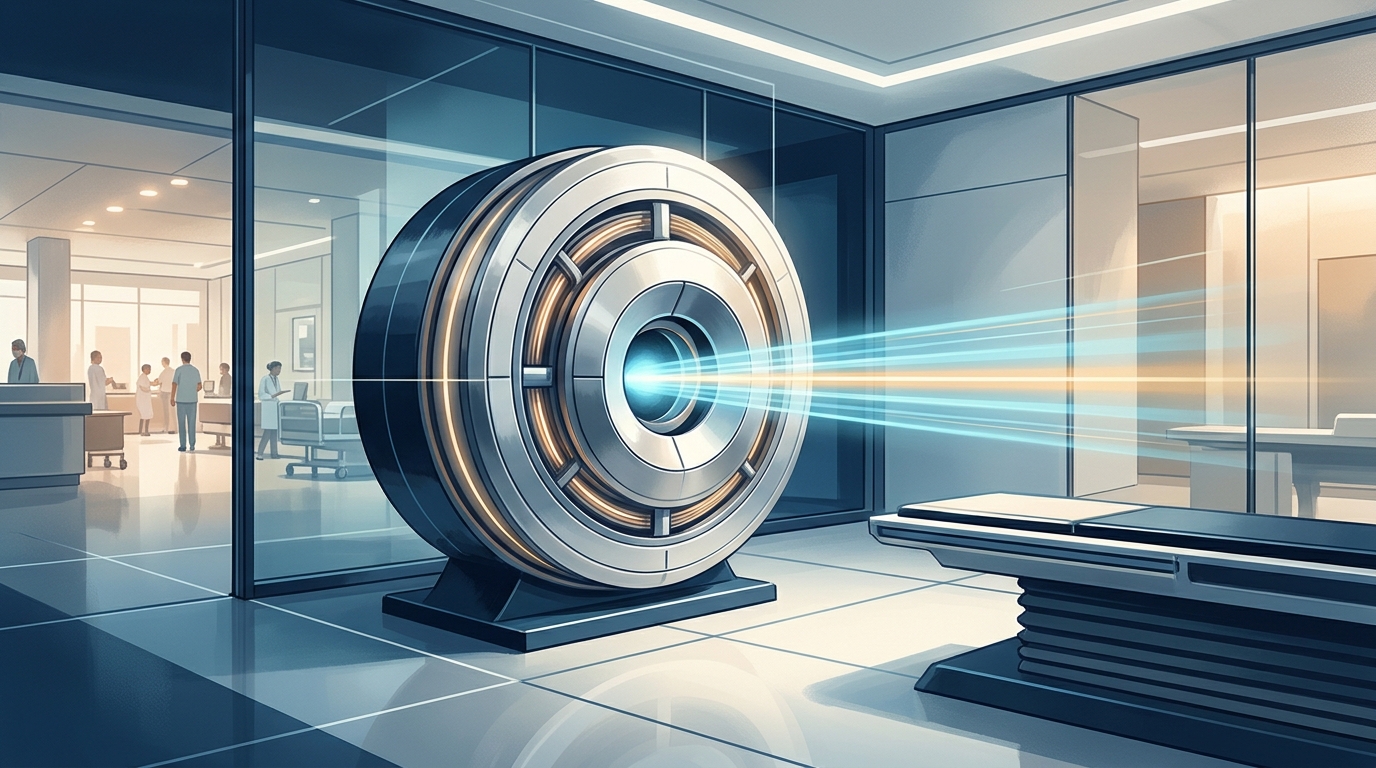
Boron neutron capture therapy, or BNCT, has long promised a way to destroy cancer cells while sparing the healthy tissue around them, but for decades the treatment demanded something few hospitals could ever provide: a nuclear reactor. The review, published on 5 October 2023, surveys the accelerator technologies, target materials and beam-shaping systems behind these devices, and reports that one cyclotron-based machine has already been approved as a medical device in Japan and is treating patients under insurance coverage.
The therapy itself relies on a remarkably selective nuclear reaction. A boron drug containing enriched boron-10 is administered to the patient before irradiation and accumulates selectively in cancer cells. When a neutron beam then strikes the affected region, boron-10 nuclei capture neutrons and split, releasing alpha particles and lithium nuclei. Both particles travel less than 10 micrometres, roughly the diameter of a human cell, and as heavy particles with a high cell-killing effect they destroy only the cancer cells they originate in, without travelling beyond them. That selectivity is what makes BNCT attractive for invasive cancers such as malignant brain tumours and recurrent cancers after conventional radiotherapy, where effective treatment methods have not yet been established.
The catch has always been neutron intensity. The therapeutic dose must be delivered to a cancerous region within roughly one hour, and the International Atomic Energy Agency’s TECDOC-1223 suggests an epithermal neutron flux of at least 5×10⁸ neutrons per square centimetre per second as the intensity needed for BNCT. Early clinical research began in the 1950s using research reactors at Brookhaven and the Massachusetts Institute of Technology in the United States, and later spread to European and Japanese reactors, and to Argentina, Taiwan and China at the end of the twentieth century. Until the 1990s, irradiation used low-energy thermal neutrons, which required surgical craniotomy to deliver neutrons inside the brain for malignant brain tumour treatment, limiting how many clinical trials each reactor could host. Once reactors began installing sources of epithermal neutrons, with energies between 0.5 electronvolts and 10 kiloelectronvolts, the dose could reach deeper tissue, craniotomy was no longer needed, and BNCT applications spread to head and neck, lung and breast cancers. Clinical trials of 1,000 cases or more on malignant brain tumours, head and neck cancer and malignant melanoma using research reactors worldwide have reported excellent treatment results, yet BNCT never became established as a global therapy because it required a reactor, and reactors make pharmaceutical approval for medical devices difficult.
Recent breakthroughs in accelerator and neutron generation technology have changed that calculus by making it possible to generate neutrons of intensity comparable to a nuclear reactor using a compact accelerator installable in a hospital. The review explains the physics of these devices: neutrons carry no electric charge and cannot be accelerated directly, so an accelerator first speeds charged particles to several or a few tens of megaelectronvolts, then fires them at a target material that emits neutrons secondarily. Those neutrons emerge with energies from a few hundred kiloelectronvolts to megaelectronvolts, far higher than treatment energies, so they are slowed in a moderator before being released from the beam aperture to the patient. For BNCT using BPA, the current standard boron compound, irradiation must finish within one hour because of the drug’s persistence in cancer cells and patient comfort, which requires a thermal neutron flux of at least 1×10⁹ per square centimetre per second around the cancerous region. Epithermal neutrons entering the body turn to thermal neutrons by reacting with hydrogen, building up to roughly twice the epithermal intensity at a depth of around 2 centimetres, so the beam aperture must emit at least 5×10⁸ epithermal neutrons per square centimetre per second, which in turn demands approximately 1×10¹¹ to 1012 high-energy neutrons per square centimetre per second from the target reaction.
That intensity target is roughly 100 times what typical compact accelerator neutron sources for research use, such as RIKEN’s RANS device in Japan, produce, and it drives the field’s two central engineering problems. The first is building a compact accelerator that can accelerate and handle high-current particles ranging from several milliamperes to several tens of milliamperes. The second is developing target technology that can withstand both the heat load and the blistering damage caused by particle beams of several tens of kilowatts, the product of average current and energy. As medical devices, these systems must also minimise activation to suppress radiation exposure to patients and staff, generate neutron beams of consistent quality stably and continuously, and allow easy short-term maintenance. Protons are generally used as the primary particle, though some groups have proposed deuterons, and with protons below about 30 megaelectronvolts, beryllium and lithium are the main target materials in current devices.
Each target material imposes its own trade-offs. Lithium generates neutrons via a resonance reaction with protons of approximately 2.25 megaelectronvolts, so accelerators run at about 2.5 megaelectronvolts, but its neutron yield is smaller than beryllium’s, requiring average currents of 10 to 30 milliamperes. Lithium melts at roughly 180 degrees Celsius, lower than beryllium, and conducts heat less well, so a proton beam of approximately 25 to 75 kilowatts forces more advanced cooling; some groups have proposed liquid lithium targets, which would need careful handling in a hospital setting. Lithium also converts to beryllium-7, a radioisotope with a half-life of approximately 53 days that must be managed. Its advantages are size and cost: the low proton energy allows a smaller accelerator, the emitted neutrons peak at several hundred kiloelectronvolts, so moderators and shielding walls shrink, the building can be smaller, and initial facility costs may fall. Beryllium, by contrast, offers a higher neutron yield, a melting point near 1287 degrees Celsius and better thermal conductivity, making target system design easier, but higher proton energy raises the maximum neutron energy in proportion, since the reaction’s Q value is −1.9 megaelectronvolts, and activates device materials; above 13.4 megaelectronvolts, irradiation also produces beryllium-7. Developers must therefore balance activation against miniaturisation when choosing proton energy.
The review highlights how real devices solve the heat and blistering problems. The NeuCure device from Sumitomo Heavy Industry uses a 5-millimetre-thick beryllium plate that doubles as the beam window, with cooling water flowing behind and in contact with the plate; because protons stop in water but not beryllium, blistering is avoided. The Tsukuba group’s iBNCT001 takes a different route with 8-megaelectronvolt protons, whose Bragg peak in beryllium lies about 0.55 millimetres deep, so the beryllium plate is 0.5 millimetres thick to avoid proton accumulation. Behind it sits a 0.5-millimetre palladium plate, a hydrogen-absorbing metal that stores protons passing through the beryllium and prevents short-term failure, and behind that a copper layer acting as a heat sink with cooling water channels. This three-layer system generates stable, continuous high-intensity neutrons at an average proton current of 2.1 milliamperes.
Accelerator choice divides the field into three camps. Cyclotrons reach high energies in compact form and are widespread in medicine, but achieving average currents of tens of milliamperes is difficult, with a few milliamperes near their limit; NeuCure pairs a cyclotron accelerating protons to 30 megaelectronvolts at 1 milliampere with a beryllium target. Linear accelerators can handle several tens of milliamperes and work with both targets, typically using a radio frequency quadrupole followed by a drift tube linac, though their size grows with energy and they need peripheral equipment such as high-frequency power sources. The CICS-1 device at Japan’s National Cancer Center Hospital uses an RFQ-only linac with a lithium target at 2.5 megaelectronvolts, designed for at least 20 milliamperes but operated at 12 milliamperes in clinical use for stability. The iBNCT001 linac combines an RFQ and DTL totalling roughly 8 metres, designed for at least 5 milliamperes and currently operating at 2.1. Electrostatic accelerators can push several tens of milliamperes but not to high energies, suiting lithium targets at about 2.5 megaelectronvolts; they are compact because they need no high-frequency power sources, and most lithium-target devices use them, including Neutron Therapeutics’ machine at Helsinki University Hospital, which accelerates protons to 2.6 megaelectronvolts, designed for 30 milliamperes but reduced to 12 in clinical use.
Behind every target sits a beam shaping assembly that tames the raw neutron output, filtering fast neutrons above 10 kiloelectronvolts, moderating the beam with materials such as MgF2 and CaF2 or Fluental, cutting thermal neutrons with millimetre-thick cadmium, absorbing gamma rays with lead or bismuth, and focusing the beam through collimators to a circular aperture, with multiple aperture diameters available to match lesion size. Worldwide, Japan leads in device development: NeuCure was approved in 2020 and treats recurrent head and neck cancer patients under insurance at two hospitals, CICS-1 is in clinical trials for malignant skin tumours, and the Tsukuba group’s iBNCT001 has generated neutrons of sufficient intensity for BNCT, producing an epithermal flux of approximately 7.0×10⁸ per square centimetre per second at the beam aperture at 2.1 milliamperes. Phantom measurements with 120- and 150-millimetre collimators recorded maximum thermal neutron fluxes of approximately 1.36×10⁹ and 1.40×10⁹ per square centimetre per second at 20 millimetres depth, leading the group to expect malignant brain tumour irradiation to complete in about 30 minutes, with non-clinical mouse studies done in 2022 and a clinical study planned soon.
Subject of Research: Development status of accelerator-based neutron sources for boron neutron capture therapy
Article Title: Current development status of accelerator-based neutron source for boron neutron capture therapy
Article References: Kumada, H., Sakae, T., & Sakurai, H. (2023). Current development status of accelerator-based neutron source for boron neutron capture therapy. EPJ Techniques and Instrumentation, 10(1), Article 18. https://doi.org/10.1140/epjti/s40485-023-00105-5
Image Credits: AI Generated
DOI: 10.1140/epjti/s40485-023-00105-5
Keywords: boron neutron capture therapy, accelerator-based neutron source, BNCT, cyclotron, linear accelerator, electrostatic accelerator, beryllium target, lithium target, beam shaping assembly, epithermal neutrons, iBNCT001, NeuCure
News Source: Nathaniel Bowman. (November 4, 2026). Compact Accelerators Bring Reactor-Free Cancer Therapy Closer to Hospitals. Scienmag.