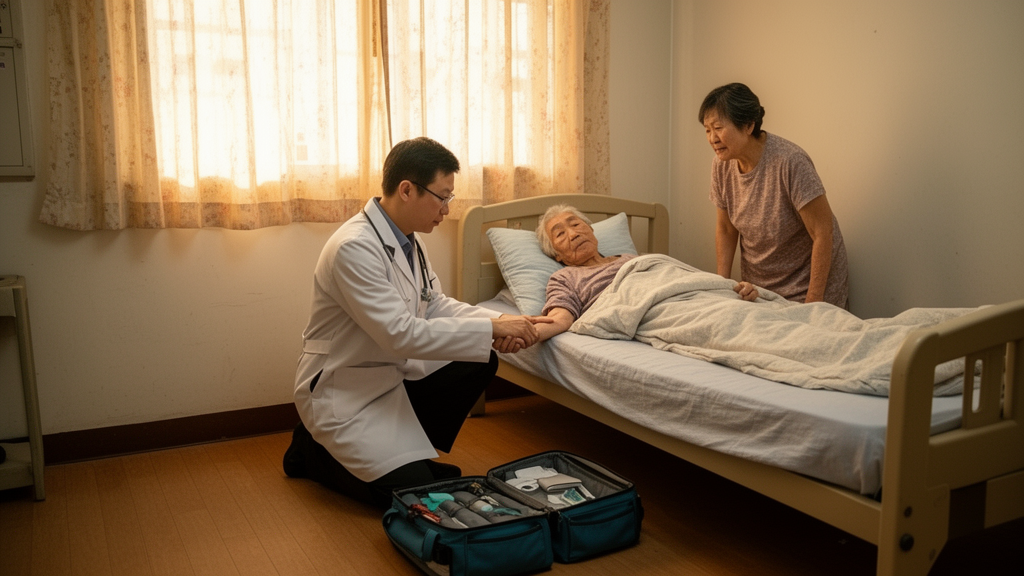
A qualitative study published in BMC Palliative Care explores how these physicians perceive Type B home-based palliative care, a community-based model promoted by Taiwan’s Ministry of Health and Welfare in which primary care physicians and community nurses provide care with support from hospital-based palliative care teams. Although Taiwan is internationally recognized for the quality of its end-of-life care, the study notes that utilization of home-based palliative care remains low, and participation is constrained by time demands, limited resources and difficulties in interprofessional collaboration.
The researchers recruited eight community physicians through purposive sampling and conducted individual, in-depth semi-structured interviews with each participant. From this analysis the team identified seven themes: opportunities, benefits, teamwork, challenges, policies, adaptation and expectations. The study was published as a peer-reviewed, accepted research article carrying a permanent DOI, with the publisher noting that the version is subject to further edits before the final Version of Record.
According to the findings, physicians entered home-based palliative care through three main routes: policy initiatives, professional networks and personal experiences. Once engaged, they recognized benefits at several levels, describing advantages for patients, for families, for the healthcare system and for their own professional fulfilment. The physicians relied on multidisciplinary collaboration to deliver care, underscoring that the model functions as an interprofessional effort rather than the work of any single discipline. The study’s authors characterize the physicians’ overall view of their work as positive, with substantial professional fulfilment reported among participants.
At the same time, the interviews surfaced a consistent set of obstacles. Physicians reported challenges involving time demands, limited clinical confidence, emotional burden, logistical constraints, reimbursement and administrative requirements. To keep practicing despite these pressures, participants described adaptive strategies they had developed to sustain their involvement in the program. The study frames these strategies as part of the adaptation theme, showing how community physicians actively manage the practical realities of delivering palliative care in patients’ homes.
The conclusions point to specific structural barriers perceived as threatening sustainable collaboration. These included inadequate reimbursement, complex national health insurance review procedures, limited continuing education opportunities for community physicians and home care nurses, and the absence of additional reimbursement for the hospitals that support community-based teams. Because Type B home-based palliative care is designed around cooperation between community providers and hospital-based palliative teams, the lack of dedicated reimbursement for supporting hospitals is presented as a direct impediment to that collaboration.
Looking forward, the physicians anticipated that stronger community-hospital collaboration, more supportive policies and continued professional development would strengthen community home-based palliative care in Taiwan. The study’s authors suggest that more supportive national health insurance policies, enhanced continuing education and greater professional exchange may help establish a more effective community-based palliative care network. As a qualitative study of eight physicians recruited through purposive sampling, the research captures the perspectives of a small, deliberately selected group rather than measuring outcomes across the wider workforce, and its findings describe participants’ experiences and perceptions of the program rather than clinical efficacy results.
Subject of Research: Experiences and perspectives of community clinic physicians providing home-based palliative care in Taiwan
Article Title: Exploring the practical experiences and perspectives of community clinic physicians in home-based palliative care: a qualitative study
Article References: Wu, C.-Y., Wu, Y.-H., Kuo, Y.-L., Chen, H.-C., Tsay, M.-S., Chang, Y.-H., & Hsieh, H.-Y. (2026). Exploring the practical experiences and perspectives of community clinic physicians in home-based palliative care: a qualitative study. BMC Palliative Care. https://doi.org/10.1186/s12904-026-02391-8
Image Credits: AI Generated
DOI: 10.1186/s12904-026-02391-8
Keywords: palliative care, home-based palliative care, Taiwan, community physicians, qualitative study, thematic analysis, end-of-life care, health policy, interprofessional collaboration, BMC Palliative Care, Exploring, practical
News Source: Ophelia Keating. (October 29, 2026). Community physicians in Taiwan describe what sustains and strains home-based palliative care. Scienmag.