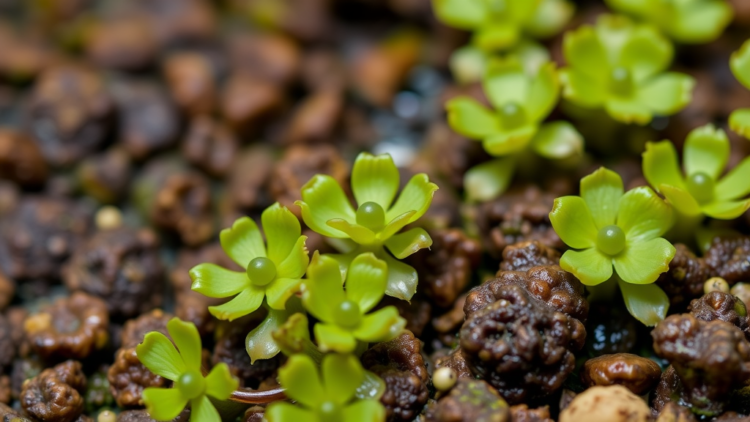
A humble green ribbon of a plant that carpets damp urban walls and greenhouse soils has delivered a striking lesson in how life copes with toxic ground. Marchantia polymorpha, a complex thalloid liverwort and one of the most studied model organisms outside the vascular plant world, has been put through a rigorous soil-based trial to see how it handles zinc, cadmium and lead. The verdict, published in the journal Plant and Soil, is a nuanced one: the liverwort takes up all three metals, displays an unusual cadmium-accumulation strategy, and pays a substantial price in growth and fitness for doing so.
The research team, led by Žan Cimerman of the University of Ljubljana, took a deliberately realistic approach. Rather than dousing plants with artificially high doses of a single metal, they created a natural concentration gradient by mixing soils collected near a former lead smelter in Žerjav, Slovenia, with clean soil from a geologically similar site in Jezersko. The metalliferous soil contained a striking 9287 milligrams of lead per kilogram, 631 milligrams of zinc and 61.9 milligrams of cadmium, while the control soil held only trace amounts. Both soils, crucially, shared comparable pH, organic matter and nutrient profiles, meaning the only meaningful variable was metal loading.
Clonal gemmae, the tiny lens-shaped reproductive structures the liverwort produces in its distinctive cup-shaped organs, were transplanted onto four soil treatments: pure metalliferous, pure control and two mixtures. Over 35 days, the researchers photographed and measured developing thalli at regular intervals, then subjected the harvested plants to a battery of analyses spanning chlorophyll quantification, antioxidant capacity assays, bulk elemental profiling via ICP-MS, micrometre-scale elemental imaging using micro-PIXE, and transmission electron microscopy of cellular ultrastructure.
The growth penalty was immediate and dramatic. Statistically significant differences in thallus surface area emerged as early as day seven, and by the experiment’s end, plants grown on native metalliferous soil had reached a mean surface area of only 4.00 square centimetres compared with 14.3 square centimetres in controls. Biomass told the same story: control plants averaged 466 milligrams fresh weight and 28.3 milligrams dry weight, while those on the worst soil managed just 86.3 and 7.42 milligrams respectively. Chlorophyll concentrations declined in step, dropping from 24.4 to 17.8 micrograms per millilitre, and total antioxidant capacity peaked at moderate metal levels before falling at the highest doses, hinting at a hormetic response at low exposure and physiological exhaustion at high exposure.
The ionomic story was equally revealing. As soil metal availability rose, concentrations of potassium, manganese and phosphorus in thalli fell steadily, suggesting competitive interference at shared transport pathways. Conversely, calcium, iron, sulphur, zinc, cadmium and lead all accumulated. The kinetics differed by metal: zinc and lead behaved as classic bioindicators, with tissue concentrations rising in near-linear proportion to soil availability, while cadmium showed a sharply different pattern, jumping early and then saturating around 53 milligrams per kilogram in planta. This saturating, accumulator-like response to cadmium had not previously been described in this species, although it fell short of the 100 milligram per kilogram threshold that defines hyperaccumulation in vascular plants.
Micro-PIXE elemental mapping added spatial resolution to the picture. In metal-exposed thalli, zinc, cadmium and lead were concentrated overwhelmingly in the lower parenchyma and ventral epidermis, with mean ventral concentrations reaching 591 milligrams per kilogram for zinc, 399 for cadmium and 1175 for lead. This sequestration strategy physically isolates the toxic load from the photosynthetically active dorsal tissues, a compartmentalisation tactic familiar from studies of other thalloid liverworts such as Conocephalum conicum and Lunularia cruciata.
Transmission electron microscopy revealed the cellular costs of this containment strategy. The ventral cuticle in metal-exposed plants averaged 34.6 nanometres, more than double the 14.4 nanometres seen in controls, suggesting reinforcement of a physical barrier. Chloroplasts showed abnormal enlargement of starch grains and proliferation of plastoglobuli, lipoprotein particles linked to stress responses. Numerous electron-dense cytoplasmic vesicles, possibly peroxisomes, appeared near chloroplasts, consistent with heightened oxidative stress management. In some cells, cytoplasmic deterioration and loss of structural integrity were observed.
Sex differences added another layer of intrigue. Male gametophytes accumulated 1.3 to 1.5 times more cadmium and lead than females, despite being slightly smaller and producing fewer gemmae cups. The researchers hypothesise that females may restrict toxic uptake as an adaptive strategy to protect sporophyte development, though conflicting evidence from other studies on cadmium tolerance in this species means the pattern warrants further investigation.
The findings carry practical implications for biomonitoring. Because zinc and lead concentrations in thalli track soil availability linearly, the species could serve as a reliable indicator of those two metals in soil-based assessments. Cadmium, with its saturating response, cannot be used quantitatively in the same way. The study also effectively debunks an older suggestion that M. polymorpha might be a lead hyperaccumulator under natural soil conditions.
Ultimately, the researchers conclude that M. polymorpha subsp. ruderalis is only weakly tolerant to zinc, cadmium and lead drawn from soil. The species survives and continues to reproduce vegetatively, thanks to a toolkit of phytochelatin-mediated detoxification, tissue-level sequestration and structural reinforcement, but persistence on contaminated ground comes at a measurable fitness cost. As legacy smelter soils and urban metal contamination continue to shape ecosystems worldwide, this small liverwort offers a window into the evolutionary trade-offs that govern survival at the margins of habitability.
Subject of Research: Metal uptake, tolerance mechanisms and fitness costs in the liverwort Marchantia polymorpha grown on zinc, cadmium and lead contaminated soils
Article Title: Distinct accumulation behaviour of Marchantia polymorpha L. grown along a soil metal gradient triggers fitness penalties
Article References: Distinct accumulation behaviour of Marchantia polymorpha L. grown along a soil metal gradient triggers fitness penalties. (n.d.). https://doi.org/10.1007/s11104-026-09105-2
Image Credits: AI Generated
DOI: 10.1007/s11104-026-09105-2
Keywords: Marchantia polymorpha, liverwort, heavy metals, cadmium, lead, zinc, metalliferous soil, bioindicator, micro-PIXE, transmission electron microscopy, phytochelatins, plant stress
Cite Scienmag News
APA
MLA
Chicago
Alan Morgan. (September 22, 2026). Common Liverwort Reveals Hidden Metal-Accumulation Tactics and Costly Fitness Penalties. Scienmag. https://scienmag.com/common-liverwort-reveals-hidden-metal-accumulation-tactics-and-costly-fitness-penalties/
Alan Morgan. “Common Liverwort Reveals Hidden Metal-Accumulation Tactics and Costly Fitness Penalties.” Scienmag, 22 September 2026, https://scienmag.com/common-liverwort-reveals-hidden-metal-accumulation-tactics-and-costly-fitness-penalties/. Accessed 22 September 2026.
Alan Morgan. “Common Liverwort Reveals Hidden Metal-Accumulation Tactics and Costly Fitness Penalties.” Scienmag. September 22, 2026. https://scienmag.com/common-liverwort-reveals-hidden-metal-accumulation-tactics-and-costly-fitness-penalties/
Copy citation
Download RIS
Tags: and lead uptake in bryophytesbioindicatorcadmiumeffects of heavy metals on non-vascular plantsenvironmental impact of metalliferous soils on plant lifefitness costs of metal accumulation in liverwortsheavy metalsleadliverwortMarchantia polymorphametal accumulation in liverwortsmetalliferous soilmicro-PIXEmodel organisms for studying metal detoxificationnatural soil contamination and plant responsephytochelatinsphytoremediation potential of Marchantia polymorphaplant adaptation to toxic soilsplant metal tolerance mechanismsplant stresstransmission electron microscopyurban wall vegetation and metal pollutionzinc