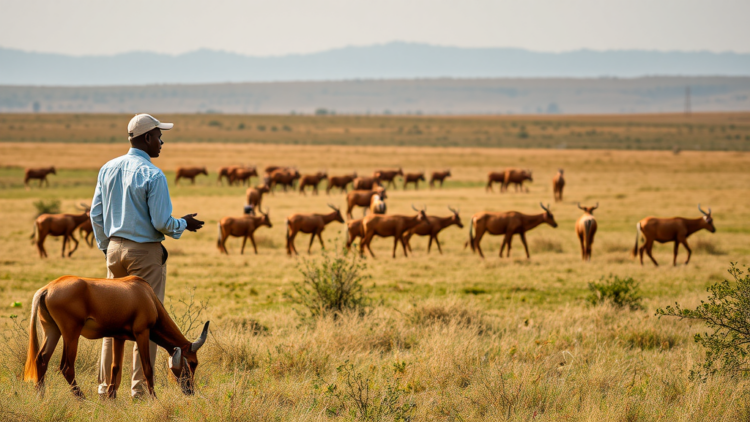
In the semi-arid highlands of northern Ethiopia, where livestock sustain thousands of farming households and rainfall has grown increasingly unreliable, a new study offers a rare moment of good news: the remedies for degraded grazing lands may already be known, both by the ecologists who measure them and by the farmers who have lived with them for generations. A research team led by Abraha Gebru of Mekelle University has combined rigorous field measurements with local participatory knowledge to evaluate how different grazing management systems shape forage productivity, plant diversity, feed quality, and livestock pressure in the Dagabir watershed of Hawzen district, eastern Tigray. The results, published in Discover Agriculture, reveal stark contrasts between protected and open grazing lands, and a striking convergence between scientific analysis and the judgment of local herders.
The study examined three grazing management systems that coexist across the Ethiopian countryside: caged plots, completely excluded from livestock with wire-mesh fencing; locally protected exclosures, managed through community by-laws; and freely grazed communal pastures, open to cattle, sheep, and goats throughout the daylight hours. Ten replicate plots were sampled for each treatment, all within similar slope positions, soil conditions, and agro-ecological settings of the same watershed, allowing the researchers to attribute differences primarily to grazing intensity rather than environmental variation. Data collection took place at the end of the main growing season, between June and September 2024, when biomass production peaks, over a study period of roughly 120 days representing one complete grazing cycle.
The numbers tell a dramatic story. Forage biomass in caged plots reached 4.06 tonnes per hectare on average, more than twelve times the 0.32 tonnes per hectare recorded in freely grazed areas. Locally protected exclosures fell in between, producing 2.11 tonnes per hectare. According to the authors, this gradient reflects the cumulative toll of frequent defoliation, trampling, and the absence of recovery periods in continuously grazed systems, all of which reduce photosynthetic capacity, inhibit tillering, and suppress vegetation regeneration. In caged plots, relieved of grazing pressure, slower-growing perennial species re-established themselves, increasing structural complexity and total biomass, a successional recovery pattern widely documented in rangeland ecosystems.
Yet total exclusion is not the whole answer. When the researchers calculated the Shannon-Wiener diversity index for each treatment, they found that locally protected plots supported the highest species diversity, at 1.16, slightly ahead of the fully caged plots at 1.11, while freely grazed land lagged far behind at 0.87. This pattern echoes the Intermediate Disturbance Hypothesis: moderate grazing regulation can prevent dominant species from competitively excluding others, allowing a broader mix of plants to coexist. Complete exclusion, while boosting biomass, may marginally reduce opportunities for disturbance-dependent species. In open pastures, selective grazing removes palatable species before they can regenerate or set seed, while trampling crushes seedlings, gradually shifting the community toward grazing-tolerant, less nutritious plants and eroding the rangeland’s resilience to drought.
The nutritional dimension of the study is equally consequential. Crude protein content, in vitro dry matter digestibility, fiber fractions, and mineral concentrations were all analyzed using standard laboratory procedures, including the Tilley and Terry two-stage digestibility method with rumen liquor from fistulated cattle at Mekelle University. Across treatments, caged plots consistently delivered superior feed quality: crude protein of 18.97 percent and digestibility of 71.18 percent, compared with 17.34 percent protein and 68.32 percent digestibility in freely grazed plots. Fiber fractions such as neutral detergent fiber, acid detergent fiber, and acid detergent lignin were highest in grazed plots, and the combined nutritive value index declined steadily from 0.973 in caged plots to 0.851 in grazed ones. In short, continuous grazing does not merely reduce how much forage is available; it degrades the quality of what remains.
Among the twenty fodder species evaluated in the laboratory, variation was wide. Maytenus senegalensis led on crude protein at 22.43 percent, with Sesbania sesban close behind at 21.33 percent, confirming the value of leguminous trees as protein sources in semi-arid systems. Olea europaea, the African olive, achieved the highest in vitro dry matter digestibility at 75.88 percent, followed closely by Tarchonanthus camphoratus and the widely planted Napier grass, Pennisetum purpureum. Even the prickly pear cactus, Opuntia ficus-indica, though low in protein, showed moderate digestibility thanks to its soluble carbohydrates, reinforcing its role as an emergency drought feed. Species such as Acacia albida and Sesbania sesban also carried high concentrations of calcium, magnesium, and potassium, making them critical dry-season supplements when herbaceous forage quality collapses.
What makes this study distinctive is the way it wove farmers’ own assessments into the science. Through participatory rural appraisal, thirty local herders, livestock owners, and elders scored twenty fodder species against twenty-one locally defined criteria spanning animal attributes such as palatability and milk production, plant attributes such as drought resistance and regrowth ability, and multipurpose uses including shade, fuelwood, medicine, and erosion control. Statistical analysis of these rankings, using the Kruskal-Wallis test with Dunn-Bonferroni post hoc comparisons, showed that farmers placed Olea europaea, Pennisetum purpureum, Cynodon dactylon, Sesbania sesban, Acacia albida, and Ficus vasta at the top of their preferences. The African olive earned the highest multipurpose score of all, valued for shade, soil conservation, fuelwood, and construction timber as much as for fodder.
The most striking finding, the authors note, is how closely the farmers’ rankings aligned with the laboratory-derived indices of protein, digestibility, and energy. This convergence between indigenous knowledge and chemical analysis suggests that local ecological knowledge, accumulated over generations of observation, can reliably identify high-quality forage resources, and that participatory evaluation deserves a formal place in forage development and rangeland rehabilitation programs. Farmers, the study shows, apply a multi-criteria decision framework that integrates feed value, resilience, and year-round availability rather than judging species on any single attribute, a sophistication that purely ecological studies often miss.
Defoliation measurements added another layer of insight. By measuring plant height and tiller number before grazing and again within twenty-four hours after, the team quantified grazing pressure species by species. Cynodon dactylon and Trifolium species suffered the most severe defoliation, with intensity values exceeding the 67 percent threshold for severe classification, a sign of both their high palatability and their vulnerability. Species such as Rumex nepalensis and Chloris virgata-type grasses with basal tillering and stronger root systems tolerated grazing better but offered lower forage value. This reveals a fundamental trade-off in rangeland ecology: the most nutritious species are eaten first, and without managed recovery periods they cannot persist, while less palatable, grazing-resistant plants gradually take their place.
The practical implications are clear. The researchers argue that controlled grazing systems, including rotational and deferred grazing, can strike the balance between forage utilization and vegetation recovery that free grazing destroys. Highly nutritious and farmer-preferred species such as Olea europaea, Pennisetum purpureum, Sesbania sesban, and Cynodon dactylon should anchor future forage development, while grazing-tolerant species can stabilize degraded soils. As climate variability intensifies across the Horn of Africa, diversified fodder systems combining grasses, legumes, and woody species may prove essential to feed security. This study’s integrated framework, spanning biomass, biodiversity, nutrition, defoliation, and human preference, offers a template for evidence-based rangeland management in semi-arid ecosystems worldwide, and a vindication of the farmers who knew much of the answer all along.
Subject of Research: Evaluation of grazing management systems and farmer preferences for fodder species in semi-arid Ethiopian rangelands
Article Title: Integrating farmer preferences and ecological assessment to evaluate grazing management in semi-arid Ethiopian rangelands
Article References: Gebru, A., Haile, M., Solomon, N., Gidey, K., Adane, Y., Berhe, A., & Gufi, Y. (2026). Integrating farmer preferences and ecological assessment to evaluate grazing management in semi-arid Ethiopian rangelands. Discover Agriculture, 4(1), Article 291. https://doi.org/10.1007/s44279-026-00772-4
Image Credits: AI Generated
DOI: 10.1007/s44279-026-00772-4
Keywords: grazing management, Ethiopian rangelands, forage biomass, species diversity, fodder species, crude protein, in vitro digestibility, defoliation intensity, exclosures, indigenous knowledge, semi-arid agriculture, livestock feed
Cite Scienmag News
APA
MLA
Chicago
Alan Morgan. (September 22, 2026). Farmers’ Knowledge and Field Science Agree on How to Save Ethiopia’s Rangelands. Scienmag. https://scienmag.com/farmers-knowledge-and-field-science-agree-on-how-to-save-ethiopias-rangelands/
Alan Morgan. “Farmers’ Knowledge and Field Science Agree on How to Save Ethiopia’s Rangelands.” Scienmag, 22 September 2026, https://scienmag.com/farmers-knowledge-and-field-science-agree-on-how-to-save-ethiopias-rangelands/. Accessed 22 September 2026.
Alan Morgan. “Farmers’ Knowledge and Field Science Agree on How to Save Ethiopia’s Rangelands.” Scienmag. September 22, 2026. https://scienmag.com/farmers-knowledge-and-field-science-agree-on-how-to-save-ethiopias-rangelands/
Copy citation
Download RIS
Tags: community-based pasture protectioncrude proteindefoliation intensityecological assessment of Ethiopian highlandsEthiopian rangeland managementEthiopian rangelandsexclosuresfodder speciesforage biomassforage productivity in semi-arid regionsgrazing land degradation solutionsgrazing managementhighland pastoral systemsimpact of grazing exclusion on biodiversityin vitro digestibilityIndigenous knowledgeintegrated scientific and local environmental knowledgelivestock feedlivestock grazing practices in Ethiopiaparticipatory land managementsemi-arid agriculturespecies diversitysustainable livestock feeding strategiestraditional ecological knowledge in Ethiopia