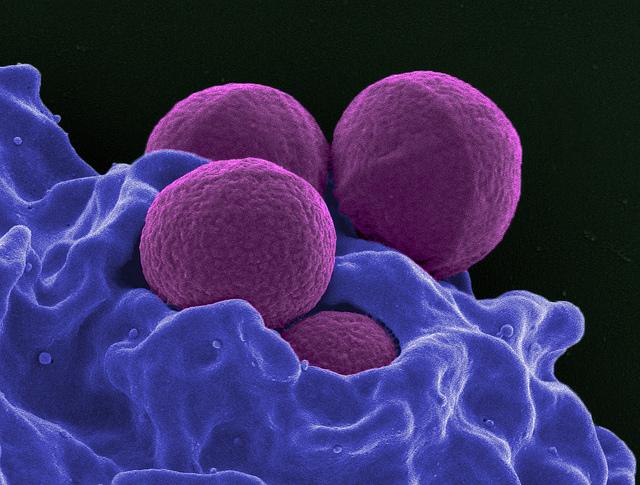
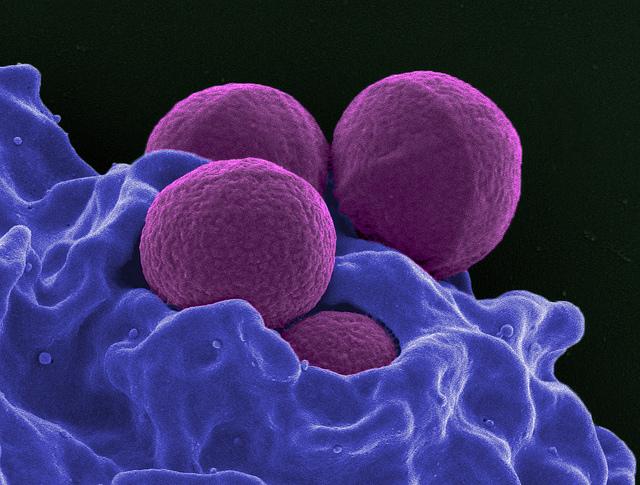
Credit: NIAID
WHAT:
Methicillin-resistant Staphylococcus aureus (MRSA) bacteria are resistant to multiple antibiotics and commonly cause skin infections that can lead to more serious or life-threatening infection in other parts of the body. In new findings published in The New England Journal of Medicine, researchers found that two common, inexpensive antimicrobials can help patients heal from MRSA skin abscesses. The findings suggest that current treatment options for MRSA still have a role, even as scientists continue to search for new antimicrobial products. The research was funded by the National Institute of Allergy and Infectious Diseases (NIAID), a part of the National Institutes of Health (NIH).
The study was conducted at hospitals across the United States and involved 796 children and adults with small, uncomplicated skin abscesses. All patients had their abscesses opened and drained as part of standard MRSA treatment. The patients were then sorted into three groups, each of which received a different, ten-day oral treatment regimen. One group received clindamycin, a second group received trimethoprim-sulfamethoxazole (TMP-SMX), and the third group received placebo.
The group treated with clindamycin had an 81.7 percent cure rate, and the group that received TMP-SMX had an 84.6 percent cure rate. The placebo group had a 62.9 percent cure rate. According to the researchers, the findings contradict a commonly held belief that antimicrobial treatment is little better than doing nothing for MRSA skin infections. It corroborates the findings of another NIAID-funded study demonstrating that TMP-SMX treatment resulted in better clinical outcomes than placebo for MRSA skin abscesses, and also upholds other findings that both clindamycin and TMP-SMX are equally beneficial in treating MRSA skin infections.
The researchers note, however, that the side effects of clindamycin and TMP-SMX (including nausea, diarrhea, and possible new Clostridium difficile infections) can be severe. In addition, some strains of Staphylococcus are resistant to clindamycin. The authors recommend that healthcare providers weigh the risks but not dismiss these antimicrobials out of hand as viable treatment options for MRSA skin abscesses.
###
Additional funding for the study was provided in part by NIH's National Center for Advancing Translational Sciences.
ARTICLE:
RS Daum et al. A placebo controlled trial of antibiotics for smaller skin abscesses. New England Journal of Medicine DOI: 10.1056/NEJMoa1607033 (2017).
WHO:
NIAID Director Anthony S. Fauci, M.D., is available for comment. Dennis Dixon, Ph.D., chief of the Bacteriology and Mycology Branch of NIAID's Division of Microbiology and Infectious Diseases, is also available for comment.
CONTACT:
To schedule interviews, please contact Elizabeth Deatrick, (301) 402-1663, [email protected].
NIAID conducts and supports research–at NIH, throughout the United States, and worldwide–to study the causes of infectious and immune-mediated diseases, and to develop better means of preventing, diagnosing and treating these illnesses. News releases, fact sheets and other NIAID-related materials are available on the NIAID website.
About the National Institutes of Health (NIH): NIH, the nation's medical research agency, includes 27 Institutes and Centers and is a component of the U.S. Department of Health and Human Services. NIH is the primary federal agency conducting and supporting basic, clinical, and translational medical research, and is investigating the causes, treatments, and cures for both common and rare diseases. For more information about NIH and its programs, visit http://www.nih.gov/.
NIH…Turning Discovery Into Health®
Media Contact
Elizabeth Deatrick
[email protected]
301-402-1663
@NIAIDNews
http://www.niaid.nih.gov
Related Journal Article
http://dx.doi.org/10.1056/NEJMoa1607033
############
Story Source: Materials provided by Scienmag