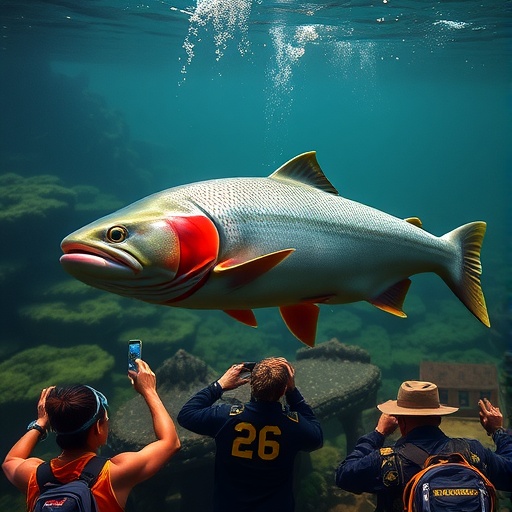
Sacramento River winter-run Chinook salmon are facing a hidden survival crisis during the first days of life, when tiny embryos developing inside river gravel encounter temperatures that can determine whether they ever emerge. A new study published in Science Advances shows that cool water during the first 15 days after fertilization is critical for survival, revealing a severe early-life bottleneck in one of California’s most endangered salmon populations. The finding may change how scientists measure recovery and how water managers decide when and where to release scarce cold water from Shasta Reservoir.
Winter-run Chinook once migrated into cold, high-elevation rivers flowing from Mount Shasta. Construction of Shasta Dam blocked access to that historical habitat, forcing the fish to spawn in the lower Sacramento River, where summer temperatures can become dangerously warm. The remaining population is the last naturally reproducing group of its kind, and only a few thousand adults have returned in many recent years. Because the fish spawn across an extended summer season, biologists have traditionally estimated reproductive success by counting adult salmon and their nests, known as redds. The new research suggests that these counts may greatly overstate the number of spawning events that actually produce surviving juveniles.
The research team combined spawning surveys, river-temperature models and chemical evidence preserved in salmon otoliths, or ear bones. These structures grow throughout a fish’s life, producing microscopic daily increments similar to tree rings. They also record changes in the chemistry of the surrounding water. Using an ion microprobe at a UCLA laboratory, researchers measured oxygen isotopes at extremely fine scales in otoliths from juvenile salmon. Because the relationship between oxygen-isotope ratios and water temperature is well established, the measurements allowed the scientists to reconstruct the thermal conditions experienced by individual fish before they emerged from their gravel nests.
The approach enabled the researchers to estimate when each juvenile hatched and compare its early developmental temperature history with the locations and dates of spawning activity. Otolith growth increments provided a biological calendar, while isotope measurements supplied a chemical record of temperature. River models then helped connect those records to particular sections of the Sacramento River. By integrating all three sources of information, the scientists identified which spawning areas and periods were most likely to have produced juveniles that survived long enough to be collected and studied.
The pattern was striking. Juveniles that survived had experienced cooler conditions during the earliest stages of development, while locations where juveniles failed to survive were consistently associated with warmer temperatures during the same period. For every 1.8-degree Fahrenheit, or 1-degree Celsius, increase in average river temperature during the critical 15-day window, the probability that juveniles in a redd would survive fell by approximately 73 percent. That relationship indicates that temperature is not merely one factor among many affecting early development; during this narrow period, it can act as a powerful biological filter.
The vulnerable period begins soon after fertilization, while the embryos are developing inside the gravel and before the young fish emerge. Temperature influences metabolic rate, developmental speed, oxygen demand and the timing of hatching. Warm water can accelerate development while simultaneously reducing the amount of oxygen available in the gravel surrounding the eggs. It may also increase physiological stress and leave embryos less capable of tolerating later environmental challenges. Although the study focused on temperature records preserved in juvenile otoliths, the results point to a complex interaction among heat, oxygen availability, development and the physical conditions within spawning beds.
The findings also show why the timing of cold water may be just as important as its overall quantity. In dry years, when reservoirs contain less water, cold water from the depths of Shasta Reservoir may barely cover the period when the greatest number of embryos are developing. Even a short mismatch between salmon spawning and the availability of sufficiently cold river water can sharply reduce recruitment. Water managers must balance these releases against the needs of farms, cities and other communities, making the discovery especially relevant to California’s increasingly difficult water decisions.
Researchers caution that the results should not be interpreted as a recommendation to concentrate all available cold water on a small portion of the spawning season or to favor only the redds most likely to succeed. Such a strategy could narrow the population’s genetic and ecological diversity by allowing only a limited subset of salmon to reproduce successfully. Diversity is essential for adaptation, particularly as climate change alters river temperatures, drought frequency and the timing of favorable conditions. If conservation programs repeatedly select the same thermal “winners,” they may unintentionally reduce the range of traits and behaviors that could help the species survive future environmental changes.
Instead, the study supports approaches that expand the salmon’s options. Reintroducing winter-run Chinook to portions of their historical habitat could provide access to naturally colder rivers and distribute spawning across more diverse environments. Restoring connectivity would not eliminate the need for careful reservoir management, but it could reduce the population’s dependence on a single warm, regulated river. Such efforts would also have consequences beyond salmon recovery, potentially affecting tribal communities, river ecosystems and the regional economy. The researchers argue that restoring habitat is particularly important for a species whose remaining population has already lost so many alternatives.
The study offers a new way to investigate survival processes that are nearly impossible to observe directly. By reading the chemical and growth records stored in otoliths, scientists can trace the experiences of individual fish during developmental stages that previously remained largely invisible. The work involved researchers from UC Davis, NOAA Fisheries, UC Santa Cruz, UCLA and the Norwegian Institute for Nature Research, along with support from the U.S. Fish and Wildlife Service and the California Department of Fish and Wildlife. Their results suggest that counting nests alone is not enough to assess extinction risk: conservation agencies may need to track the number of spawning events that produce viable juveniles. As warming threatens rivers worldwide, the same otolith-based framework could help reveal early-life thermal bottlenecks in other fish and aquatic species.
Subject of Research: Animals
Article Title: Thermal bottlenecks constrain early-life survival of native fish in regulated rivers
News Publication Date: 21-Aug-2026
Web References:
https://www.fisheries.noaa.gov/west-coast/endangered-species-conservation/sacramento-river-winter-run-chinook-salmon
https://www.fisheries.noaa.gov/west-coast/endangered-species-conservation/recovery-through-reintroductions-californias-central-valley-salmon
https://uclasims.epss.ucla.edu/ims-1290/
References:
Arai, K. et al. “Thermal bottlenecks constrain early-life survival of native fish in regulated rivers.” Science Advances. DOI: 10.1126/sciadv.aeg3586
Image Credits: George Whitman/UC Davis Center for Watershed Sciences
Keywords
Sacramento River winter-run Chinook salmon, salmon conservation, otoliths, ion microprobe, river temperature, climate change, endangered species, aquatic ecology, freshwater ecosystems, early-life survival, Shasta Reservoir, California fisheries
Tags: California salmon conservationclimate change effects on salmon spawningcold water temperature impactcritical first 15 days post-fertilizationearly-life survival bottleneckembryo development in river gravelEndangered Sacramento River Chinook salmonhabitat loss due to Shasta Damsalmon population recovery strategiessalmon reproductive success measurementShasta Reservoir water managementwinter-run Chinook salmon population decline