• HOME
  • NEWS
  • EXPLORE
    • CAREER
      • Companies
      • Jobs
    • EVENTS
    • iGEM
      • News
      • Team
    • PHOTOS
    • VIDEO
    • WIKI
  • BLOG
  • COMMUNITY
    • FACEBOOK
    • INSTAGRAM
    • TWITTER
Friday, July 10, 2026
BIOENGINEER.ORG
No Result
View All Result
  • Login
  • HOME
  • NEWS
  • EXPLORE
    • CAREER
      • Companies
      • Jobs
        • Lecturer
        • PhD Studentship
        • Postdoc
        • Research Assistant
    • EVENTS
    • iGEM
      • News
      • Team
    • PHOTOS
    • VIDEO
    • WIKI
  • BLOG
  • COMMUNITY
    • FACEBOOK
    • INSTAGRAM
    • TWITTER
  • HOME
  • NEWS
  • EXPLORE
    • CAREER
      • Companies
      • Jobs
        • Lecturer
        • PhD Studentship
        • Postdoc
        • Research Assistant
    • EVENTS
    • iGEM
      • News
      • Team
    • PHOTOS
    • VIDEO
    • WIKI
  • BLOG
  • COMMUNITY
    • FACEBOOK
    • INSTAGRAM
    • TWITTER
No Result
View All Result
Bioengineer.org
No Result
View All Result
Home NEWS Science News Chemistry

Commemorating 30 years of optical vortices: A comprehensive review

Bioengineer by Bioengineer
November 4, 2019
in Chemistry
Reading Time: 2 mins read
0
IMAGE
Share on FacebookShare on TwitterShare on LinkedinShare on RedditShare on Telegram

IMAGE

Credit: Yijie Shen, Xuejiao Wang, Zhenwei Xie,Changjun Min , , Qiang Liu, Mali Gong, Xiaocong Yuan


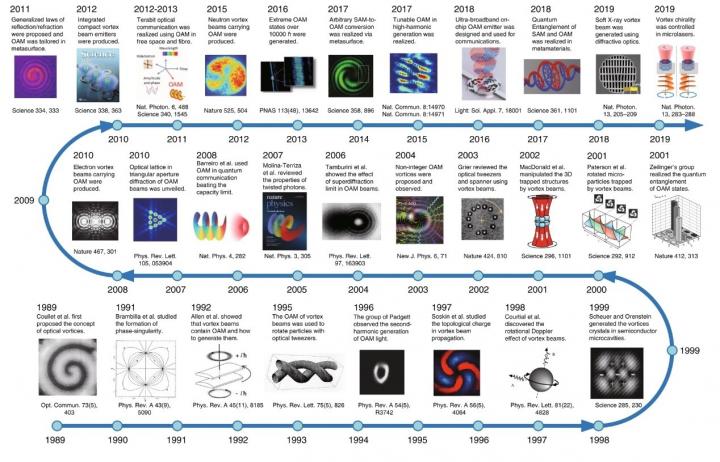
Vortices are common phenomena that widely exist in nature, from quantum vortices in liquid nitrogen to ocean circulation and typhoon vortices and even to spiral galaxies in the Milky Way. Vortices also exist in optics, the concept of which was first proposed by theoretical physicist Pierre Coullet and colleagues [Opt. Commun. 73, 403 (1989)] thirty years ago. Hitherto, owing to their amazing structures, optical vortices (OVs) have engendered tremendous advanced applications such as optical tweezers, quantum entanglement, nonlinear optics, throughout every branch of modern optics.

They divided the 30-year development of OVs into three stages: the first 10 years is the fundamental theories stage that new physical concepts and novel physical phenomena were put forward during this stage, such as topological charge, phase singularity, vortex lattice, orbital angular momentum (OAM), and vortex beams with the spiral wave front, which laid solid theoretical foundations for the subsequent scientific applications; the second 10 years is the application development stage that due to the characteristics of singular phase of OV and high dimension of OAM, optical vortices bring a unique kind of light sources with superior performance for the applications of quantum technology, optical tweezers and particle manipulation, super-resolution imaging, biomedical and chemical detection, high-capacity optical communication etc.; The recent 10 years is the technology breakthrough stage that metasurface has brought OV into nanoscale, OAM-multiplexing has extended the capacity of optical communication to terabit- even petabit-level, and improved tunability of OV has realized novel nonlinear and quantum phenomena, pushing OV as one of the hottest scientific topics.

In this review paper, they also explained how the concept of optical vortices emerged from observed similarities between the behavior of fluid vortices and some forms of laser light. The light waves of optical vortices are twisted around their direction of travel, with a point of zero intensity at their center. The authors surveyed the steady refinement of techniques used to create optical vortices, and explore their applications. They emphasized that the tunability of OVs includes not only the spectral and temporal tunability but also the OAM-, chirality-, topological-charge-, and singularity-distribution tunability. Prominent applications include sophisticated optical computing processes, novel microscopy and imaging techniques, the creation of ‘optical tweezers’ to trap particles of matter, and optical machining using light to pattern structures on the nanoscale.

###

Media Contact
Xing Fu
[email protected]

Related Journal Article

http://dx.doi.org/10.1038/s41377-019-0194-2

Tags: Chemistry/Physics/Materials SciencesOptics
Share15Tweet10Share3ShareShareShare2

Related Posts

Artificial Intelligence Transforms Material Synthesis Methods

Artificial Intelligence Transforms Material Synthesis Methods

July 10, 2026
Computer Chip Uses Vibrations for Memory Storage

Computer Chip Uses Vibrations for Memory Storage

July 10, 2026

Rapid Screening Advances Discovery of Nanocrystals

July 10, 2026

New Eco-Friendly Method Developed for Alcohol Oxidation

July 10, 2026
Please login to join discussion

POPULAR NEWS

  • Detection of EDCs in Breast Milk and Infant Urine Up to Six Months Highlights Early Exposure Risks

    77 shares
    Share 31 Tweet 19
  • New Drug Candidate Developed at McMaster Shows Potential for Treating Brain Cancer

    58 shares
    Share 23 Tweet 15
  • KTU Researchers Explore Ultrasound’s Role in Enhancing Blood Flow Beyond Diagnostics

    53 shares
    Share 21 Tweet 13
  • 高齢者の骨粗鬆症治療の持続性比較

    51 shares
    Share 20 Tweet 13

About

We bring you the latest biotechnology news from best research centers and universities around the world. Check our website.

Follow us

Recent News

Long-Term Stem Cell Data Boosts Chronic Stroke Recovery Research

Hantavirus Risks and Pandemic Potential from Nature Cruises Explored

Study Explores Traditional Chinese Medicine for Treating Post-COVID Syndrome

Subscribe to Blog via Email

Enter your email address to subscribe to this blog and receive notifications of new posts by email.

Join 84 other subscribers
  • Contact Us

Bioengineer.org © Copyright 2023 All Rights Reserved.

Welcome Back!

Login to your account below

Forgotten Password?

Retrieve your password

Please enter your username or email address to reset your password.

Log In
No Result
View All Result
  • Homepages
    • Home Page 1
    • Home Page 2
  • News
  • National
  • Business
  • Health
  • Lifestyle
  • Science

Bioengineer.org © Copyright 2023 All Rights Reserved.