• HOME
  • NEWS
  • EXPLORE
    • CAREER
      • Companies
      • Jobs
    • EVENTS
    • iGEM
      • News
      • Team
    • PHOTOS
    • VIDEO
    • WIKI
  • BLOG
  • COMMUNITY
    • FACEBOOK
    • INSTAGRAM
    • TWITTER
Saturday, May 9, 2026
BIOENGINEER.ORG
No Result
View All Result
  • Login
  • HOME
  • NEWS
  • EXPLORE
    • CAREER
      • Companies
      • Jobs
        • Lecturer
        • PhD Studentship
        • Postdoc
        • Research Assistant
    • EVENTS
    • iGEM
      • News
      • Team
    • PHOTOS
    • VIDEO
    • WIKI
  • BLOG
  • COMMUNITY
    • FACEBOOK
    • INSTAGRAM
    • TWITTER
  • HOME
  • NEWS
  • EXPLORE
    • CAREER
      • Companies
      • Jobs
        • Lecturer
        • PhD Studentship
        • Postdoc
        • Research Assistant
    • EVENTS
    • iGEM
      • News
      • Team
    • PHOTOS
    • VIDEO
    • WIKI
  • BLOG
  • COMMUNITY
    • FACEBOOK
    • INSTAGRAM
    • TWITTER
No Result
View All Result
Bioengineer.org
No Result
View All Result
Home NEWS Science News Chemistry

Combustion behavior of aromatics may provide keys to enhancing heavy oil extraction

Bioengineer by Bioengineer
October 3, 2019
in Chemistry
Reading Time: 2 mins read
0
IMAGE
Share on FacebookShare on TwitterShare on LinkedinShare on RedditShare on Telegram

Kazan University’s In-Situ Combustion Lab continues its inquiries in Journal of Industrial and Engineering Chemistry
IMAGE

Credit: Kazan Federal University

The problem of petroleum depletion becomes more and pertinent every day. As deficits arise, non-traditional and heavy oils, including bitumen and shales, emerge as the focus of extensive research. Globally, they account for about 60 to 70 percent of explored reserves. For Russia, it’s also over 60 percent.

Head of Ecooil Research Unit at Kazan University Mikhail Varfolomeev comments on this particular paper, “We studied how components and composition of oil can influence the implementation of in-situ combustion. We used model components to mimic in-situ processes and compiled our recommendations for oil companies.”

For this purpose, the team separately researches saturated fractions, aromatic fractions, tars, and asphaltenes.

Senior Research Associate of Rheology and Thermochemical Research Lab Yuan Chengdong explains, “We managed to compare the characteristics of these four components and analyze the effects of their combined combustion. The study helps to better understand the behavior of crude oil during in-situ combustion. We can understand the mechanisms of hydrocarbon oxidation because alkanes, aromatics and their oxygen-containing and sulfur-containing derivatives can be found in common motor fuels, such as petrol, diesel, and airplane fuel.”

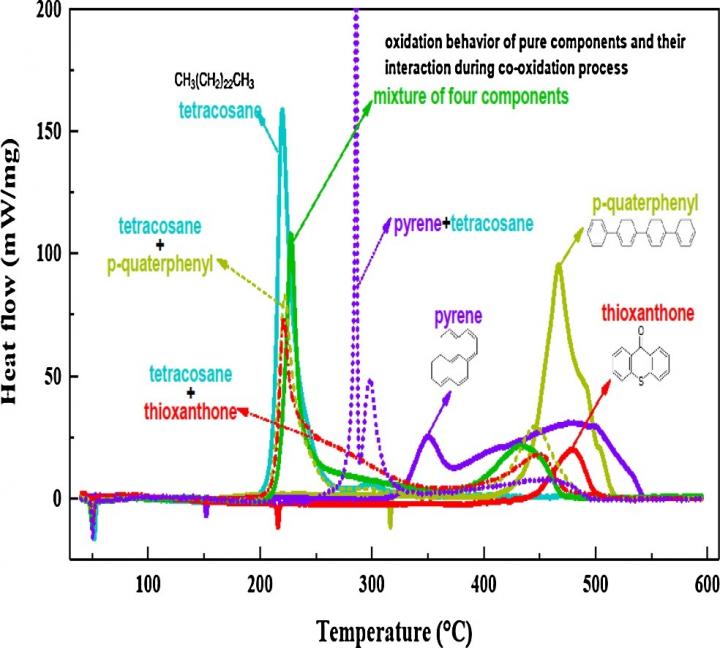
The combustion behavior of aromatics (p-quaterphenyl, thioxanthone, pyrene) and their interaction with n-alkane (tetracosane) were investigated by high-pressure differential scanning calorimetry (HP-DSC). Tetracosane only showed low-temperature oxidation (LTO), while p-quaterphenyl and thioxanthone only showed high-temperature oxidation (HTO). Pyrene exhibited a unique middle-high temperature oxidation (M-HTO). Tetracosane significantly promoted the HTO of p-quaterphenyl and thioxanthone, and shifted their HTO into lower temperatures. While p-quaterphenyl and thioxanthone did not significantly affect the occurrence of the LTO of tetracosane, but they did reduce the heat release and reaction rate of the LTO of tetracosane. The co-oxidation of tetracosane and pyrene triggered an intense interaction that exerts a strong inhibition on the LTO of tetracosane, and induces an explosive oxidation reaction followed by a mild oxidation from 280 to 325?°C. The intense interaction also significantly promoted the HTO of the pyrene. In general, the interaction strength is in turn pyrene?+?tetracosane?>?thioxanthone?+?tetracosane?>?p-quaterphenyl?+?tetracosane. Due to the strong interaction between the alkane and aromatics during their co-oxidation, the additivity of heat release in both LTO and HTO cannot be applied in terms of reaction process as well as total heat release.

###

Media Contact
Yury Nurmeev
[email protected]

Original Source

https://kpfu.ru/eng/news-eng/in-situ-combustion-aromatics.html

Related Journal Article

http://dx.doi.org/10.1016/j.jiec.2019.04.014

Tags: Earth ScienceEnergy Sources
Share12Tweet8Share2ShareShareShare2

Related Posts

Miniature Sensor Uses Light to Detect Touch — Chemistry

Miniature Sensor Uses Light to Detect Touch

May 8, 2026
Iron Minerals Determine Whether Dissolved Organic Matter Fuels Microbes or Becomes Long-Term Carbon Storage — Chemistry

Iron Minerals Determine Whether Dissolved Organic Matter Fuels Microbes or Becomes Long-Term Carbon Storage

May 8, 2026

Kate Evans Appointed Associate Lab Director for Biological and Environmental Systems Science at ORNL

May 8, 2026

Advancing Multiscale Modeling and Overcoming Operational Challenges in Autothermal CO₂-to-Methanol Reactors

May 8, 2026
Please login to join discussion

POPULAR NEWS

  • Research Indicates Potential Connection Between Prenatal Medication Exposure and Elevated Autism Risk

    839 shares
    Share 336 Tweet 210
  • New Study Reveals Plants Can Detect the Sound of Rain

    727 shares
    Share 290 Tweet 181
  • Scientists Investigate Possible Connection Between COVID-19 and Increased Lung Cancer Risk

    68 shares
    Share 27 Tweet 17
  • Salmonella Haem Blocks Macrophages, Boosts Infection

    61 shares
    Share 24 Tweet 15

About

We bring you the latest biotechnology news from best research centers and universities around the world. Check our website.

Follow us

Recent News

Estrogen Deficiency Triggers Bone EVs Causing Cell Aging

Esomeprazole vs. Fexuprazan: Anti-Inflammatory Effects Compared

Medical Care Patterns in Complex-Needs Chinese Elders

Subscribe to Blog via Email

Enter your email address to subscribe to this blog and receive notifications of new posts by email.

Join 82 other subscribers
  • Contact Us

Bioengineer.org © Copyright 2023 All Rights Reserved.

Welcome Back!

Login to your account below

Forgotten Password?

Retrieve your password

Please enter your username or email address to reset your password.

Log In
No Result
View All Result
  • Homepages
    • Home Page 1
    • Home Page 2
  • News
  • National
  • Business
  • Health
  • Lifestyle
  • Science

Bioengineer.org © Copyright 2023 All Rights Reserved.