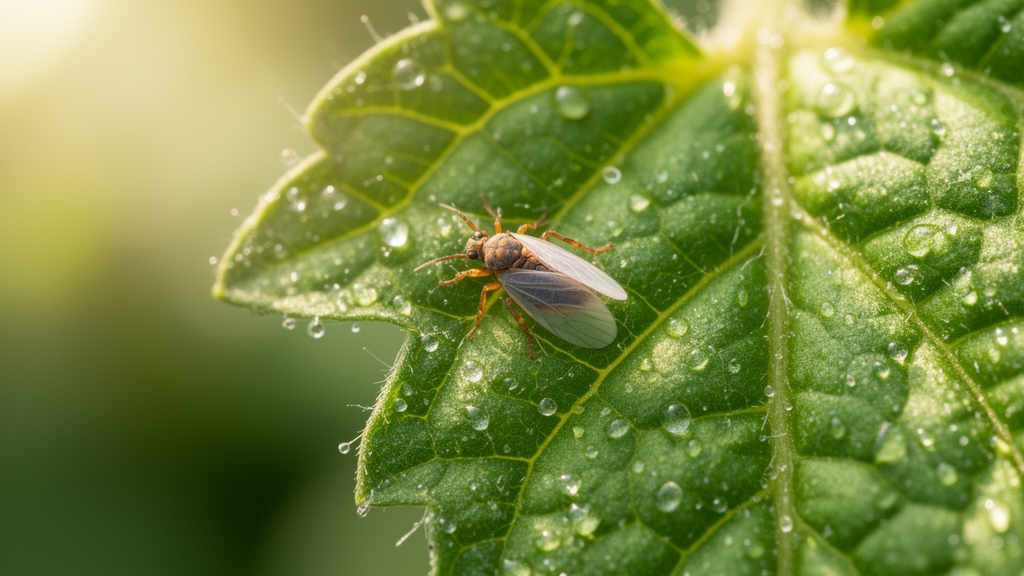
Combining selective insecticides with the predatory mite Amblyseius swirskii achieved the highest overall suppression of invasive Mediterranean Bemisia tabaci whiteflies in greenhouse cage trials on potted salvia, according to research published in Frontiers in Insect Science.
The investigation evaluated a neonicotinoid stewardship approach for managing Bemisia tabaci biotype Q, also known as the MED whitefly. In greenhouse ornamental production, this invasive insect represents a major pest problem because repeated chemical applications have led to an increased reliance on neonicotinoid insecticides. This prolonged chemical dependence has intensified concerns among researchers and growers regarding pest resistance and long-term control failure, highlighting the need to identify effective conventional and non-neonicotinoid alternatives.
To address these concerns, the research team examined selected insecticides for their efficacy against MED whitefly life stages and assessed their compatibility with A. swirskii, a predatory mite widely used as a biological control agent in protected crops. The experiments were carried out on potted salvia plants under greenhouse cage conditions. The researchers tested four distinct treatments throughout an eight-week evaluation period: an untreated control, insecticide applied alone, A. swirskii released alone, and a combined treatment pairing A. swirskii with an insecticide.
Across the eight-week study period, six chemical treatments successfully reduced MED whitefly populations: dinotefuran, cyantraniliprole, pyrifluquinazon, flupyradifurone, spinetoram plus sulfoxaflor, and afidopyropen. In contrast, pymetrozine provided comparatively weak and inconsistent suppression of the pest. Although multiple insecticides demonstrated efficacy on their own, the highest overall level of suppression across the trials was generally achieved by the combined insecticide and A. swirskii treatments.
The trials further revealed that predator compatibility differed substantially across the evaluated chemical options. Researchers documented the continuous recovery of overlapping A. swirskii generations in the dinotefuran, cyantraniliprole, flupyradifurone, pymetrozine, and afidopyropen combination treatments. This sustained reproduction indicated substantial compatibility between these specific insecticides and the predatory mite in protected ornamental settings.
In contrast, pyrifluquinazon and the spinetoram plus sulfoxaflor mixture appeared less favorable for sustained predator establishment. The authors noted that effective MED whitefly suppression can be accomplished without exclusive dependence on neonicotinoids. By identifying several chemistries that can be integrated directly with A. swirskii, the study provides a practical framework for integrated pest management programs that strengthen biological control, support resistance management, and expand rotation options in greenhouse ornamentals.
Subject of Research: Neonicotinoid stewardship and biological control compatibility for greenhouse whitefly management
Article Title: Neonic stewardship for MED Bemisia tabaci management: evaluating insecticide alternatives and biological control compatibility in greenhouse ornamentals
Article References: Jha, V., Kakkar, G., Dahal, S., Osborne, L. S., & McKenzie, C. (2026). Neonic stewardship for MED Bemisia tabaci management: evaluating insecticide alternatives and biological control compatibility in greenhouse ornamentals. Frontiers in Insect Science, 6, 1925775. https://doi.org/10.3389/finsc.2026.1925775
Image Credits: AI Generated
DOI: 10.3389/finsc.2026.1925775
Keywords: Bemisia tabaci, MED whitefly, biotype Q, Amblyseius swirskii, predatory mites, biological control, neonicotinoid stewardship, greenhouse ornamentals, potted salvia, integrated pest management, insecticide resistance, cyantraniliprole, flupyradifurone, afidopyropen, dinotefuran, pyrifluquinazon, spinetoram, sulfoxaflor
News Source: Drew Townsend. (November 18, 2026). Combining Predatory Mites with Selective Insecticides Enhances Greenhouse Whitefly Control. Scienmag.