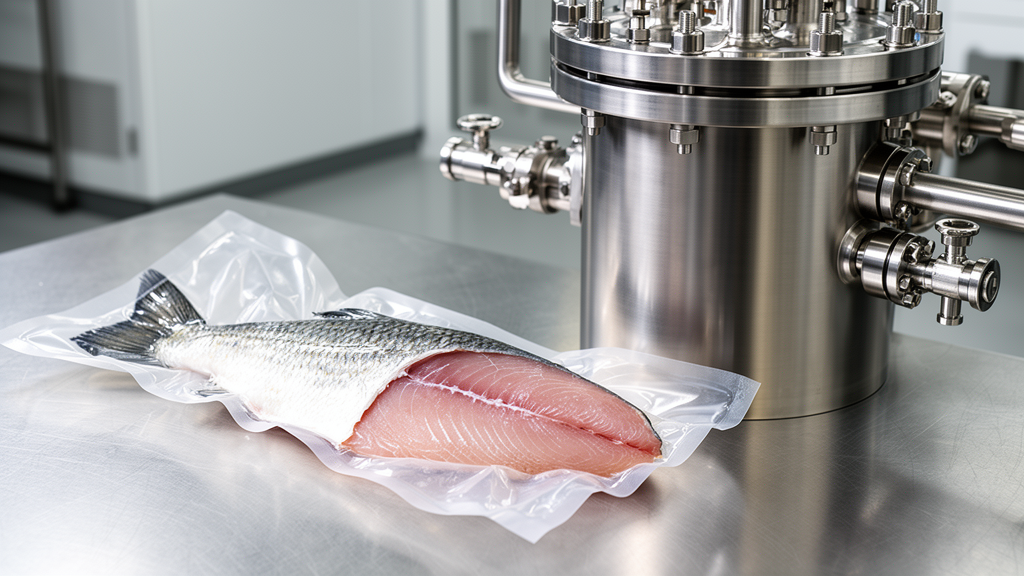
Combining sous-vide cooking with high-hydrostatic pressure processing effectively extends the refrigerated shelf life of barramundi meat while maintaining sensory quality, according to a study published in Food Chemistry: X. The research demonstrates that a sequential treatment of 55 °C for 30 minutes followed by 500 MPa for 5 minutes significantly reduces microbial loads and delays the accumulation of spoilage indicators compared to untreated controls or single treatments. The study, conducted by researchers in Taiwan, utilized commercially slaughtered farmed barramundi to evaluate the physicochemical, microbiological, and sensory changes over a 15-day refrigerated storage period at 4 °C.
Sous-vide cooking, which involves vacuum sealing and low-temperature heating, is widely used to preserve moisture and texture in seafood, but it often fails to achieve complete microbial inactivation when temperatures remain below 70 °C. To address this limitation, high-hydrostatic pressure (HP) processing was applied as an additional preservation step. HP is a non-thermal technology that applies extreme pressure to reduce spoilage-associated microbial loads without significantly altering flavor or nutrient content. The researchers hypothesized that the sublethal thermal stress induced by sous-vide would increase the susceptibility of certain bacterial taxa to subsequent high-pressure treatment, leading to a synergistic preservation effect.
The experimental design involved 30 farmed barramundi, which were filleted and cut into uniform pieces before being pooled to minimize biological variability. The samples were divided into four treatment groups: an untreated raw control, sous-vide only, high-pressure only, and a combination of both. Each group was stored at 4 °C for 15 days, with analyses conducted at three-day intervals. The study measured aerobic plate count (APC), psychrotrophic bacteria count (PBC), H₂S-producing bacteria count, and Enterobacteriaceae levels, alongside color, texture, total volatile basic nitrogen (TVBN), and sensory acceptability. High-throughput sequencing (HTS) of 16S rRNA genes was also performed to characterize bacterial community composition at the start and end of the storage period.
Immediately after treatment, the combination of sous-vide and high-pressure processing resulted in the most significant reduction in microbial loads. The aerobic plate count in the untreated control was approximately 4.22 log CFU/g, whereas the combined treatment reduced this to below the detection limit of 2.0 log CFU/g. Similarly, Enterobacteriaceae counts dropped from 2.41 log CFU/g in the control to below 1.0 log CFU/g in all treated groups. The researchers noted that the enhanced microbial inactivation in the combined treatment likely represents a sequential hurdle effect, where thermal stress permeabilizes microbial cell membranes, sensitizing surviving bacteria to irreversible membrane disruption under high pressure.
During the 15-day refrigerated storage, the untreated control samples exhibited rapid microbial growth, with the aerobic plate count reaching approximately 8.83 log CFU/g by day 15. In contrast, the combined treatment group showed no detectable bacterial growth until day 6, with the count only reaching 4.12 log CFU/g by the end of the period. The high-pressure only group also demonstrated strong inhibitory effects, with no detectable growth of psychrotrophic bacteria or H₂S-producing bacteria throughout the storage. The sous-vide only group showed the weakest antimicrobial activity, with microbial counts increasing steadily over time, although still slower than the untreated control.
Chemical and sensory analyses further supported the preservation effects of the combined treatment. Total volatile basic nitrogen (TVBN), a key indicator of fish freshness, increased over time in all groups but remained below the regulatory limit of 25 mg/100 g for the high-pressure and combined treatment groups throughout the 15 days. The untreated control exceeded this limit by day 12, while the sous-vide only group exceeded it by day 15. Sensory scores, evaluated by a panel of seven trained assessors, declined over storage time but remained above the acceptability threshold of 12 for the high-pressure and combined groups at day 15. The control and sous-vide groups fell below this threshold by days 12 and 15, respectively.
Texture analysis revealed that the combined treatment resulted in the highest hardness, reaching 54.50 N immediately after processing, compared to 28.00 N for the control. This increase in firmness is attributed to protein denaturation and aggregation induced by both heat and pressure. While the combined treatment increased hardness, it also reduced cohesiveness and chewiness, potentially indicating a more brittle structure. Color measurements showed that all treatments increased the lightness (L*) and whiteness (W) of the fish, resulting in an opaque, bright white appearance. The combined treatment produced a lower overall color difference (ΔE) compared to single treatments, suggesting a more stable color profile during the initial processing phase.
High-throughput sequencing provided insights into the shifts in bacterial community composition. In fresh barramundi, dominant genera included Cutibacterium, Cetobacterium, and Streptococcus. After 15 days of storage, the control group was dominated by spoilage-associated genera such as Serratia (45%) and Raoultella (24%), which belong to the family Enterobacteriaceae. In the combined treatment group, the relative abundance of these Enterobacteriaceae-associated genera was markedly reduced. Instead, genera such as Kocuria, Enterococcus, and Sphingobium became predominant. The researchers noted that while 16S rRNA sequencing detects bacterial DNA from both viable and dead cells, the reduction in Enterobacteriaceae sequences in the combined group aligns with the absence of detectable growth in culture-based enumeration.
The study highlights the potential of combined sous-vide and high-pressure processing as a strategy for extending the shelf life of ready-to-eat seafood products. The sequential application of thermal and pressure treatments appears to create a more effective barrier against microbial spoilage than either method alone. However, the researchers emphasized that the precise shelf-life endpoints could not be determined due to the three-day sampling intervals. Therefore, the high-pressure and combined treatments are considered to maintain acceptable quality for at least 15 days under the tested conditions, rather than defining an exact expiration date.
Limitations of the study include the use of pooled samples for sequencing, which limits the ability to make statistically confirmed claims about changes in bacterial richness. Additionally, the temperature history experienced by microorganisms within the fish matrix during high-pressure treatment could not be directly determined, meaning the contribution of temperature to microbial inactivation cannot be completely excluded. The study also did not apply kinetic models to estimate shelf life beyond the 15-day observation period. Future research should investigate different pressure levels and holding times, along with quantitative and functional analyses, to better understand the mechanisms underlying microbial inactivation and community shifts in barramundi meat.
The study utilized commercially slaughtered farmed barramundi, a tropical aquaculture species characterized by high protein content and low connective tissue. Because the fish were procured post-mortem from a local factory in Kaohsiung, Taiwan, no live animals were handled or euthanized by the authors, and formal approval from an Institutional Animal Care and Use Committee was not required. The researchers selected a sous-vide condition of 55 °C for 30 minutes based on previous literature indicating that this temperature range balances texture preservation with microbial reduction in fish muscle. Similarly, the high-pressure treatment of 500 MPa for 5 minutes was adopted as a literature-informed working condition rather than a statistically optimized parameter for barramundi specifically. These parameters were intended to provide a consistent starting point for evaluating the combined effects of thermal and pressure stress on the meat’s quality attributes.
During the high-pressure processing, the temperature of the water-based pressure-transfer fluid increased by approximately 2.5 °C for every 100 MPa of pressure applied. At the target pressure of 500 MPa, the fluid reached a peak temperature of about 30.5 °C from an initial 18 °C. Because this temperature was measured in the external system rather than at the center of the fish samples, the exact thermal history experienced by microorganisms within the meat could not be directly determined. Consequently, the researchers interpreted the treatment as a combined pressure and temperature exposure, acknowledging that the contribution of heat to microbial inactivation cannot be completely excluded. This distinction is important for understanding the mechanism of preservation, as the process was not strictly pressure-only.
Sensory evaluation was conducted by seven trained non-smoking panelists who underwent 15 hours of training to assess odour, colour, appearance, and texture. The panelists scored each attribute on a five-point scale, with a total score of 12 serving as the acceptability threshold. The protocol was approved by the Institutional Review Board, and informed consent was obtained from all participants. Because the treatments altered the initial visual appearance of the fish, the colour and appearance scores reflected the perceived sensory attributes of the processed samples rather than their similarity to raw fish. This approach allowed the researchers to track the decline in sensory quality over time, providing a subjective measure of spoilage that complemented the objective microbiological and chemical data.
The study also examined the presence of Legionella in the bacterial community profiles. While Legionella is naturally found in freshwater environments, its detection in seafood is often associated with contaminated water sources. Species-level classification suggested affinities to L. norrlandica and L. saoudiensis rather than the more common pathogen L. pneumophila. However, these assignments are considered tentative because no independent species-level confirmation was applied. The absence of L. pneumophila reads in the sequencing data does not prove the product was free of food-safety hazards, as targeted pathogen-specific assays would be required for such a conclusion. Therefore, the Legionella findings are presented primarily as observations of community composition rather than indicators of immediate safety risks.
Subject of Research: Microbial inactivation and shelf-life extension of barramundi via combined sous-vide and high-hydrostatic pressure processing
Article Title: Effect of high-hydrostatic pressure for microbial inactivation and shelf-life extension of sous-vide cooked barramundi meats
Article References: Chien, H.-I., Huang, C.-H., Lin, C.-S., Hwang, C.-C., Zhang, E.-C., Lee, Y.-C., & Tsai, Y.-H. (2026). Effect of high-hydrostatic pressure for microbial inactivation and shelf-life extension of sous-vide cooked barramundi meats. Food Chemistry: X, 40, Article 104714. https://doi.org/10.1016/j.fochx.2026.104714
Image Credits: AI Generated
DOI: 10.1016/j.fochx.2026.104714
Keywords: barramundi, sous-vide, high-hydrostatic pressure, shelf life, microbial inactivation, food safety, 16S rRNA sequencing, TVBN, sensory quality, aquaculture, Effect, high-hydrostatic
News Source: Bethany Barker. (November 9, 2026). Combined Sous-Vide and High-Pressure Processing Extends Barramundi Shelf Life. Scienmag.