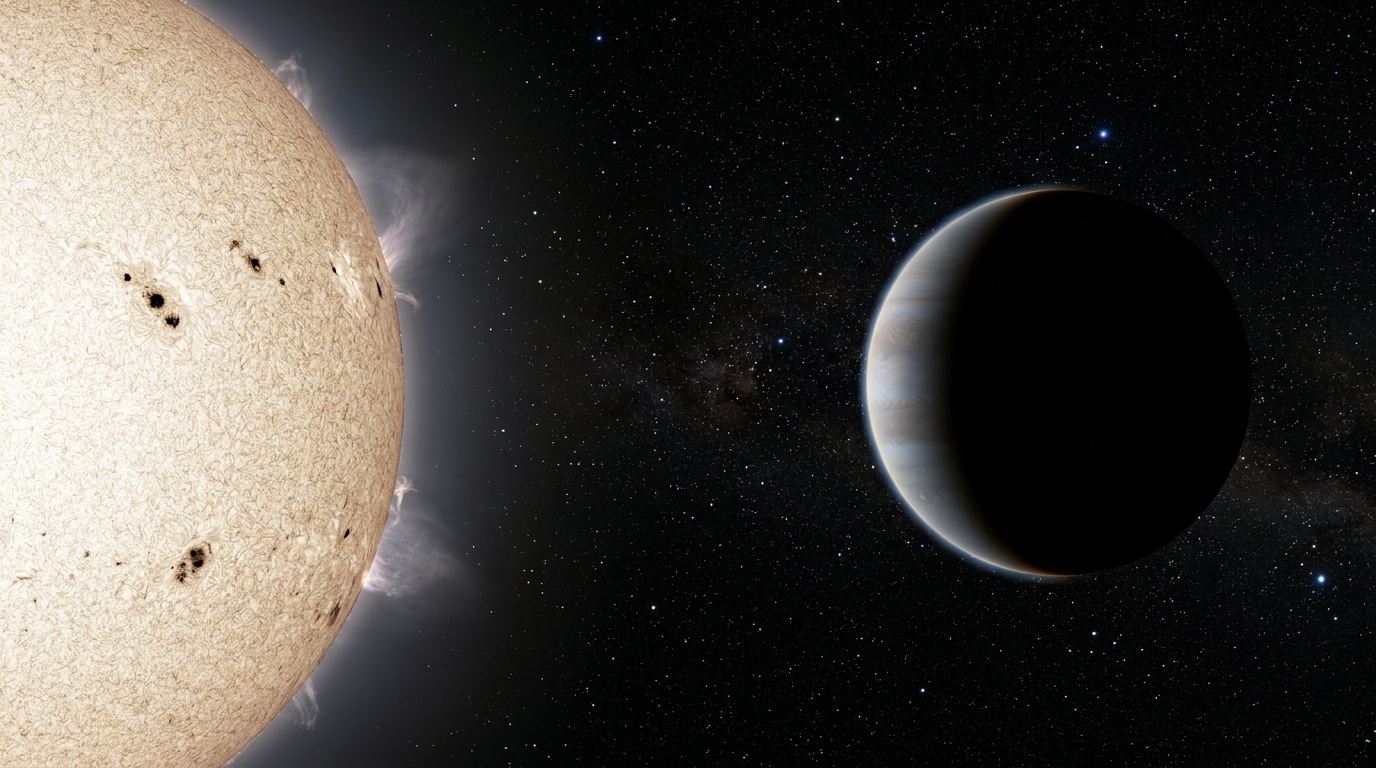
Researchers combining theoretical calculations with existing observational data have established new constraints on the hypothetical electric and magnetic properties of dark matter, despite finding no direct evidence of the elusive substance. In a statistical analysis published in the Journal of Cosmology and Astroparticle Physics, physicists Alejandro Ibarra, Merlin Reichard, and Gaurav Tomar evaluated how planets and stars might act as natural collection points for slow-moving dark matter particles. By analyzing observations of the Sun, Earth, Jupiter, and white dwarfs, the research team ruled out specific combinations of particle masses and interaction characteristics that laboratory detectors had left open. While dark matter continues to evade direct detection across terrestrial experiments, these celestial bounds offer fresh guidance for narrowing the theoretical parameters of future astrophysical searches.
Dark matter is estimated to constitute approximately 85 percent of all matter in the universe, yet its presence has been revealed almost entirely through its gravitational effects on visible cosmic structures. This presents an ongoing catch-22 for physicists: without observing dark matter directly, scientists cannot definitively establish what it is, but without knowing its precise properties, designing experiments to locate it remains exceptionally difficult. Conventional terrestrial experiments are constructed to test diverse hypotheses regarding its underlying nature, but none have achieved a confirmed direct detection. One prominent theoretical possibility is that dark matter particles participate in very weak electric or magnetic interactions with ordinary matter alongside their gravitational pull, perhaps carrying an extraordinarily tiny electric charge or functioning like minute magnets. Slower-moving particles might impart insufficient kinetic energy during collisions within human-made terrestrial detectors to trigger a measurable response. Conversely, when such slow particles traverse massive celestial bodies, losing merely a slight quantity of energy through collisions can render them gravitationally bound and unable to escape.
Once trapped by the gravitational pull of stars or planets, these captured particles would gradually sink and accumulate within the central regions of celestial bodies over billions of years. Confining dense concentrations of particles inside such compact interior spaces significantly increases the probability of mutual encounters. Depending on their fundamental physical properties, these trapped particles could undergo annihilation processes in which they convert into other particles. Such annihilation products can either deposit their energy directly into the interior of the celestial host, generating internal heating, or escape into surrounding space in forms that instruments can measure. In their investigation, the authors examined four specific celestial bodies: the Sun, Earth, Jupiter, and white dwarfs. For Earth and the Sun, the researchers evaluated observational data gathered from neutrino searches, including the IceCube neutrino observatory located at the South Pole. Because neutrinos interact very weakly and can penetrate massive quantities of dense matter, any neutrinos generated by dark matter annihilations deep inside the Sun or Earth could escape to reach terrestrial detectors, providing indirect evidence of interior particle activity.
For Jupiter and white dwarfs, the research team applied an alternative diagnostic strategy centered on planetary and stellar heating rather than neutrino emissions. Unlike the Sun, which generates enormous internal energy through nuclear fusion, Jupiter and white dwarfs do not host ongoing nuclear fusion reactions, creating much more favorable baseline conditions for isolating potential anomalous thermal contributions. In their study, the investigators theoretically calculated the quantity of heat that captured dark matter annihilations would inject into these objects and systematically compared those calculations against the actual observed energy emitted by each body. If a given dark matter model predicted that captured particles alone would generate a greater amount of heat than the celestial body is observed to radiate into space, that specific scenario could be formally excluded. This comparative energetic evaluation enabled the researchers to constrain parameter spaces that were previously consistent with laboratory constraints.
The resulting comparisons successfully ruled out multiple combinations of dark matter particle mass and electromagnetic properties that previous experimental efforts had left undetermined. The analysis demonstrated that Earth was particularly effective as a probe for testing whether dark matter particles carry a minute electric charge. In contrast, observations of white dwarfs proved especially capable of placing stringent upper limits on other possible electromagnetic characteristics, such as miniature magnetic behaviors. By taking advantage of the vast physical dimensions, intense gravitational fields, and multi-billion-year exposure times of these astronomical bodies, the authors were able to probe physical regimes that remain extraordinarily difficult or impossible to recreate and evaluate within controlled laboratory settings on Earth.
Nevertheless, the researchers emphasized that the newly derived limits are subject to important methodological assumptions and observational uncertainties, most notably regarding the local abundance of dark matter surrounding the examined stars. Because a higher local ambient density of dark matter would naturally cause a star to capture a greater number of particles over billions of years, the calculated bounds are sensitive to ambient environmental estimates. Corresponding author Gaurav Tomar of the Center for Quantum Spacetime at Sogang University in South Korea pointed out that the dark matter density surrounding the white dwarfs analyzed in the study—which reside within the M4 cluster—has not been directly measured. Instead, the team relied on density values estimated from theoretical models. Consequently, if future observational or astrophysical assessments revise these regional density estimates, the resulting limits on dark matter electromagnetic properties would correspondingly become either weaker or stronger.
Looking ahead, the authors identified several promising observational avenues that could further refine limits on dark matter properties or aid future detection efforts. Tomar highlighted that searching for even colder white dwarf stars situated within denser dark matter environments would provide substantially cleaner observational conditions, as any excess heat produced by accumulated dark matter would stand out much more conspicuously against a cooler stellar surface. Furthermore, the researchers pointed to exoplanets located beyond our Solar System as additional candidate dark matter traps. As astronomical instruments advance and expand observational catalogs of distant planets and cold stellar remnants, these natural astrophysical probes may continue to narrow the viable physical properties of dark matter particles across the cosmos.
Subject of Research: Celestial constraints on dark matter electromagnetic interactions
Article Title: The Sun, Earth, Jupiter and white dwarfs: potential traps for dark matter
Article References: The Sun, Earth, Jupiter and white dwarfs: potential traps for dark matter. Original publication (Bibliographic details unavailable.)
Image Credits: AI Generated
DOI: Not provided
Keywords: dark matter, celestial probes, white dwarfs, Jupiter, Sun, Earth, Journal of Cosmology and Astroparticle Physics, neutrinos, IceCube, electromagnetic interactions, particle annihilation, M4 cluster, gravitational capture, dark matter density, exoplanets, Gaurav Tomar, Alejandro Ibarra, Merlin Reichard
News Source: Grant Pearson. (November 17, 2026). Planets and Stars Set New Limits on Dark Matter Electromagnetic Properties. Scienmag.