Research team’s project to extend the excited lifetime of atoms could pave the way for new quantum applications and devices
Credit: Illustration: Sebastian Will
A team of Columbia University scientists has been awarded $2 million to execute a project aimed at extending the excited state lifetime of atoms, allowing for new technological innovation and advancing the field of quantum science.
The project is among the first to be chosen for federal funding for quantum research since the announcement of the National Quantum Initiative Act, signed into law by President Trump last December. The act provides for a coordinated federal program to accelerate quantum research and development for economic and national security. It allocates $1.2 billion in government funds to advance the application of quantum physics to real-world problems in the United States over the next five years.
Out of 200 pre-proposals for this funding opportunity, only 19 grants were awarded by the National Science Foundation (NSF). Of those, the proposal put forth by Principal Investigator Sebastian Will (Physics), and Co-PIs Ana Asenjo-Garcia (Physics), and Nanfang Yu (Applied Physics) was one of two that received a “high priority” ranking.
“It’s an honor,” said Will, an assistant professor of physics. “This is a really unique opportunity to connect fundamental science and engineering advances and turning them into novel technology. It’s a chance to work on breakthroughs that have true potential to change the way we control the quantum world.”
The theoretical ideas behind the project constitute a paradigm shift in the fundamental understanding of light-matter interactions. The convergence between Will’s experimental expertise with ultracold atomic systems, Asenjo-Garcia’s novel theoretical ideas, and the groundbreaking hologram technology developed by Yu gives the team an edge in the race to transform light-matter interfaces. If the team can successfully achieve its goal, the result could redefine the limits of quantum applications and devices, including optical lattice clocks, quantum sensors, and quantum memories.
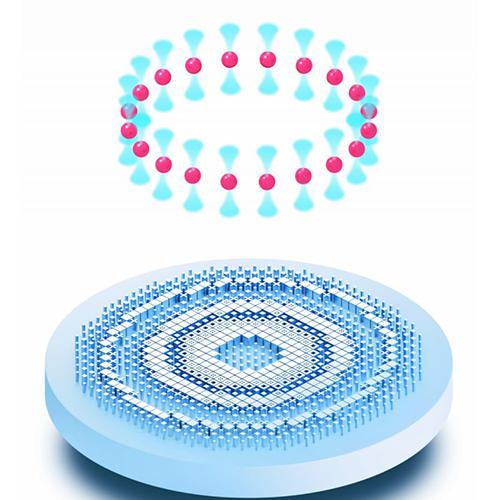
The funding, spread out over three years, will be used to build an apparatus that can trap individual atoms and allow for them to be rearranged in an arbitrary way, including 3-D structures, rings, and lines. The goal is to arrange those individually trapped atoms in an array such that they “talk” to each other by exchanging light particles, or photons, which will keep the atom in an excited state. The atom traps, formed by intense laser beams, will be generated in a novel way utilizing holographic surfaces that can shape laser beams with the utmost precision and flexibility.
When light, at a frequency chosen to excite the atom, hits an atom in the ground state, it causes an electron of the atom to jump to a higher energy level. The atom, wanting to return to the ground state, tries to lose the excitation by discarding the photon attained from the light. Finding ways to keep atoms in the excited state for a longer period of time is critical to making quantum physics useful to technology, Will explained. This is key to building things like very accurate clocks or quantum computers.
The researchers believe they can arrange several atoms in very close proximity to each other–.5 micrometers or less–in a way that, when an atom tries to eject a photon in an effort to return to the ground state, the photon interacts with a neighboring atom. If things are tuned correctly, the interaction will prevent the atom from losing its excitation. This longer storage of the photon enhances quantum coherence and helps to stabilize the “quantumness” of the array.
“This project brings together experimental and theoretical atomic physics techniques with quantum engineering expertise,” said Bogdan Mihaila, the NSF program officer overseeing this Quantum Idea Incubator research grant. “If successful in protecting collective quantum states from decay, overcoming a key limitation of existing quantum systems, this effort will demonstrate an important step forward for developing quantum memory and quantum sensors. That would achieve a primary goal of Quantum Leap, one of NSF’s 10 Big Ideas for Future Investments.”
“It’s brilliant to see exceptional early-career leadership in quantum science as recognized by this very competitive funding award,” said Peter de Menocal, dean of the School of Arts & Sciences’ Division of Natural Sciences. “We continue to make strategic investments in this discipline based on its great promise to benefit society by transforming computing, communications, and sensing. This research extends a long tradition of quantum leadership at Columbia beginning with Nobel Laureate Professor I.I. Rabi’s pioneering experiments in quantum mechanics.”
Columbia has a long and distinguished history of making extraordinary scientific contributions in physics. For more than a century, Columbia was a leader in physics theory and research, and many modern scientific and technological developments, including nuclear energy, atomic physics, molecular beams, lasers, x-ray technology, semiconductors, superconductors, and supercomputers, were built on the foundations of relativity and quantum mechanics influenced by Columbia University physicists.
“We’re excited to be part of a rebirth of quantum optics at Columbia,” Will said, explaining that the university provides unique opportunities for interdisciplinary collaborations with the collective experience and knowledge to translate fundamental science into quantum devices. “It is exciting to be working in a field where science and technology breakthroughs are ahead of us.”
###
Media Contact
Jessica Guenzel
[email protected]
212-854-0588
Original Source
https:/