• HOME
  • NEWS
  • EXPLORE
    • CAREER
      • Companies
      • Jobs
    • EVENTS
    • iGEM
      • News
      • Team
    • PHOTOS
    • VIDEO
    • WIKI
  • BLOG
  • COMMUNITY
    • FACEBOOK
    • INSTAGRAM
    • TWITTER
Thursday, May 21, 2026
BIOENGINEER.ORG
No Result
View All Result
  • Login
  • HOME
  • NEWS
  • EXPLORE
    • CAREER
      • Companies
      • Jobs
        • Lecturer
        • PhD Studentship
        • Postdoc
        • Research Assistant
    • EVENTS
    • iGEM
      • News
      • Team
    • PHOTOS
    • VIDEO
    • WIKI
  • BLOG
  • COMMUNITY
    • FACEBOOK
    • INSTAGRAM
    • TWITTER
  • HOME
  • NEWS
  • EXPLORE
    • CAREER
      • Companies
      • Jobs
        • Lecturer
        • PhD Studentship
        • Postdoc
        • Research Assistant
    • EVENTS
    • iGEM
      • News
      • Team
    • PHOTOS
    • VIDEO
    • WIKI
  • BLOG
  • COMMUNITY
    • FACEBOOK
    • INSTAGRAM
    • TWITTER
No Result
View All Result
Bioengineer.org
No Result
View All Result
Home NEWS Science News Chemistry

Color superlensing to assist in surpassing diffraction barrier

Bioengineer by Bioengineer
January 3, 2020
in Chemistry
Reading Time: 2 mins read
0
IMAGE
Share on FacebookShare on TwitterShare on LinkedinShare on RedditShare on Telegram

A paper by Kazan Federal University’s Sergey Kharintsev appeared in Optics Letters
IMAGE

Credit: Kazan Federal University


The research was supported by a Russian Science Foundation’s grant under the title “Synthesis and research of a new class of nanocomposite ceramics with degenerate dielectric permeability for opto-plasmonic applications.”

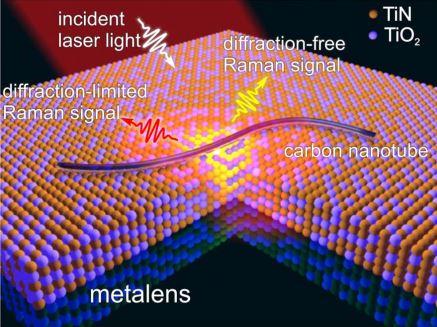
A metalens described in the article is a thin composite metal-dielectric film placed on a dielectric substrate; the width is several dozen nanometers.

“The light has a wave nature, so there is a diffraction limit which confines the resolution of traditional optical microscopy,” explains Kharintsev. “Our metalens is an optical device capable of surpassing that diffraction limit. Such a solution paves way for using optical technologies in nanoscale integral circuits and sensors.”

The ultra-high resolution is based on an unusual behavior of the metalens in optical and infrared ranges.

“The material part of the dielectric constant oscillates near zero. This property can be used to enhance stimulated Raman scattering of light in a spatially limited medium illuminated by low-intensity continuous laser light. For most materials found in nature, nonlinear effects are weak, and to observe them it is necessary to increase the length of the medium (for example, using optical fibers) and / or to increase the laser pump power (using high-power pulsed lasers).

“We used a 50 nm thick titanium oxy nitride (TiON) film as a disordered nonlinear medium. The film was synthesized by magnetron sputtering and subsequent oxidation in air. As a result of a two-stage procedure, metal (TiN) and dielectric (TiO2) nanoparticles were formed in the film. An increase in the amplitude of the Stokes wave in a TiN / TiO2 film occurs due to the enhancement of the cubic susceptibility because of localized plasmon resonance and a small refractive index of the effective medium. Such metal-insulator nanocomposite films having several epsilon-near-zero frequencies in the visible and infrared ramges have found application in creating broadband metal technologies providing resolution beyond the limits of light diffraction,” adds the author.

Kazan University employees have succeeded in visualizing 40 nm multiwall carbon nanotubes scattered along the surface of the metalens created by them, and the resolution was below 100 nm.

“Nanocomposite epsilon-near-zero film works as a surface-enhanced Raman scattering substrate, and it helps not only enhance the scattered signal, but also achieve beyond-diffraction resolutions. Metalenses and ENZ films can be used to create broadband absorbers for solar panels,” concludes Dr. Kharintsev.

###

Media Contact
Yury Nurmeev
[email protected]

Original Source

https://kpfu.ru/eng/news-eng/color-superlensing.html

Related Journal Article

http://dx.doi.org/10.1364/OL.44.005909

Tags: Chemistry/Physics/Materials SciencesMaterialsOptics
Share12Tweet8Share2ShareShareShare2

Related Posts

Advancing In Vivo and In Situ Monitoring: Science Bulletin Highlights Host-Based Antifouling Gold Nanotube Sensor for Selective Detection of Mechanically Sensitive Serotonin Release in Intestinal Mucosa — Chemistry

Advancing In Vivo and In Situ Monitoring: Science Bulletin Highlights Host-Based Antifouling Gold Nanotube Sensor for Selective Detection of Mechanically Sensitive Serotonin Release in Intestinal Mucosa

May 20, 2026
How Magnetic Orientation Could Influence the Building Blocks of Life — Chemistry

How Magnetic Orientation Could Influence the Building Blocks of Life

May 20, 2026

Breaking a 200-Year-Old Belief: Novel Surface Design Achieves Two Distinct Wetting States on One Substrate

May 20, 2026

Unveiling Sound Waves: Scientists Discover Hidden Behaviors in Acoustic Phenomena

May 20, 2026
Please login to join discussion

POPULAR NEWS

  • blank

    New Study Reveals Plants Can Detect the Sound of Rain

    733 shares
    Share 292 Tweet 183
  • ESMO 2025: mRNA COVID Vaccines Enhance Efficacy of Cancer Immunotherapy

    301 shares
    Share 120 Tweet 75
  • Research Indicates Potential Connection Between Prenatal Medication Exposure and Elevated Autism Risk

    846 shares
    Share 338 Tweet 212
  • Breastmilk Balances E. coli and Beneficial Bacteria in Infant Gut Microbiomes

    58 shares
    Share 23 Tweet 15

About

We bring you the latest biotechnology news from best research centers and universities around the world. Check our website.

Follow us

Recent News

Smart Non-Invasive System Revolutionizes Breast Ultrasound

Experts Warn of a Moral Crisis in Healthcare

Common Food Preservatives Associated with Elevated Blood Pressure and Increased Heart Disease Risk

Subscribe to Blog via Email

Enter your email address to subscribe to this blog and receive notifications of new posts by email.

Join 82 other subscribers
  • Contact Us

Bioengineer.org © Copyright 2023 All Rights Reserved.

Welcome Back!

Login to your account below

Forgotten Password?

Retrieve your password

Please enter your username or email address to reset your password.

Log In
No Result
View All Result
  • Homepages
    • Home Page 1
    • Home Page 2
  • News
  • National
  • Business
  • Health
  • Lifestyle
  • Science

Bioengineer.org © Copyright 2023 All Rights Reserved.