• HOME
  • NEWS
  • EXPLORE
    • CAREER
      • Companies
      • Jobs
    • EVENTS
    • iGEM
      • News
      • Team
    • PHOTOS
    • VIDEO
    • WIKI
  • BLOG
  • COMMUNITY
    • FACEBOOK
    • INSTAGRAM
    • TWITTER
Wednesday, May 20, 2026
BIOENGINEER.ORG
No Result
View All Result
  • Login
  • HOME
  • NEWS
  • EXPLORE
    • CAREER
      • Companies
      • Jobs
        • Lecturer
        • PhD Studentship
        • Postdoc
        • Research Assistant
    • EVENTS
    • iGEM
      • News
      • Team
    • PHOTOS
    • VIDEO
    • WIKI
  • BLOG
  • COMMUNITY
    • FACEBOOK
    • INSTAGRAM
    • TWITTER
  • HOME
  • NEWS
  • EXPLORE
    • CAREER
      • Companies
      • Jobs
        • Lecturer
        • PhD Studentship
        • Postdoc
        • Research Assistant
    • EVENTS
    • iGEM
      • News
      • Team
    • PHOTOS
    • VIDEO
    • WIKI
  • BLOG
  • COMMUNITY
    • FACEBOOK
    • INSTAGRAM
    • TWITTER
No Result
View All Result
Bioengineer.org
No Result
View All Result
Home NEWS Science News Chemistry

Colloidal Quantum Dot Photodetectors can now see further than before

Bioengineer by Bioengineer
January 16, 2020
in Chemistry
Reading Time: 3 mins read
0
IMAGE
Share on FacebookShare on TwitterShare on LinkedinShare on RedditShare on Telegram

IMAGE

Credit: ©ICFO


Optical sensing in the mid to long infrared (5microns – um) is becoming of utmost importance in different fields since it is proving to be an excellent tool for environmental monitoring, gas sensing, thermal imaging as well as food quality control or the pharmaceutical industry, to name a few. The amount of information hidden within this very rich spectral window opens new possibilities for multi or even hyperspectral imaging. Even though there are technologies that can address these challenges, they are very complex and expensive.

Even though there is a strong market need in bringing such functionalities to the consumer market, this would require a technology that is low-cost, CMOS compatible and does not impose severe regulatory concerns.

PbS Colloidal Quantum Dots (CQDs) have emerged as a cost-competitive and high performance photodetector technology, compatible with CMOS technology, which has demonstrated recently to be successful in the short-wave infrared (1-2 um). However, so far, there has been a fundamental limit: such quantum dots have relied on interband absorption of light (photons excite carrier across the bandgap of the material) and as a result there is a lower energy limit that this technology can operate: the bandgap of the material.

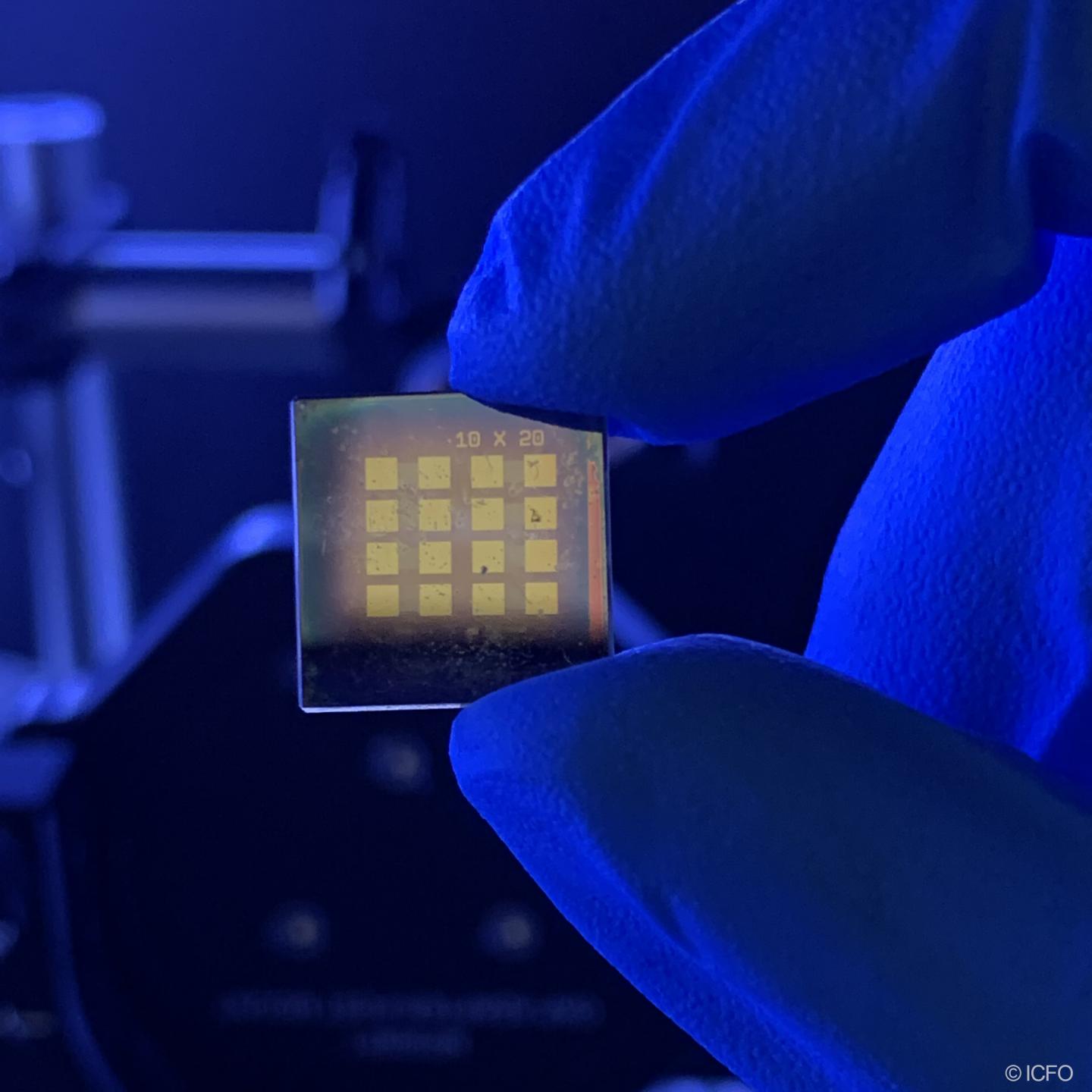
In a study recently published in Nanoletters, ICFO researchers Iñigo Ramiro, Onur Ozdemir, Sotirios Christodoulou, Shuchi Gupta, Mariona Dalmases, Iacopo Torre, led by ICREA Prof. at ICFO Gerasimos Konstantatos, now report the development of a colloidal quantum dot photodetector that is capable of detecting light in the long infrared range, from 5 um – 10 um (microns), using PbS CQDs that, for the first time, are made with mercury-free material.

In their experiment, the researchers used a technique to electronically dope the quantum dots robustly and permanently. This heavy doping approach allowed them to enable a new regime for transitions of electrons: instead of relying on transitions across the bandgap of the material, they found a way to facilitate transitions amongst higher excited states, known as intersubband (or intraband) transitions. By achieving this, they were able to excite electrons by absorbing photons with photon energies much lower than before in the mid and long wave infrared. They also demonstrated that the spectral coverage of such detectors can be tuned by changing the size of the dots, that is, the larger the quantum dots, the farther the absorption in the infrared.

The results of this study have reported a novel and unique material platform, based on heavily doped PbS CQDs covering a broad range of light, which could address and solve the challenges that the field of photodetector technologies is facing nowadays. This newly discovered property of light absorption in the long infrared together with a low-cost and maturing CQD technology may bring about a revolution to extreme broadband as well as multispectral CMOS compatible photodetectors.

###

LINKS:

Link to the paper: https://pubs.acs.org/doi/10.1021/acs.nanolett.9b04130

Link to the research group led by ICREA Prof. at ICFO Gerasimos Konstantatos: https://www.icfo.es/lang/research/groups/groups-details?group_id=30

Media Contact
Alina Hirschmann
[email protected]
0034-935-542-246

Tags: Chemistry/Physics/Materials SciencesMaterialsNanotechnology/MicromachinesOpticsSuperconductors/Semiconductors
Share12Tweet8Share2ShareShareShare2

Related Posts

How Magnetic Orientation Could Influence the Building Blocks of Life — Chemistry

How Magnetic Orientation Could Influence the Building Blocks of Life

May 20, 2026
Breaking a 200-Year-Old Belief: Novel Surface Design Achieves Two Distinct Wetting States on One Substrate — Chemistry

Breaking a 200-Year-Old Belief: Novel Surface Design Achieves Two Distinct Wetting States on One Substrate

May 20, 2026

Unveiling Sound Waves: Scientists Discover Hidden Behaviors in Acoustic Phenomena

May 20, 2026

Thermal Imaging Uncovers Altermagnetic Domains in RuO2 for the First Time, Paving the Way for Advanced Spintronic Technologies

May 20, 2026
Please login to join discussion

POPULAR NEWS

  • blank

    New Study Reveals Plants Can Detect the Sound of Rain

    732 shares
    Share 292 Tweet 183
  • Research Indicates Potential Connection Between Prenatal Medication Exposure and Elevated Autism Risk

    846 shares
    Share 338 Tweet 212
  • ESMO 2025: mRNA COVID Vaccines Enhance Efficacy of Cancer Immunotherapy

    293 shares
    Share 117 Tweet 73
  • Breastmilk Balances E. coli and Beneficial Bacteria in Infant Gut Microbiomes

    58 shares
    Share 23 Tweet 15

About

We bring you the latest biotechnology news from best research centers and universities around the world. Check our website.

Follow us

Recent News

AI System Revolutionizes Scientific Research by Automating Code Generation

Unraveling the Multifaceted Role of H2AK119 Mono-Ubiquitination in Biology and Disease

CsA+ATG Outperforms CsA Alone in Pediatric Aplasia

Subscribe to Blog via Email

Enter your email address to subscribe to this blog and receive notifications of new posts by email.

Join 82 other subscribers
  • Contact Us

Bioengineer.org © Copyright 2023 All Rights Reserved.

Welcome Back!

Login to your account below

Forgotten Password?

Retrieve your password

Please enter your username or email address to reset your password.

Log In
No Result
View All Result
  • Homepages
    • Home Page 1
    • Home Page 2
  • News
  • National
  • Business
  • Health
  • Lifestyle
  • Science

Bioengineer.org © Copyright 2023 All Rights Reserved.