


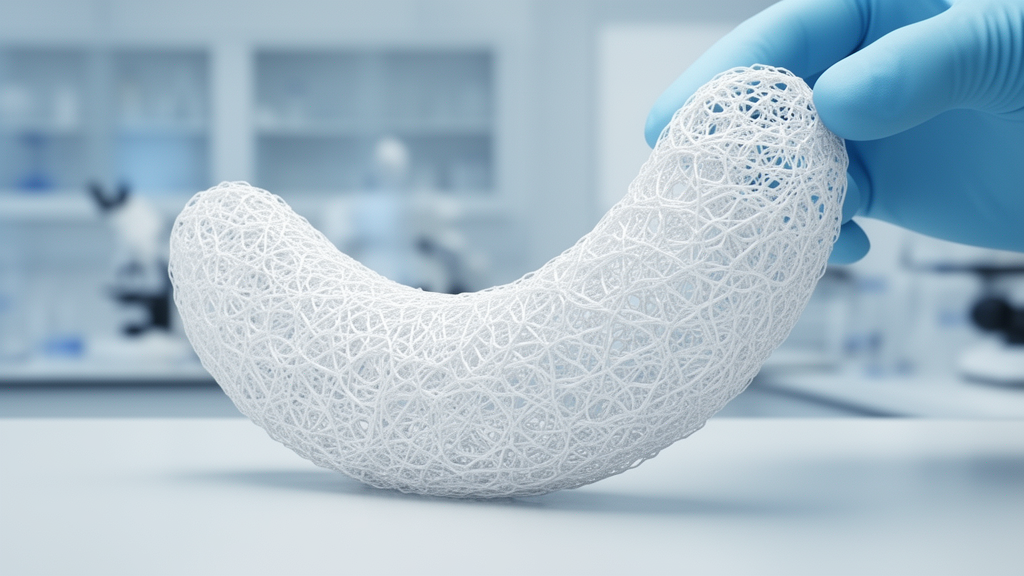
The meniscus, the wedge of fibrocartilage wedged between the femoral condyles and tibial plateau, absorbs shock, distributes load, stabilizes the knee and helps circulate synovial fluid. It is also notoriously bad at healing itself. Because blood vessels reach only the peripheral 10 to 30 percent of the tissue, the inner avascular “white zone” depends on nutrient diffusion from synovial fluid and has almost no regenerative capacity. A new review published in Collagen and Leather examines how collagen-based biomaterials, the most abundant structural protein of the extracellular matrix repurposed as implantable scaffolds, are being engineered to overcome that limitation and regenerate meniscal tissue in place.
The stakes are considerable. Meniscal tears are highly prevalent in sports-related injuries, and roughly half of patients may develop secondary osteoarthritis 10 to 20 years after the initial tear, a condition marked by worsening pain and progressive loss of joint function. Current clinical options, including suturing, trimming and partial meniscectomy, fall short: removing meniscal tissue alters the knee’s mechanical environment, accelerating cartilage wear and raising osteoarthritis risk. That gap has pushed regenerative medicine toward scaffolds that combine biology, materials science and engineering to rebuild the structure and function of the tissue in situ.
Collagen brings strong credentials to this problem. It offers excellent biocompatibility, low immunogenicity and tunable biological functions, and its side-chain chemical groups, amino groups on lysine residues plus carboxyl and hydroxyl groups on acidic residues, serve both as cell recognition sites and as anchors for crosslinking and functional modification. The review notes that collagen-based materials have already shown promise in regenerating bone, cartilage and skin; one three-layer scaffold of type II collagen, chondroitin sulfate and hydroxyapatite demonstrated favorable regeneration with minimal inflammation in a rabbit osteochondral defect model after four months.
Pure collagen, however, has a fundamental weakness for a load-bearing application: scaffolds in the kPa range cannot withstand the circumferential tensile loads and dynamic compressive stresses the native meniscus endures. The native tissue’s circumferential tensile modulus reaches approximately 100 to 300 MPa, far above its radial modulus of roughly 10 to 50 MPa, while compressive modulus ranges from 0.1 to 0.8 MPa depending on anatomical zone and test conditions. Unmodified collagen is also rapidly degraded by matrix metalloproteinases, often dissolving before new tissue has remodeled. Much of the review therefore focuses on crosslinking and composite strategies to close that mechanical gap.
Crosslinking options each carry trade-offs. Glutaraldehyde sharply increases mechanical strength and enzymatic resistance but is limited by cytotoxicity and calcification, prompting dual-crosslinking schemes that neutralize toxicity. Genipin, a natural crosslinker, improves both biocompatibility and mechanical properties with significantly lower cytotoxicity than glutaraldehyde in comparative studies. Riboflavin photocrosslinking under blue light at 465 nm increased the Young’s modulus of a collagen scaffold 2.5-fold, while enzymatic approaches such as microbial transglutaminase preserve the triple-helical structure and support cell adhesion. Physical crosslinking avoids residual chemical toxicity but yields weak networks prone to rapid degradation, and the authors argue the optimal strategy must balance mechanical enhancement against biocompatibility and degradation timing.
Fabrication technique matters as much as chemistry. Freeze-drying produces porous scaffolds with controlled pore structure; 3D printing enables precise, heterogeneous architectures, including meniscus scaffolds built from GelMA and decellularized matrix; electrospinning creates nanofibers that mimic the native fibrous arrangement, and collagen-functionalized PLA nanofibers showed strong cell adhesion and tissue regeneration in a meniscal tear model. Decellularization of native meniscal tissue offers another route, preserving the native extracellular matrix while removing immunogenic material; one optimized protocol reduced double-stranded DNA content from 130.23 to 30.49 nanograms per milligram of dry weight, below the 50 ng/mg safety threshold, while maintaining porous architecture with 10 to 40 micrometer pores favorable for cell infiltration.
The clinical benchmark is the Collagen Meniscus Implant, a scaffold of purified bovine type I collagen crosslinked with aldehydes that received FDA approval in 2008 for partial meniscal defects involving more than 50 percent tissue loss. Clinical data cited in the review indicate a success rate exceeding 80 percent at five-year follow-up, with magnetic resonance imaging showing neotissue occupying approximately 78 percent of the original meniscal volume. Lysholm knee scores rose from a preoperative average of 64.3 to 93.2 at 24 months, while pain scores during strenuous activity fell from 59 to 14. Limitations persist, however: suboptimal mechanical properties under joint loading, degradation mismatches, and occasional volume reduction or complete absorption of the implant on MRI.
Composite scaffolds aim to fix what single-component collagen cannot. Blending collagen with silk fibroin leverages silk’s high strength and toughness; a collagen-coated silk fibroin sponge showed less cartilage wear and better tissue repair than pure silk fibroin after three months in a rabbit meniscectomy model. Collagen-hyaluronic acid composites improve lubrication and hydration, collagen-chitosan scaffolds add antibacterial properties, and synthetic partners such as PCL, PLA and PLGA supply tunable strength and degradation kinetics. A PCL/decellularized matrix composite reached longitudinal and transverse tensile moduli of about 8.5 and 2.3 MPa, while a collagen-PLGA electrospun scaffold achieved a compressive modulus near 444.6 kPa. The review stresses that component selection should match the repair scenario, from weight-bearing defects to superficial tears requiring lubrication.
Pro-angiogenic strategies illustrate the field’s double-edged challenges. Microchannels wider than 150 micrometers can guide host vessels deep into a scaffold, and sustained release of growth factors such as CTGF and TGF-β3 can induce zone-specific remodeling. Yet vascularization of the inner zone carries pathological risks: increased density of CGRP-positive sensory nerve fibers has been identified as a primary cause of chronic postoperative pain, and indiscriminate use of potent pro-angiogenic factors like VEGF has led to chondrocyte hypertrophy and matrix calcification in roughly 20 percent of reported cases. The authors advocate promoting angiogenesis only in the peripheral red zone while suppressing it in the avascular interior.
Translational hurdles remain substantial. The review highlights a lack of unified testing protocols that makes cross-comparison of materials nearly impossible, notes that most studies report only static rather than dynamic fatigue properties despite the meniscus enduring millions of loading cycles annually, and points to dimensional mismatch between rabbit models, whose meniscus is 3 to 4 millimeters wide, and the human meniscus at 12 to 15 millimeters. In one ovine model with satisfactory early histological scores, 82.7 percent of implants still underwent meniscal extrusion at 12 months, losing chondroprotective function. The authors call for long-term studies in large animal models, standardized evaluation such as ASTM F3223-17, improved collagen bioinks for 3D printing, and personalized scaffold design informed by sex-specific differences in meniscal cell response to mechanical stimuli.
Subject of Research: Collagen-based biomaterials for tissue-engineered meniscus repair and regeneration
Article Title: Advances in collagen-based materials for tissue-engineered meniscus
Article References: Sun, Y., Li, J., Zhang, X., Zhan, X., Wen, Y., Li, X., Liang, J., Chen, Y., Fan, Y., & Zhang, X. (2026). Advances in collagen-based materials for tissue-engineered meniscus. Collagen and Leather, 8(1), Article 29. https://doi.org/10.1186/s42825-026-00253-w
Image Credits: AI Generated
DOI: 10.1186/s42825-026-00253-w
Keywords: meniscus, collagen, tissue engineering, biomaterials, scaffolds, crosslinking, 3D printing, decellularized matrix, osteoarthritis, knee repair, regenerative medicine, composite scaffolds
News Source: Denise Maddox. (October 29, 2026). Collagen Scaffolds Move Closer to Rebuilding the Knee’s Meniscus. Scienmag.



