• HOME
  • NEWS
  • EXPLORE
    • CAREER
      • Companies
      • Jobs
    • EVENTS
    • iGEM
      • News
      • Team
    • PHOTOS
    • VIDEO
    • WIKI
  • BLOG
  • COMMUNITY
    • FACEBOOK
    • INSTAGRAM
    • TWITTER
Saturday, May 2, 2026
BIOENGINEER.ORG
No Result
View All Result
  • Login
  • HOME
  • NEWS
  • EXPLORE
    • CAREER
      • Companies
      • Jobs
        • Lecturer
        • PhD Studentship
        • Postdoc
        • Research Assistant
    • EVENTS
    • iGEM
      • News
      • Team
    • PHOTOS
    • VIDEO
    • WIKI
  • BLOG
  • COMMUNITY
    • FACEBOOK
    • INSTAGRAM
    • TWITTER
  • HOME
  • NEWS
  • EXPLORE
    • CAREER
      • Companies
      • Jobs
        • Lecturer
        • PhD Studentship
        • Postdoc
        • Research Assistant
    • EVENTS
    • iGEM
      • News
      • Team
    • PHOTOS
    • VIDEO
    • WIKI
  • BLOG
  • COMMUNITY
    • FACEBOOK
    • INSTAGRAM
    • TWITTER
No Result
View All Result
Bioengineer.org
No Result
View All Result
Home NEWS Science News Biology

Cognitive decline not always a sign of Alzheimer’s disease

Bioengineer by Bioengineer
January 10, 2022
in Biology
Reading Time: 2 mins read
0
Cognitive Decline Not Always a Sign of Alzheimer’s Disease
Share on FacebookShare on TwitterShare on LinkedinShare on RedditShare on Telegram

At the first sign of cognitive trouble, people often worry Alzheimer’s disease is forthcoming. But poor cognition can be part of the spectrum of normality in older age, according to new research published in JNeurosci.
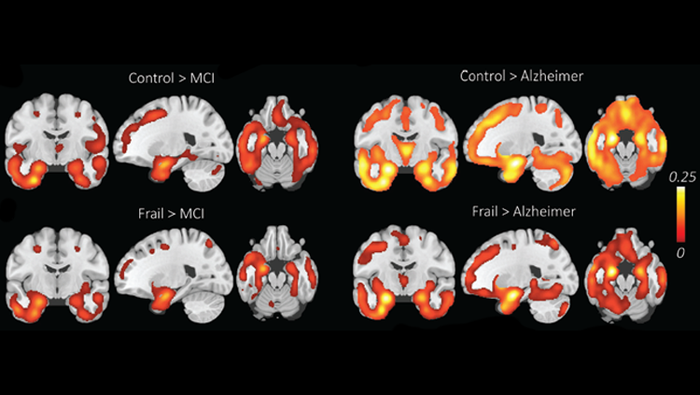
Cognitive Decline Not Always a Sign of Alzheimer’s Disease

Credit: Kocagoncu et al., JNeurosci 2022

At the first sign of cognitive trouble, people often worry Alzheimer’s disease is forthcoming. But poor cognition can be part of the spectrum of normality in older age, according to new research published in JNeurosci.

Kocagoncu et al. compared the brains of cognitively frail adults — people with reduced cognitive function who haven’t noticed memory issues — to those of adults with a mild cognitive impairment (MCI) or Alzheimer’s disease (AD) and healthy controls. They recruited healthy and cognitively frail adults from the Cambridge Centre for Ageing and Neuroscience study. Researchers measured participants’ cognition with a battery of tests, their brain structure with MRI, and their brain activity with EEG and MEG.

Cognitively frail adults performed like adults with MCI on the cognitive tests — both worse than controls. But their brain structure and activity resembled those of the healthy controls: the atrophy in regions like the hippocampus typical in adults in AD did not appear in cognitively frail adults. Impaired cognition can be part of the range of normal aging and is not always an early sign of Alzheimer’s disease. Cognitive frailty may instead hinge on lifestyle factors — many of which are reversible and modifiable — like physical activity, stress, education, and cardiovascular health.

###

Paper title: Neurophysiological and Brain Structural Markers of Cognitive Frailty Differ From Alzheimer’s Disease

Please contact [email protected] for the full-text PDF and to join SfN’s journals media list.

About JNeurosci

JNeurosci, the Society for Neuroscience’s first journal, was launched in 1981 as a means to communicate the findings of the highest quality neuroscience research to the growing field. Today, the journal remains committed to publishing cutting-edge neuroscience that will have an immediate and lasting scientific impact, while responding to authors’ changing publishing needs, representing breadth of the field and diversity in authorship.

About The Society for Neuroscience

The Society for Neuroscience is the world’s largest organization of scientists and physicians devoted to understanding the brain and nervous system. The nonprofit organization, founded in 1969, now has nearly 37,000 members in more than 90 countries and over 130 chapters worldwide.


Journal

JNeurosci

DOI

10.1523/JNEUROSCI.0697-21.2021

Method of Research

Observational study

Subject of Research

People

Article Title

Neurophysiological and Brain Structural Markers of Cognitive Frailty Differ from Alzheimer’s Disease

Article Publication Date

10-Jan-2022

Share12Tweet8Share2ShareShareShare2

Related Posts

Successful Birth Following Uterus Transplant Marks Medical Breakthrough — Biology

Successful Birth Following Uterus Transplant Marks Medical Breakthrough

May 1, 2026
Cockatoos Mimic Peers to Sharpen Adaptation Skills, Study Finds — Biology

Cockatoos Mimic Peers to Sharpen Adaptation Skills, Study Finds

May 1, 2026

Gut Microbe’s Sulfated Bile Acid Eases Pediatric Sepsis

May 1, 2026

AI Breakthrough Solves One of Science’s Most Challenging Math Problems

May 1, 2026

POPULAR NEWS

  • Research Indicates Potential Connection Between Prenatal Medication Exposure and Elevated Autism Risk

    831 shares
    Share 332 Tweet 208
  • New Study Reveals Plants Can Detect the Sound of Rain

    714 shares
    Share 285 Tweet 178
  • Scientists Investigate Possible Connection Between COVID-19 and Increased Lung Cancer Risk

    67 shares
    Share 27 Tweet 17
  • Salmonella Haem Blocks Macrophages, Boosts Infection

    61 shares
    Share 24 Tweet 15

About

We bring you the latest biotechnology news from best research centers and universities around the world. Check our website.

Follow us

Recent News

Paul and Shelia Schlosberg Family Foundation Advances Military Brain Health with Pioneering $3 Million Grant

Early Detection of Keratoconus Enhanced by Light Polarization and AI

Improving Hip Fracture Care in Frail Elders

Subscribe to Blog via Email

Enter your email address to subscribe to this blog and receive notifications of new posts by email.

Join 82 other subscribers
  • Contact Us

Bioengineer.org © Copyright 2023 All Rights Reserved.

Welcome Back!

Login to your account below

Forgotten Password?

Retrieve your password

Please enter your username or email address to reset your password.

Log In
No Result
View All Result
  • Homepages
    • Home Page 1
    • Home Page 2
  • News
  • National
  • Business
  • Health
  • Lifestyle
  • Science

Bioengineer.org © Copyright 2023 All Rights Reserved.