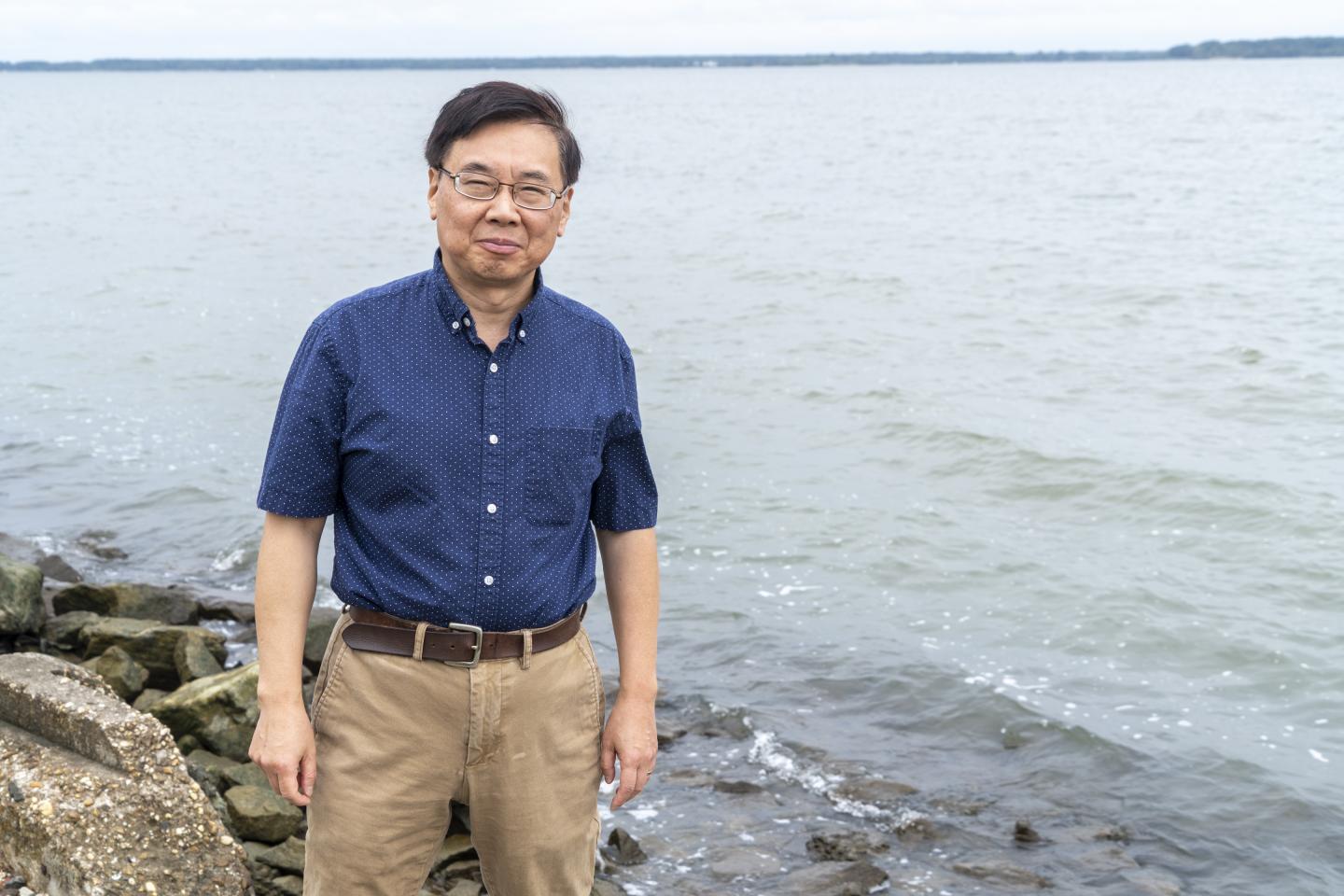
Credit: University of Maryland Center for Environmental Science/Cheryl Nemazie
CAMBRIDGE, MD (January 30, 2020)– The University of Maryland Center for Environmental Science (UMCES) has been awarded a $500,000 grant by the National Science Foundation (NSF) to lead a coalition of scientists from around the country to study the impact of storms, sea-level rise, and climate change on estuaries and bays.
This national Research Coordination Network (RCN), part of NSF’s new initiative on People and Coasts (CoPe), will synthesize insights from existing coastal resiliency projects around the country and propose bold new strategies that integrate ecosystem enhancement and recovery to protect coastal communities and infrastructure.
“The increasing severity of storms and flooding due to changing land use and climate change are testing the resilience of coastal communities and ecosystems. Much needs to be done to prepare communities and the environment to adapt,” said Peter Goodwin, president of the University of Maryland Center for Environmental Science. “This visionary NSF program reaches across the national scientific and engineering community to identify critical gaps in our current understanding and to pursue innovative technologies and strategies. UMCES is excited to bring together some of the top experts from around the country to tackle the critical environmental challenge of building coastal resilience.”
Led by UMCES oceanographer Ming Li, the coalition-based initiative called Estuarine CoPe RCN will study the impact of storms, sea-level rise, and climate change on estuaries and bays. Scientists will focus their attention on coastline management strategies such as engineered structures and natural/nature-based systems. They will also explore the human dimensions of coastal resilience. Funding will provide interdisciplinary training to young scientists through workshops and focus-group interactions.
“It is a recognition of the expertise of the University of Maryland Center for Environmental Science that we were granted this prestigious award by the National Science Foundation to study how we can make more resilient coastal communities,” said Mike Roman, director of UMCES’ Horn Point Laboratory. “The results that this top team of scientists generates will directly benefit the citizens of Maryland and beyond.”
According to the National Science Foundation, “the goal is to translate research results into specific recommendations for developing coastal resiliency solutions and seek stakeholders’ feedback to orient academic research towards addressing pressing concerns faced by urban and rural communities living around the Nation’s estuaries and bays.”
U.S. coasts feature a number of bays and estuaries within which many metropolitan cities are located, including New York City on the Hudson River, Washington, D.C. near the Chesapeake Bay, and San Francisco on San Francisco Bay. The impacts of sea-level rise and storms on estuaries and bays are just beginning to be understood, and many questions remain unanswered. Natural habitats, such as salt marshes, oyster reefs, and sand dunes offer coastal protection with ecosystem benefits, but the effectiveness and environmental impacts of these structures are not well understood.
“We are fortunate to have this opportunity to collaborate with scientists from a number of institutions across the country, including University of Maryland, College Park; University of California, Berkeley; University of California, Davis; Stevens Institute of Technology; Woods Hole Oceanographic Institution; University of Massachusetts, Dartmouth; and California Polytechnic University, San Luis Obispo,” explained organizing Professor Ming Li. “The Estuarine CoPe RCN allows us to bring together oceanographers, engineers, ecologists, and social scientists to synthesize recent research, explore open questions, and advance the transdisciplinary science of coastal resiliency.”
The first workshop will be held March 16-18 at the Stevens Institute of Technology in Hoboken, NJ, located alongside the Hudson River. One full day of the conference will be devoted to dialogues with stakeholders, inviting professionals from the infrastructure management community to provide input and further the discussion.
###
UNIVERSITY OF MARYLAND CENTER FOR ENVIRONMENTAL SCIENCE
A globally eminent research and graduate institution focused on advancing scientific knowledge of the environment, the University of Maryland Center for Environmental Science provides sound advice to help state and national leaders manage the environment and prepares future scientists to meet the global challenges of the 21st century. http://www.
Media Contact
Amy Pelsinsky
[email protected]
410-330-1389
Original Source
https:/