Trains carrying loads of coal bring with them higher rates of asthma, heart disease, hospitalization and death for residents living nearest the rail lines, according to a new study from the University of California, Davis.
Credit: UC Davis
Trains carrying loads of coal bring with them higher rates of asthma, heart disease, hospitalization and death for residents living nearest the rail lines, according to a new study from the University of California, Davis.
The study, published online today in the journal Environmental Research, focuses on the San Francisco Bay Area and is the first health impact assessment of coal train pollution in the world.
It found that coal train pollution has significant health effects that disproportionately impact communities of color and people who are young, old, or have low incomes.
While centered on East Bay neighborhoods, the study carries implications for communities worldwide living alongside passing coal trains. At least 80 countries use coal power, which generates about 40% of the world’s electricity.
“These trains run all over the world, exposing the poorest populations who often live close to the train tracks,” said lead author Bart Ostro, a scientist with the UC Davis Air Quality Research Center. “As a result, these impacts have local and global implications.”
Coal, and more coal
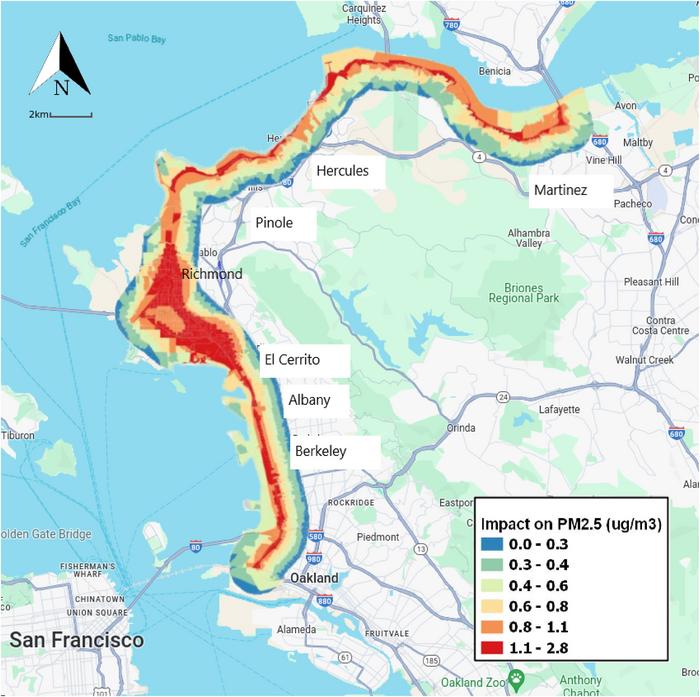
The study includes parts of Oakland, Berkeley, Martinez and Richmond, where coal is already being transported from Utah mines by rail. The assessment specifically centers on the potential health impacts of a proposed coal terminal under review, which could bring an additional 7.4 million tons of coal per year by rail to the Port of Oakland.
“That translates to about 10 trains per week potentially passing through a densely populated urban area,” Ostro said. “The trains continuously generate microscopic particles -—called PM2.5, or fine particles, which are regulated by the U.S. EPA. This results in chronic exposures. The particles can infiltrate the lungs and bloodstream and pose serious health risks.”
Health impacts of coal trains
To quantify the health impacts of PM2.5 emitted from passing coal trains, the study authors integrated air quality data with medical and demographic information using software mapping and analysis programs. They ran different scenarios for increases in PM2.5 for the roughly 262,000 people who would be exposed.
They found that, under the most severe scenario—an increase in annual fine particulates of 2.1 micrograms per cubic meter of air—six additional people would be expected to die each year among this population.
When the authors adjusted the analysis to incorporate the higher risks for people of color, an estimated 15 total deaths were possible.
The study results also suggested:
- 28 additional hospital admissions for heart disease.
- 22 new cases of asthma.
- 17 additional cases of pneumonia.
- 58,000 additional days of asthma attributable to coal train transit.
Several of these outcomes represent a 3 to 6% increase over current levels.
Under a less severe scenario (1 microgram per cubic meter of air), additional yearly health impacts would be about 50% lower.
Race-specific estimates
The study also provided race-specific estimates, finding that Hispanic and Black residents have 41% and 29% higher levels of PM25.5 exposure, respectively, relative to White residents.
“Our study is a microcosm of what likely affects millions of city residents throughout the world living near passing, uncovered coal trains that deliver coal to power plants and export terminals,” said Ostro.
Additional co-authoring institutions include UC Irvine and the California Office of Environmental Health Hazard Assessment.
The research was supported by the California Air Resources Board Community Air Monitoring Grant Program and the UC Davis Environmental Health Science Center.
Journal
Environmental Research
DOI
10.1016/j.envres.2024.118787
Method of Research
Data/statistical analysis
Article Title
Health impact assessment of PM2.5 from uncovered coal trains in the San Francisco Bay Area: Implications for global exposures
Article Publication Date
18-Apr-2024