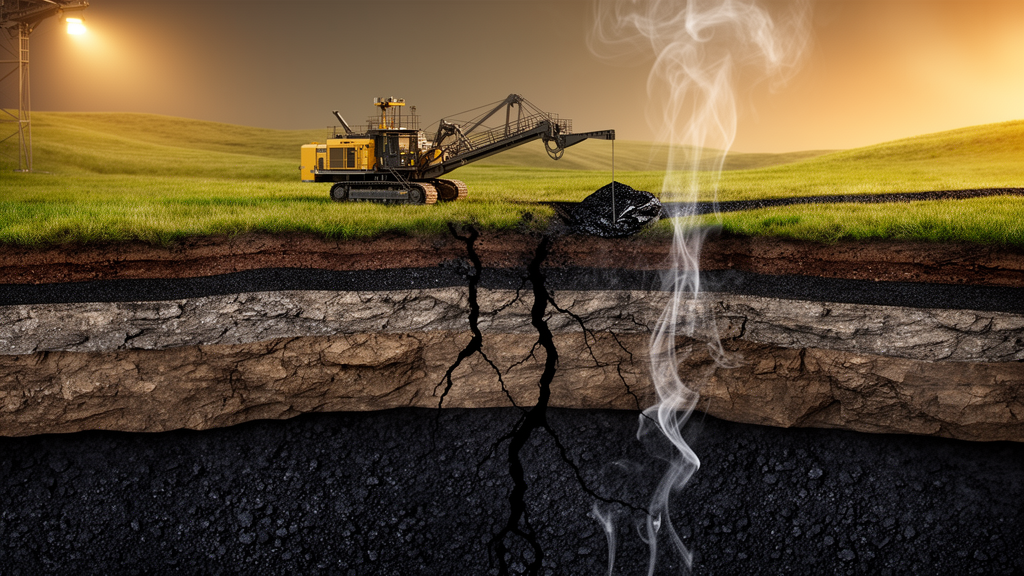
Where coal seams lie beneath uranium ore bodies, digging out the coal may quietly break the natural barrier that keeps radioactive gas away from miners. A new numerical study, published in GeoEnergy Communications, simulates what happens when underground coal extraction damages the aquitard — the low-permeability rock layer separating a uranium-bearing aquifer from the coal workings below — and finds that mining-induced fractures can open high-permeability pathways through which radon dissolved in groundwater migrates upward into the coal mining area. The work, led by Guicheng He, Jingbo Meng, He Liu and Wei Zhang, offers a methodological framework and preliminary insights into a risk that has remained insufficiently understood in coal-uranium overlapping mining regions.
The researchers built a coupled stress-damage-seepage-mass transport model to capture the chain of physical processes set in motion by coal extraction. Mining alters the stress field around the excavation, inducing damage that propagates upward through the roof strata. Changes in effective stress alter porosity, and porosity and damage together govern permeability through a damage-related form of the Kozeny-Carman relationship. Permeability changes reshape the groundwater flow field, and pore pressure under seepage conditions feeds back on the stress field. Because flowing groundwater is both the carrier and the driving force of radon advection, the seepage field ultimately determines the direction, pathway and rate of radon migration. Radon transport itself was modeled with an advection-dispersion equation that includes diffusion, a radioactive decay constant of 2.1 × 10⁻⁶ s⁻¹, and a source term representing radon generated from solid particles and released into pore water.
Before applying the model to a real geological setting, the team verified its damage predictions qualitatively against a similar-material simulation experiment. A layered numerical model with the same scaled geometry as the physical model — 1300 mm long and 810 mm high, containing mudstone, coarse sandstone, fine sandstone and coal seam layers — was mined from left to right in 50 mm steps using a regional deactivation method. The geometric similarity ratio was 1:200, the bulk density ratio 1:1.5, and the strength, stress and elastic modulus ratios 1:300. As the simulated mining face advanced from 350 mm to 750 mm, damage in the overlying strata evolved from a limited arch-shaped zone near the coal seam roof into a vertically continuous or quasi-continuous fractured structure, mirroring the progressive collapse, bending and fracture extension observed in the physical experiment. Apart from small spans, the damage heights from the two approaches agreed well in both magnitude and trend, which the authors say validates the constitutive relations, failure criteria and parameter calibration of the numerical model.
With the model verified, the researchers constructed a three-dimensional geological model based on subsurface stratigraphic data from a uranium mining area, measuring 700 m by 270 m by 180 m. From top to bottom, the model contains overlying strata, an upper aquitard, an ore-bearing aquifer, a lower aquitard and underlying strata. The uranium ore body sits within the ore-bearing aquifer at an approximate burial depth of 450 m, and the excavated coal seam lies within the underlying strata. Mining starts from the side farther from the uranium-bearing layer and advances toward it in 20 m steps, for a total distance of 160 m, using an arched-roof mining method. The simulation was run in COMSOL with solid mechanics, groundwater flow and diluted species transport modules, on a free tetrahedral mesh of 636,590 elements with an average element quality of 0.8613. A hydraulic head of 400 m was specified upstream of the ore-bearing aquifer and 365 m downstream, with transient flow and fully saturated aquifer conditions; some site data remain confidential, so the reported information is limited.
The stress and displacement results show a familiar mining signature with a distinctive arched twist. High-stress zones concentrate at both ends of the mining space, near the arch shoulders and ahead of the working face, while most of the overlying strata experience relatively small stress changes. As mining advances from 40 m to 160 m, the high-stress zones extend along the coal seam strike and local peak stress rises. Vertical displacement concentrates in the roof of the mining space and falls off rapidly with distance, forming a subsidence trough whose minimum deepens from approximately 0.09 m at 40 m of advance to approximately 0.13 m at 160 m. The arched-roof structure disperses roof deformation, so subsidence develops smoothly along the arch profile rather than as abrupt concentrated collapse in the middle of the roof.
The damage evolution follows the same pattern. At 40 m of mining, damage clusters near the arch shoulders, arch feet and the area ahead of the mining front, while the middle of the arch roof remains relatively intact. By 80 m the damaged zone has extended significantly along the strike, and at 120 m damage still propagates upward mainly from the arch shoulders rather than breaking directly through the central roof, unlike what a flat-roof layout would tend to produce. At 160 m, however, the arched roof can no longer fully resist the sustained disturbance: damage breaks through the near-field constraint, penetrates the aquitard, and although no large-scale through-going failure develops, the local integrity of the aquitard is significantly weakened. Permeability monitoring along a line through the upper aquitard shows the consequence — in zones unaffected by mining, permeability stays at its initial value of 1.18 × 10⁻¹⁵ m², but in damage-affected zones it rises to approximately 1.5 × 10⁻¹³ m², an increase of about two orders of magnitude.
That permeability jump redirects groundwater, and groundwater carries the radon. Under mining disturbance, the overall flow field still moves from right to left, but in the upper part of the mining region a portion of the seepage flow is deflected from the ore-bearing aquifer toward the mining-induced damaged zone, supplying the hydrodynamic conditions for radon-bearing solution to move toward the coal seam. The simulated radon plume advances progressively from the left side of the uranium ore body toward the coal mining space. After 12 months the maximum migration distance is 38.24 m; after 24 months, 71.3 m; after 48 months, 130.93 m; and after 72 months, 187.96 m. During the 48-to-72-month window the distribution shifts from a broad cluster-like shape to a concentrated wedge, indicating directional transport along high-permeability pathways. By 98 months the front has reached 239.81 m and by 120 months 268.98 m, forming concentrated local anomalies around the coal mining area before a late-stage attenuation-dispersion phase in which the peak concentration declines while migration continues.
The critical moment comes at 72 months, when the radon migration pathway begins to pass from the ore-bearing aquifer through the aquitard and into the coal mining area, and the amount of radon-bearing solution crossing the barrier increases markedly. Around the coal workings, radon concentration is nearly zero before 72 months, then climbs steadily as high-concentration zones expand along the axial direction and roof of the excavation. The average radon concentration in the coal mining area peaks at approximately 140 months, reaching 2.3 × 10⁴ Bq/m³. Thereafter, diffusion, transport and radioactive decay gradually erode the local hotspots, and the average concentration decreases and stabilizes after about 170 months at roughly 1.1 × 10⁴ Bq/m³ — a dynamic equilibrium in which radon input, diffusion, decay and dilution reach a new balance. Comparing the results with an earlier study by Zhou and colleagues, the authors note that both show an initial rise followed by a decrease and eventual stabilization, but in Zhou’s model the peak came at 30 months with stabilization after 98 months; the difference reflects the slower route in the present study, where radon must migrate with groundwater and penetrate the aquitard.
The authors stress that their findings are simulation-based and framed as a methodological framework with preliminary risk insights rather than field-confirmed measurements. The model assumes a fully saturated aquifer, neglects storage terms, and relies on damage-permeability parameters adopted from previous research on damage-seepage behavior, with the damage evolution validated only qualitatively against a scaled physical analogue. Some site data were confidential, limiting the geological detail that could be reported. Even so, the study quantifies a mechanism of direct concern to operations where uranium overlies coal: mining-induced damage weakens the aquitard’s barrier function, creates local high-permeability conduits, and allows dissolved radon to follow the deflected flow field into mine workings, where modeled concentrations remain elevated long after the initial breakthrough.
Subject of Research: Numerical simulation of mining-induced aquitard damage and cross-strata radon migration in coal-uranium overlapping areas
Article Title: Numerical investigation of aquitard damage evolution and radon migration behavior induced by mining of underlying coal seams in coal-uranium overlapping areas
Article References: He, G., Meng, J., Liu, H., & Zhang, W. (2026). Numerical investigation of aquitard damage evolution and radon migration behavior induced by mining of underlying coal seams in coal-uranium overlapping areas. GeoEnergy Communications, 2(1), Article 12. https://doi.org/10.1007/s44421-026-00024-7
Image Credits: AI Generated
DOI: 10.1007/s44421-026-00024-7
Keywords: radon, aquitard damage, coal mining, uranium deposits, groundwater seepage, permeability, numerical simulation, coupled modeling, radioactive contamination, mine safety, Numerical, investigation
News Source: Denise Maddox. (October 28, 2026). Coal Mining Can Crack Seals Above Uranium Ore and Let Radon Leak Through. Scienmag.