• HOME
  • NEWS
  • EXPLORE
    • CAREER
      • Companies
      • Jobs
    • EVENTS
    • iGEM
      • News
      • Team
    • PHOTOS
    • VIDEO
    • WIKI
  • BLOG
  • COMMUNITY
    • FACEBOOK
    • INSTAGRAM
    • TWITTER
Tuesday, July 7, 2026
BIOENGINEER.ORG
No Result
View All Result
  • Login
  • HOME
  • NEWS
  • EXPLORE
    • CAREER
      • Companies
      • Jobs
        • Lecturer
        • PhD Studentship
        • Postdoc
        • Research Assistant
    • EVENTS
    • iGEM
      • News
      • Team
    • PHOTOS
    • VIDEO
    • WIKI
  • BLOG
  • COMMUNITY
    • FACEBOOK
    • INSTAGRAM
    • TWITTER
  • HOME
  • NEWS
  • EXPLORE
    • CAREER
      • Companies
      • Jobs
        • Lecturer
        • PhD Studentship
        • Postdoc
        • Research Assistant
    • EVENTS
    • iGEM
      • News
      • Team
    • PHOTOS
    • VIDEO
    • WIKI
  • BLOG
  • COMMUNITY
    • FACEBOOK
    • INSTAGRAM
    • TWITTER
No Result
View All Result
Bioengineer.org
No Result
View All Result
Home NEWS Science News

CO2, the philosopher’s stone to obtain valuable pharmaceuticals

Bioengineer by Bioengineer
January 14, 2017
in Science News
Reading Time: 2 mins read
0
Share on FacebookShare on TwitterShare on LinkedinShare on RedditShare on Telegram
IMAGE

Credit: ICIQ

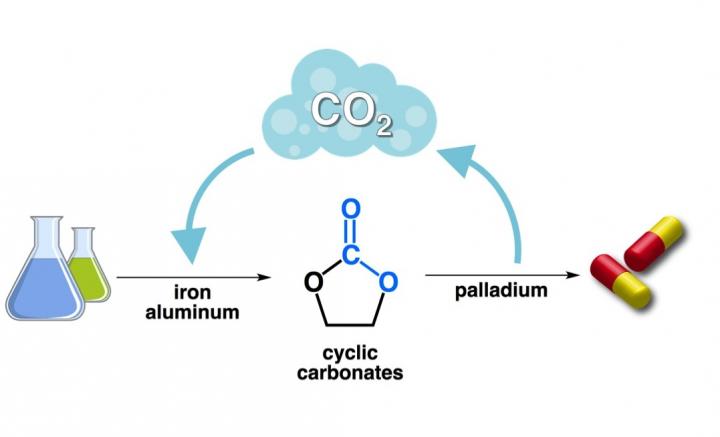
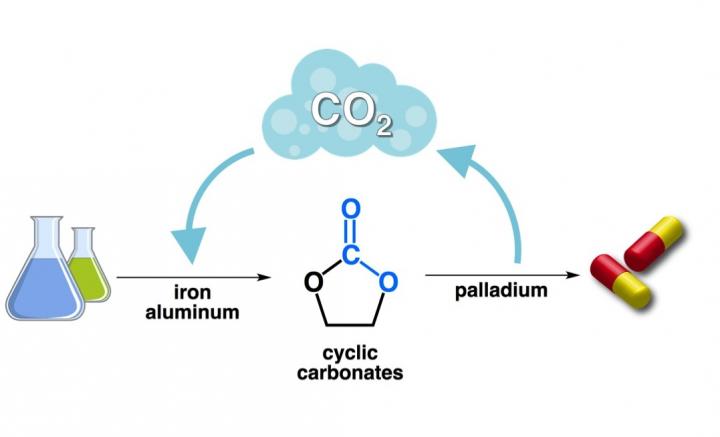
Researchers at the Institute of Chemical Research of Catalonia (ICIQ) in Tarragona have developed a method that transforms cyclic carbonates -that can be easily obtained from CO2- into more valuable, chiral molecules chemists call vicinal amino-alcohols. Amino-alcohols are used in a myriad of drugs such as antimalarials, antivirals (like Tamiflu®), analgesics and antiarrhytmics.

The group, led by Prof. Arjan Kleij, develops new methodologies to convert small molecules -like CO2 and other waste gases- into useful chemicals. In previous work, they developed various catalytic routes to functional cyclic carbonates using carbon dioxide and easily accessible chemicals. Kleij and co-workers made these transformations possible with cheap and sustainable iron and aluminium catalysts.

Now, in a new paper recently published in the Journal of the American Chemical Society, ICIQ researchers show how to transform these carbonates into more valuable, highly challenging chiral molecules known as amino-alcohols. The process uses a very efficient palladium catalyst, which is more abundant and less expensive than previously used rhodium alternatives. This reaction also releases CO2, which can be re-used to make new carbonates, thereby closing the cycle.

"Chiral amino-alcohol structures are very common in pharmaceutical products, this new methodology allows us to obtain them selectively from simple, readily available starting materials," says Aijie Cai, who carried out the experiments. "Moreover, the method is quite user-friendly, it works without any additives or special precautions in just a few hours at 0°C," he adds.

Prof. Kleij, group leader at ICIQ, comments how "many years ago we developed various efficient ways to prepare functional cyclic carbonates using CO2. Now we are focusing on their post-synthetic conversion to create more challenging molecules with wider application potential. Chiral amino-alcohols are particularly valuable for the pharmaceutical industry, because they are precursors to important drugs such as antivirals and antimalarials."

CO2 is key to all this process; it is the philosopher's stone that transforms simple chemicals into valuable drugs. Kleij typically refers to it as "CO2 facilitated chemistry": without carbon dioxide, none of the reaction steps would work. In the first step, researchers convert the gas into useful cyclic carbonates. During the second step, a palladium-catalysed CO2 elimination triggers the formation of the chiral products. The release of the gas allows the chemistry to move forward. CO2 could be recycled, making the overall process sustainable with minimal carbon emission.

###

Media Contact

Fernando Gomollón-Bel
[email protected]
34-977-920-200 x370
@ICIQchem

http://www.iciq.es/

############

Story Source: Materials provided by Scienmag
Share12Tweet8Share2ShareShareShare2

Related Posts

Flame retardant BDE-209 targets molecularly linked to ulcerative colitis

July 6, 2026
Ultra-high frequency particle impacts mimic rockbursts to shatter hard rock

Ultra-high frequency particle impacts mimic rockbursts to shatter hard rock

July 6, 2026

Kidney transplant outcomes in older adults studied by German researchers

July 6, 2026

Embodied cognition yields interpretable trajectory predictions for autonomous systems.

July 6, 2026
Please login to join discussion

POPULAR NEWS

  • Detection of EDCs in Breast Milk and Infant Urine Up to Six Months Highlights Early Exposure Risks

    77 shares
    Share 31 Tweet 19
  • New Drug Candidate Developed at McMaster Shows Potential for Treating Brain Cancer

    58 shares
    Share 23 Tweet 15
  • Saying Goodbye to PGY-6: Pediatric Fellowship Realities

    103 shares
    Share 41 Tweet 26
  • KTU Researchers Explore Ultrasound’s Role in Enhancing Blood Flow Beyond Diagnostics

    53 shares
    Share 21 Tweet 13

About

We bring you the latest biotechnology news from best research centers and universities around the world. Check our website.

Follow us

Recent News

Flame retardant BDE-209 targets molecularly linked to ulcerative colitis

Ultra-high frequency particle impacts mimic rockbursts to shatter hard rock

Kidney transplant outcomes in older adults studied by German researchers

Subscribe to Blog via Email

Enter your email address to subscribe to this blog and receive notifications of new posts by email.

Join 83 other subscribers
  • Contact Us

Bioengineer.org © Copyright 2023 All Rights Reserved.

Welcome Back!

Login to your account below

Forgotten Password?

Retrieve your password

Please enter your username or email address to reset your password.

Log In
No Result
View All Result
  • Homepages
    • Home Page 1
    • Home Page 2
  • News
  • National
  • Business
  • Health
  • Lifestyle
  • Science

Bioengineer.org © Copyright 2023 All Rights Reserved.