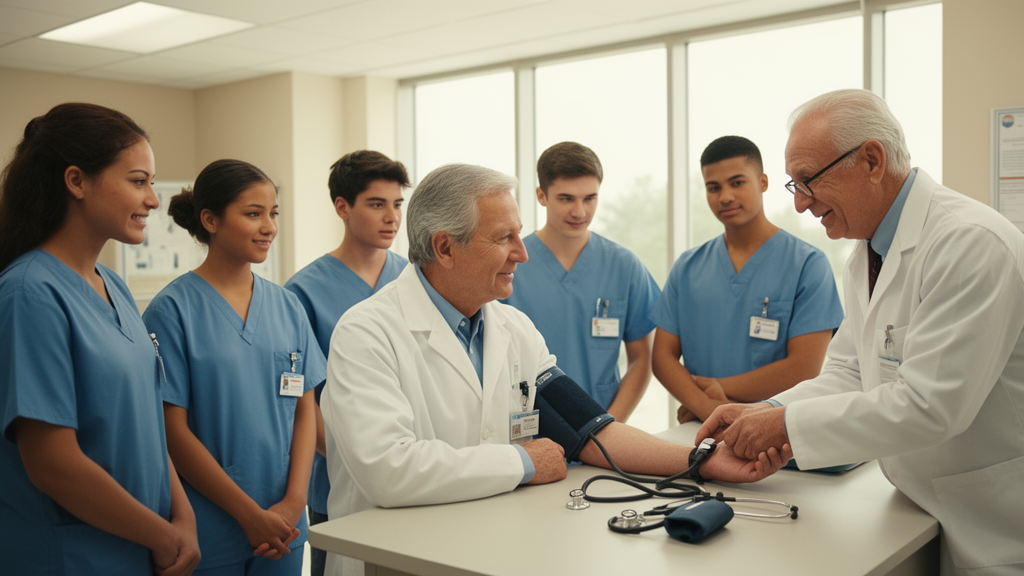
Medical students rarely see prevention in action, and a new perspective article argues that this hidden curriculum is quietly shaping the next generation of doctors. Writing in Frontiers in Public Health, researchers from University Medical Center Utrecht, including Marielle Jambroes and colleagues, describe how clinicians can act as deliberate role models for preventive action, both at the bedside and at the level of the population. Their argument is not a report of new experimental data but a conceptual framework grounded in established theories of workplace learning.
Role modelling, the authors explain, is one of the most powerful mechanisms in medical education. Through observational, or vicarious, learning, exposure to competent practitioners also builds self-efficacy: the confidence that one can perform similar actions oneself. Importantly, the article rejects the idea of a single exemplary physician.
Instead, students are described as assembling a mosaic of role models, drawing on diverse professionals who each demonstrate different competencies. This mosaic underscores the value of exposing students to varied clinical perspectives rather than expecting one supervisor to embody every ideal. Yet when it comes to prevention, the mosaic has a conspicuous gap.
The authors note that medical students report limited exposure to role models who explicitly demonstrate preventive care, even as prevention grows in importance due to ageing populations, increasing multimorbidity and persistent health inequities. Preventive actions are often underrepresented or remain implicit in daily clinical practice, partly because curative care is prioritised and population-level activities are less visible in clinical settings. There is also a recognition problem.
Clinicians may not recognise or articulate their own preventive efforts as role modelling opportunities. The authors argue that making such reasoning explicit is the key to converting invisible prevention into visible professionalism. To structure this argument, the article introduces a framework describing preventive action at two levels: the individual patient and the population.
The framework is organised around three steps: identification, intervention and evaluation. Building on this framework, the authors outline how clinicians can model preventive care effectively using four phases of role model learning drawn from observational learning theory: attention, retention, reproduction and motivation. First, the student must notice the preventive action, which requires the clinician to make it visible.
Second, the student must retain an understanding of it, which the authors suggest is strengthened when clinicians explain the underlying reasoning behind their decisions. Third, the student needs opportunities to reproduce the behaviour in supervised practice. Fourth, motivation must be sustained, for example by demonstrating outcomes that show the value of preventive work.
The practical strategies that follow from these phases are deliberately concrete. Clinicians can narrate their preventive thinking aloud during consultations, involve students in population-oriented activities that are normally conducted behind the scenes, and explicitly connect preventive interventions to the outcomes they achieve. By naming these actions as part of professional practice, teachers signal that prevention belongs to core medicine rather than to a peripheral specialty.
The authors conclude that deliberate and explicit role modelling of prevention, combined with active student engagement, can strengthen learning and support the integration of preventive care as a core component of medical professionalism. Because the article is a perspective piece rather than an empirical study, its claims rest on educational theory and the authors' experience rather than on measured outcomes, and testing whether such modelling changes students' preventive competencies would require future research. Even so, the message arrives at a moment when health systems face mounting chronic disease burdens and widening inequities.
If the doctors of tomorrow are to treat prevention as ordinary medicine, the argument runs, they must first see their teachers practising it, explaining it and valuing it, one visible action at a time.
Subject of Research: Role modelling of preventive care in medical education
Article Title: Being a role model for preventive action
Article References: Seeleman, C., Berg, N. V. D., Kersten, A., & Jambroes, M. (2026). Being a role model for preventive action. Frontiers in Public Health, 14, Article 1973597. https://doi.org/10.3389/fpubh.2026.1973597
Image Credits: AI Generated
DOI: 10.3389/fpubh.2026.1973597
Keywords: medical education, role modelling, preventive care, public health, observational learning, professional identity, self-efficacy, medical students, clinical teaching, health promotion, UMC Utrecht, Frontiers in Public Health
News Source: Ophelia Keating. (October 26, 2026). Clinicians as role models: making preventive care visible to medical students. Scienmag.