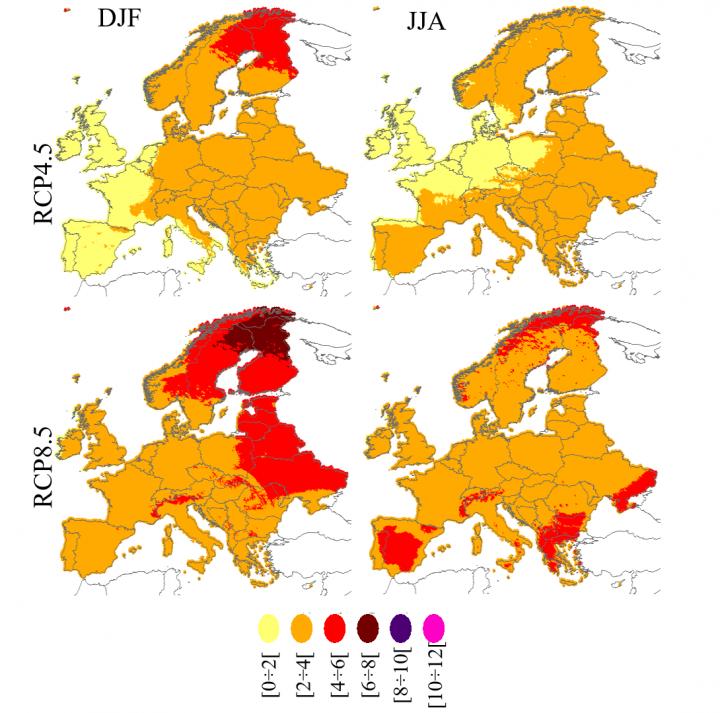
Credit: We acknowledge the World Climate Research Programme’s Working Group on Regional Climate, and the Working Group on Coupled Modelling. We thank the climate modelling groups. We acknowledge the Earth System…
Buildings and infrastructure also need to adapt to the changing climate. Updating structural design standards is crucial to improving European climate resilience and ensuring the safety of constructions, that are expected to suffer from changes in atmospheric variables and more frequent and intense extreme weather events.
In 2017, the Joint Research Centre (JRC) – the European Commission’s science and knowledge service – established the scientific network on adaptation of structural design to climate change. A network of experts, which includes the CMCC Foundation, dedicated to studying how research can help decision-makers take predicted changes in the climate system into account when amending the Eurocodes, the European standards for structural design.
The role of expected increases in temperature in Europe over the coming decades is at the centre of two new reports realised by the network, the first focused on thermal actions on structures (Thermal design of structures and the changing climate), and the other on corrosion in the context of a changing climate (Expected implications of climate change on the corrosion of structures).
In their contribution to these publications, CMCC researchers from the REMHI division – Regional Models and geo-Hydrological Impacts – analyzed temperature variations and other atmospheric variables expected over the next 50 years, a period that usually represents the use lifespan of a structure built today. The study used the results of the projections included in the EURO-CORDEX ensemble.
The first study, considered the “worst-case” scenario (RCP8.5) – or rather the “high emissions scenario”, predicts a growth in greenhouse gas emissions at current rates for the future as a reference scenario to investigate the case study of Italy, noting for the entire country a relevant temperature increase by 2070.
“Taking as a reference the maximum and minimum temperature levels that are expected to occur at least once in 50 years, we found a significant increase in both the maximum values of the maximum temperature – which in some areas of Italy can reach +6°C – and the maximum values of the minimum temperature – with variations up to +8°C in the mountain ranges,” explains Guido Rianna, CMCC researcher and one of the authors of the study. “The increase in minimum temperature may not be that relevant for buildings, as it implies that constructions will be exposed to less rigid temperatures than today, and therefore less stress. Instead, the increase in the maximum expected temperature could lead to the need for a revision of building standards to ensure the safety of constructions: linear structures such as bridges and viaducts, for example, are subject to thermal expansion.”
The second publication is about a study – conducted on a European scale – on the expected variation in air temperatures and relative humidity in 2070 due to climate change, aimed at understanding to what extent these atmospheric variables may affect the corrosion of buildings in the future. Indeed, increasing temperature and relative humidity can accelerate the corrosion process of steel structures or bars embedded in reinforced concrete, undermining their resistance and therefore threatening the safety of buildings.
“Climate simulations tell us that temperatures in the next 50 years are increasing significantly throughout Europe, albeit with regional differences,” continues Rianna. “The extent of this increase is between 3 and 5°C on average and depends on the climate change mitigation measures that will be implemented.” Here too, the authors explain, an amendment of the Eurocodes may be necessary, in order to take into account the acceleration of the corrosion process in buildings induced by climate change and provide for measures to limit it. Future changes in relative humidity, the study explains, are not significant. Indicating that the real engine of corrosion processes of structures on a European scale will be represented by increases in temperature, rather than humidity.
“These publications are the result of a series of studies aimed at supporting the definition and revision of the European standards for structural design most suited to the world of the future,” says Paola Mercogliano, director of the REMHI division of the CMCC Foundation. “After having analyzed, in the past, the impact of snowpack and in these recent studies, thermal impact, the next step will be to study the impact of wind. Our ultimate goal is to support policy-makers and builders with sound services and information for the update of current structural design standards, considering the various atmospheric phenomena and the different types of constructions, in order to allow for the implementation of effective policies and adaptation actions.”
###
More information
Athanasopoulou, A., Sousa, M.L., Dimova, S., Rianna, G., Mercogliano, P., Villani, V., Croce P., Landi, F., Formichi, P., Markova, J., Thermal design of structures and the changing climate, EUR 30302 EN, Publications Office of the European Union, Luxembourg, 2020, ISBN 978-92-76-20776-4, doi:10.2760/128894, JRC121351.
M.L. Sousa, S. Dimova, A. Athanasopoulou, G. Rianna, P. Mercogliano, V.Villani, M. Nogal, H. Gervasio, L. Neves, E. Bastidas-Arteaga, G. Tsionis. Expected implications of climate change on the corrosion of structures, EUR 30303 EN, Publications Office of the European Union, Luxembourg, 2020, ISBN 978-92-76-20782-5, doi:10.2760/05229, JRC121312.
Media Contact
Mauro Buonocore
[email protected]
Original Source
https:/
Related Journal Article
http://dx.