Thousands of historic and archaeological sites in Georgia are at risk from tropical storm surges, and that number will increase with climate change, according to a study published February 28, 2024 in the open-access journal PLOS ONE by Matthew D. Howland and Victor D. Thompson of Wichita State University and the University of Georgia.
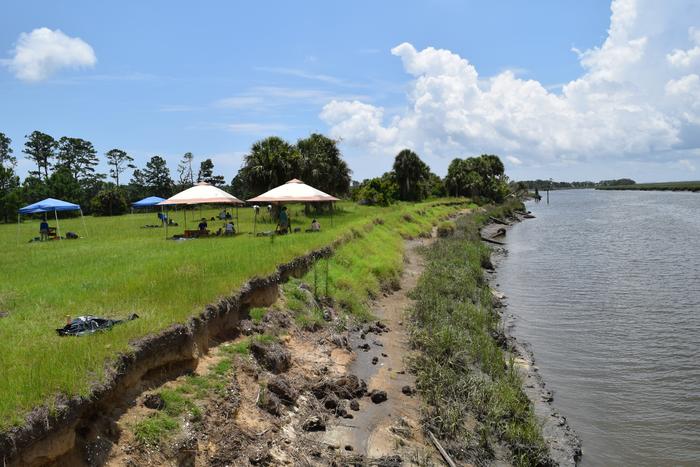
Credit: UGA Laboratory of Archaeology, CC-BY 4.0 (https://creativecommons.org/licenses/by/4.0/)
Thousands of historic and archaeological sites in Georgia are at risk from tropical storm surges, and that number will increase with climate change, according to a study published February 28, 2024 in the open-access journal PLOS ONE by Matthew D. Howland and Victor D. Thompson of Wichita State University and the University of Georgia.
Anthropogenic climate change poses a major risk to coastlines due to rising sea level and increasingly severe tropical storms. This threatens not only living populations but also historic and archaeological sites. Mitigating damage requires accurate assessments of risks, but most predictive models focus on projected sea level rise while most physical observations focus on storm surge events. In this study, Howland and Thompson use the Sea, Lake and Overland Surges from Hurricanes (SLOSH) model developed by the National Weather Service to estimate risks of storm surges along the coast of the US state of Georgia.
The low-lying coastal plain of Georgia hosts thousands of Native American cultural sites, historic colonial sites, and more, representing the physical cultural heritage of the region. This study finds over 4,200 such sites are potentially at risk of inundation from the storm surge of a Category 5 hurricane at present-day sea level. By the year 2100, nearly 5,000 sites could be flooded by severe hurricanes, with over 2,000 threatened by even relatively weak tropical storms. These numbers are more than ten times the estimates from previous models accounting only for sea level rise.
These results underline the importance of accounting for storm surge events along with rising sea level when assessing risks to coastal sites. The authors hope these projections will help cultural heritage managers to facilitate protection and mitigation efforts in Georgia, and they note that a similar modeling approach could be applied to coastal environments around the world.
Matthew D. Howland adds: “This study shows that the archaeological resources of the Georgia coast are at great risk of damage from potential storm surge at any time. Up until now, archaeologists have generally underestimated the threat to coastal cultural heritage since they have been thinking of long term averages of sea level rise rather than the kind of dramatic disaster events that can happen in Georgia and the Atlantic Coast, like Hurricane Michael in 2018.”
Victor D. Thompson adds: “The Georgia coast’s cultural heritage spans millennia, from the earliest Native American villages of Ancestral Muskogean people to its colonial missions and later plantations. These cultural sites are increasingly being impacted by storms and sea level change which threaten the material link to the broader histories of Native peoples, the enslaved, and their place in American history.”
#####
In your coverage please use this URL to provide access to the freely available article in PLOS ONE: https://journals.plos.org/plosone/article?id=10.1371/journal.pone.0297178
Citation: Howland MD, Thompson VD (2024) Modeling the potential impact of storm surge and sea level rise on coastal archaeological heritage: A case study from Georgia. PLoS ONE 19(2): e0297178. https://doi.org/10.1371/journal.pone.0297178
Author Countries: USA
Funding: This work was supported by funding from the Historic Preservation Division of the Georgia Department of Natural Resources. VDT’s work and understanding of the region was supported, in part, through grants associated with the Georgia Coastal Ecosystems LTER project, National Science Foundation (https://beta.nsf.gov/funding) Grants OCE-0620959, OCE-123714). The funders had no role in study design, data collection and analysis, decision to publish, or preparation of the manuscript.
Journal
PLoS ONE
DOI
10.1371/journal.pone.0297178
Method of Research
Computational simulation/modeling
Subject of Research
Not applicable
Article Title
Modeling the potential impact of storm surge and sea level rise on coastal archaeological heritage: A case study from Georgia
Article Publication Date
28-Feb-2024
COI Statement
The authors have declared that no competing interests exist.