Credit: Tuomas Kankaanpää
Through a unique research collaboration, researchers at the University of Helsinki have exposed major changes taking place in the insect communities of the Arctic. Their study reveals how climate change is affecting small but important predators of other insects, i.e. parasitoids.
“Predators at the top of the food web give us a clue to what is happening to their prey species, too. These results increase our understanding of how global warming is changing nature. At the same time, they suggest new inroads for finding answers to big questions in the field of ecology,” says Professor Tomas Roslin from the University of Helsinki and the Swedish University of Agricultural Sciences (SLU).
The researchers’ main discovery was that clear traces of climate change can already be seen in arctic insect communities.
“In areas where summers are rapidly warming, we find a higher proportion of cold-sensitive predators than we might expect based on the previous climate,” Roslin notes.
The study joined research teams working in Greenland, Canada, Russia, Norway, Finland and Iceland, which together compared regions where the climate has changed at different rates and in different ways in recent decades.
Parasitoids are fierce predators but sensitive to changes in climatic conditions
“The climate of the Arctic is currently changing about twice as fast as the global average. Therefore, the Arctic region provides an important laboratory when we try to understand the effects of climate change on nature,” says Tuomas Kankaanpää, lead author of the study and active at the Faculty of Agriculture and Forestry, University of Helsinki.
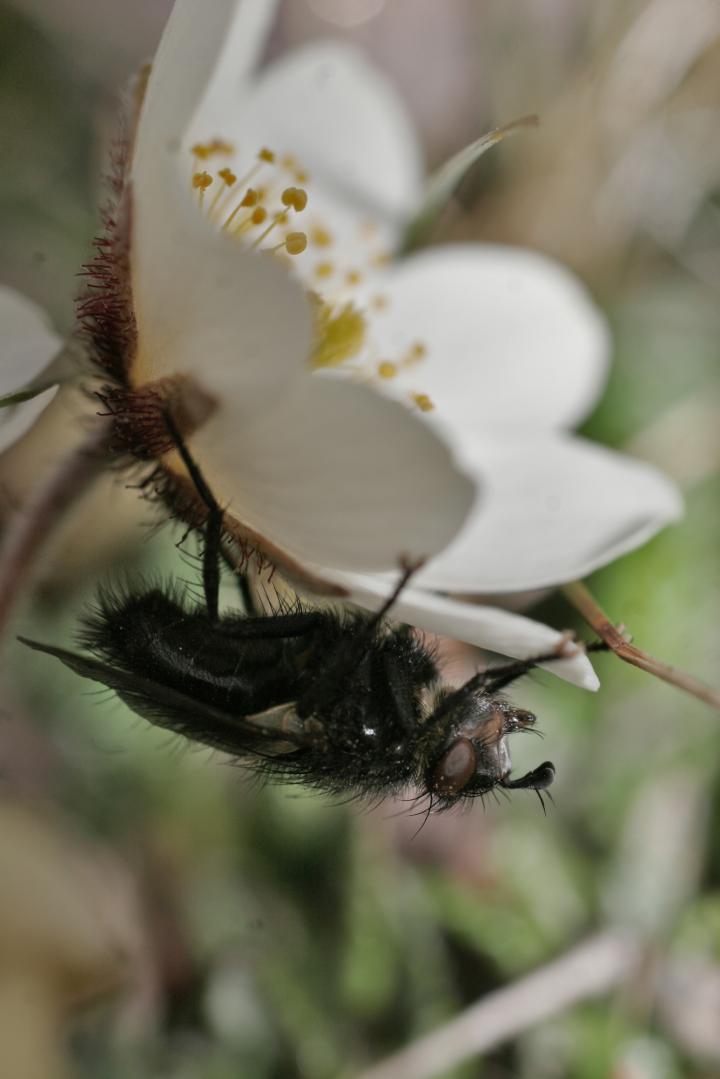
“To distinguish the key consequences of climate change, we have focused on some of the most important predators in the Arctic, parasitoid wasps and flies. These parasitoids are predators whose larvae develop on or within a single host individual and usually kill it in the process. And now we have found that climate change is dramatically affecting the relative dominance of different types of parasitoids.”
The researchers found that the changes particularly affect the ratios between parasitoids adhering to different lifestyles. On the other hand, different parasitoid species use different hosts. In the Arctic, Lepidoptera i.e. butterflies and moths and Diptera such as flies and gnats are the largest host groups of the parasitoids. Diptera are more dominant towards the north, while the species richness of Lepidoptera increase towards the south.
“We have found that the proportion of parasitoids preying on warmth-loving butterflies is especially in areas where summer temperatures in particular have risen in recent decades. By contrast, winter-time warming is reflected in a large representation of parasitoid species feeding on Diptera,” says Kankaanpää.
Cunning koinobionts and greedy idiobionts
“Beyond their host species, parasitoids can also be classified into two other groups based on how they use their host. Koinobionts are the true masters of the parasitic lifestyle and manipulate their host with surgical precision. Females lay their eggs in the host’s egg or larva, where the parasitoid larva then waits patiently until the host has grown larger. To do this, the koinobiont must skillfully manipulate the host’s immune defense to survive. The second group, idiobionts, are more reminiscent of classic predators. The larvae of idiobionts start eating the host as soon as they hatch,” says Kankaanpää.
“These different strategies are directly reflected in the sensitivity of the two groups to climatic conditions. Koinobionts can wait until the host has retreated to sheltered conditions to hibernate before killing it. Thus, they get protection from the worst frosts. Idiobionts lack this advantage, and often paralyze the host where found, having to then live in it at the mercy of the weather.”
New approaches bring synergies
“In our project, we have harnessed the ratio between parasitoids of Lepidoptera and Diptera, and between koinobionts and idiobionts, into a sensitive barometer of the effects of climate change, Kankaanpää says. To this end, we have adopted a number of effective solutions. A common approach to predicting the effects of climate change is to compare contemporary communities of organisms in different climates. We then assume that communities in cold areas will eventually begin to resemble their current counterparts in warmer regions as the climate warms. The time dimension of change is thus replaced by distance, in what is called a space for time substitution. Now, however, we can already compare areas where the climate has changed in different ways. This is especially true in the Arctic, where change, and at the same time regional disparities, are large,” says Kankaanpää.
Professor Tomas Roslin has been the supervisor of Tuomas Kankaanpää and is equally enthusiastic about new ways of research – and also points out another advance.
“For studies like this, we are also cooperating in a new way. This allows us to ask questions that would otherwise be too expensive, difficult and logistically challenging to address. If one research team was to send its members around the world, it would cost hundreds of thousands of euros. But by collaborating with other scientists across the Arctic and asking them for a few working days, everyone can provide their piece of the bigger puzzle, as collected using uniform methods. This is how we put together the full picture with realistic resources. And I am convinced that this kind of collaboration will pave the way for new breakthroughs,” Roslin says.
Fantastic parasitic beasts and where to find them
With their clever and slightly macabre lifestyles, parasitoids have inspired us humans as well. The monsters in the Alien movies are classical parasitoids which, just like some parasitic flies, leave their eggs waiting for a passing host. Due to their cruel appearance, parasitoid wasps are often despised. But at the same time, we have the parasitoids to thank for our crops and gardens. Parasitoids are among the main enemies of herbivorous insects, and without them much of the world’s greenery could disappear into smaller mouths. In the Arctic, the parasitoids are, in fact, the most numerous and species-rich predators.
###
Media Contact
Tomas Roslin
[email protected]
Original Source
https:/
Related Journal Article
http://dx.