An international team of researchers examined data for 25 exoplanets and found some links among the properties of the atmospheres, including the thermal profiles and chemical abundances in them. This marks the first time exoplanet atmospheres have been studied as populations, rather than individually. These findings will help establish a generalized theory of planet formation which will improve our understanding of all planets, including the Earth.
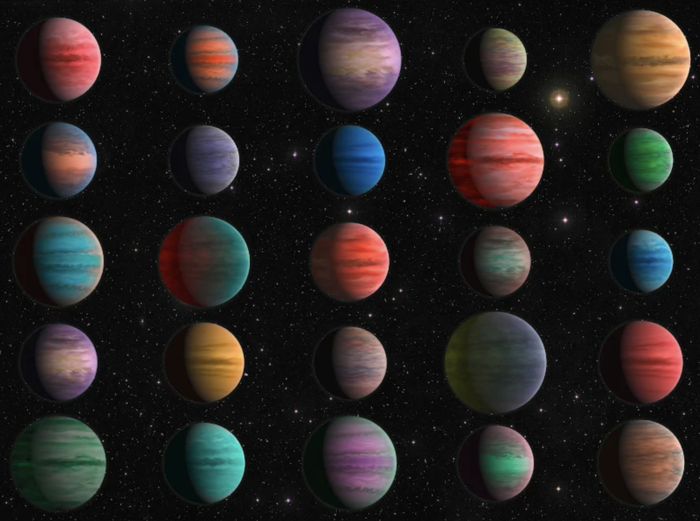
Credit: ESA/Hubble, N. Bartmann
An international team of researchers examined data for 25 exoplanets and found some links among the properties of the atmospheres, including the thermal profiles and chemical abundances in them. This marks the first time exoplanet atmospheres have been studied as populations, rather than individually. These findings will help establish a generalized theory of planet formation which will improve our understanding of all planets, including the Earth.
Today there are more than 3000 confirmed exoplanets, planets orbiting stars other than the Sun. Because they are far away from Earth, it is difficult to study them in detail. Determining the characteristics of even one exoplanet has been a noteworthy accomplishment.
In this research, astronomers used archival data for 25 hot Jupiters, gas giant planets that orbit close to their host stars. The data included 600 hours of observations from the Hubble Space Telescope and more than 400 hours of observations from the Spitzer Space Telescope.
One of the characteristics investigated by the team was the presence or absence of a “thermal inversion.” Planetary atmospheres trap heat, so in general the temperature increases as you probe deeper into the atmosphere. But some planets show a thermal inversion where an upper layer of the atmosphere is warmer than the layer beneath it. On Earth, the presence of ozone causes a thermal inversion. The team found that almost all of the hot Jupiters with a thermal inversion also showed evidence for hydrogen anion (H–) and metallic species such as titanium oxide (TiO), vanadium oxide (VO), or iron hydride (FeH). Conversely, exoplanets without these chemicals almost never had thermal inversions. It is difficult to draw conclusions based on correlation alone, but since these metallic species are efficient absorbers of stellar light, one theory holds that when these chemicals are present in the upper atmosphere, they absorb light from the host star and cause the temperature to increase.
Masahiro Ikoma at the National Astronomical Observatory of Japan, a co-investigator in this study, explains, “The theory of gas giant formation proposed by my students and I predicted diversity in the composition of hot Jupiter atmospheres, and helped to motivate this systematic survey of atmospheric characteristics.”
This new study, identifying populations of similar exoplanet atmospheres, will help refine the theoretical models, bringing us closer to a comprehensive understanding of planet formation. In the coming decade, new data from next-generation space telescopes, including the James Webb Space Telescope, Twinkle, and Ariel, will provide data for thousands of exoplanets, both enabling and necessitating new categories for classifying exoplanets beyond the methods explored in this research.
These results appeared as Changeat et al. “Five key exoplanet questions answered via the analysis of 25 hot Jupiter atmospheres in eclipse” in The Astrophysical Journal Supplement Series on April 25, 2022.
Journal
The Astrophysical Journal Supplement Series
DOI
10.3847/1538-4365/ac5cc2
Method of Research
Observational study
Subject of Research
Not applicable
Article Title
Five key exoplanet questions answered via the analysis of 25 hot-Jupiter atmospheres in eclipse
Article Publication Date
25-Apr-2022