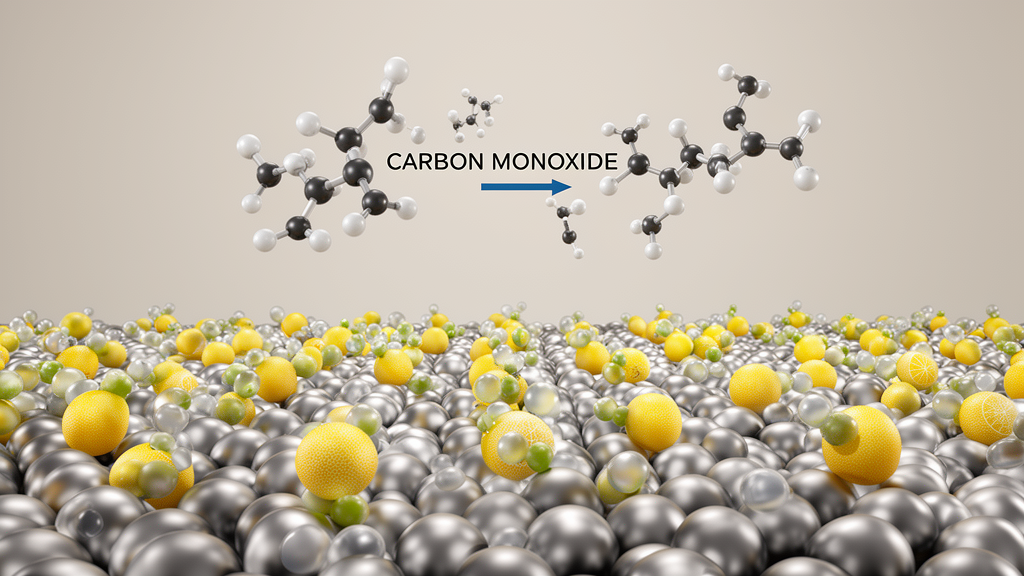
Cobalt catalysts that convert carbon dioxide into carbon monoxide through the reverse water-gas shift (RWGS) reaction tend to fall apart at the very temperatures the reaction demands. Operating near 600 °C, the metal particles sinter, growing larger and losing active surface area. A new study in Catalysis Letters reports that a simple change in catalyst preparation—adding citric acid during impregnation—produced a cobalt-on-silica catalyst that resisted this degradation and ran markedly longer in high-temperature tests.
The research team synthesized their Co-SiO2 catalyst using an organic-acid-assisted impregnation method with citric acid. According to the abstract, incorporating the organic acid strengthened the interactions between the cobalt and the silica support and reduced the size of the Co3O4 nanoparticles formed in the fresh catalyst. Smaller oxide particles, held more tightly to the support, are the starting point for a catalyst that can survive punishing reaction conditions.
The most striking difference emerged after the catalysts were reduced at 600 °C. In the organic-acid-modified material, cobalt remained as CoO species, whereas the conventional Co-SiO2 reference produced metallic Co0. Characterization results indicated that the strengthened Co-SiO2 interfacial interaction restrained the deep reduction of CoO. In other words, the acid treatment left the cobalt locked into a partially reduced oxide state rather than letting it fully convert to metal, a state the authors associate with the improved high-temperature behavior.
Performance testing backed up the structural story. Compared with the unmodified catalyst, the organic-acid-assisted version showed improved activity in the RWGS reaction and, more importantly, substantially prolonged catalytic stability during 600-minute time-on-stream tests at 600 °C. Thermo-gravimetric analysis of the spent catalyst revealed negligible carbon deposition, addressing another common failure mode in CO2 hydrogenation, where coke buildup can choke off active sites over time.
The authors frame the work as offering a facile synthetic strategy for fabricating robust CoO-based catalysts for efficient CO2 conversion via the RWGS reaction.
Catalyst stability at the high temperatures the reaction requires remains a central obstacle, which is why strategies that suppress metal sintering—here by tuning metal-support interactions during synthesis—are of broad interest to the catalysis community.
For now, the study’s contribution is a clear structure-performance link: citric acid in the impregnation step shrank the cobalt oxide particles, strengthened the interface with the silica, preserved CoO after high-temperature reduction, and translated those changes into longer-lived, more active performance with little carbon fouling. Whether the same organic-acid treatment benefits other supports or scales to longer industrial-relevant operating periods will require further work, but the reported 600-minute stability gain at 600 °C marks a concrete step toward durable cobalt catalysts for CO2 utilization.
Subject of Research: Organic-acid-assisted synthesis of a stable CoO-based Co-SiO2 catalyst for the reverse water-gas shift reaction
Article Title: Enhanced Stability of Organic Acid-Assisted Co-SiO2 Catalyst for Reverse Water-Gas Shift Reaction
Article References: Liu, H., Wang, K., Cao, Z., Liu, Y., Wei, Q., Lin, R., & Wang, L. (2026). Enhanced Stability of Organic Acid-Assisted Co-SiO2 Catalyst for Reverse Water-Gas Shift Reaction. Catalysis Letters, 156(11), Article 312. https://doi.org/10.1007/s10562-026-05560-9
Image Credits: AI Generated
DOI: 10.1007/s10562-026-05560-9
Keywords: RWGS reaction, CO2 hydrogenation, cobalt catalyst, Co-SiO2, citric acid, metal-support interaction, catalyst stability, sintering, CoO species, carbon deposition, silica support, Catalysis Letters
News Source: Bethany Barker. (October 29, 2026). Citric Acid Trick Keeps Cobalt Catalyst Stable in CO2-to-CO Conversion. Scienmag.